
Judge, 1931-07-04 · page 13 of 36
Judge — July 4, 1931 — page 13: what you’re looking at
What you’re looking at
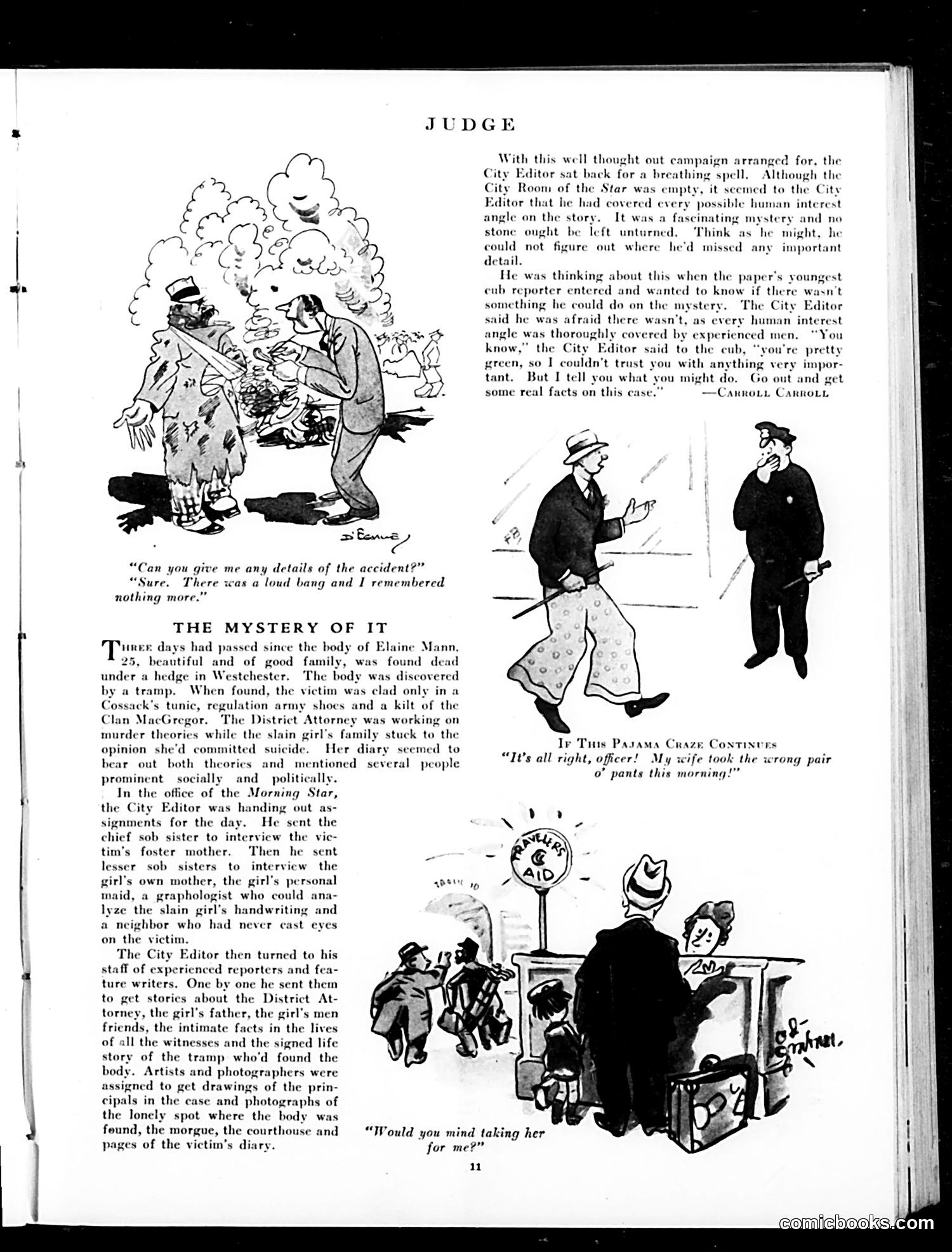
# Explanation for Modern Readers This page satirizes sensationalist journalism through two separate pieces: **"The Mystery of It"** mocks newspaper coverage of a high-profile murder case involving a wealthy young woman (Elaine Mann) found dead in bizarre circumstances (wearing mismatched Scottish/Russian clothing). The City Editor obsessively assigns reporters to cover every conceivable angle—interviewing the victim's family, friends, servants, even a graphologist—yet remains convinced he's somehow missed something. The satire targets the era's yellow journalism: the exhaustive, often exploitative human-interest coverage that treats tragic crimes as entertainment spectacles. By having the editor send his inexperienced cub reporter to find those elusive "real facts," the piece suggests that thorough crime coverage is often performative rather than substantive. **The cartoon** above jokes about marital confusion: a man tells an officer his wife wore the wrong pants that morning—likely a reference to 1920s "pajama craze" fashion trends where women wore loose, pants-like garments. Both pieces reflect early 20th-century concerns about press sensationalism and changing social norms.
📄 Transcribed text from this page (OCR, searchable)
Machine-transcribed from the original scan — historical spelling and the odd misread are preserved.
—&, * “Can you give me any details of the accident?” “Sure. There was a loud bang and I remembered nothing more.” THE MYSTERY OF IT Toner days had passed since the body of Elaine Mann, 5, beautiful and of good family, was found dead under a hedge in Westchester. The body was discovered by a tramp. When found, the victim was clad only in a Cossack’s tunic, regulation army shoes and a kilt of the Clan MacGregor. The District Attorney working on murder theories while the slain girl's family stuck to the opinion she'd committed suicide. Her diary seemed to bear out both theories and mentioned several people prominent socially and _ politically. In the office of the Morning Star, the City Editor was handing out as- signments for the day. He sent the chief sob sister to interview the vi tim’s foster mother. Then he sent lesser sob sisters to interview the girl’s own mother, the girl's personal maid, a graphologist who could an lyze the slain girl's handwriting and a neighbor who had never cast eyes on the victim. The City Editor then turned to his staff of experienced reporters and fea- ture writers. One by one he sent them to get stories about the District At- torney, the 's father, the girl's men friends, the intimate facts in the liv of all the witnesses and the signed life story of the tramp who'd found the body. Artists and photographers were assigned to get drawings of the prin- cipals in the case and photographs of the lonely spot where the body was feund, the morgue, the courthouse and pages of the victim's diary. JUDGE “Would you mind taking her for me?” With this well thought out campaign arranged for, the City Editor sat back for a breathing spell. Although the City Room of the Star was empty, it seemed to the City Editor that he had covered every possible human interest angle on the story. It was uscinating mystery and no stone ought be left unturned. Think as he might, he could not figure out where he'd missed any important detail. He was thinking about this when the paper's youngest cub reporter entered and wanted to know if there wasn't something he could do on the mystery. The City Editor id he was afraid there wasn't, as every human interest angle was thoroughly covered by experienced men. “You know,” the City Editor said to the cub, “you're pretty green, so I couldn't trust you with tant. But I tell you what you m some real facts on this case.” ything very impor- ht do. Go out and get -Cannot CarnoLt Ir Tits Pasama Craze Continers “It’s all right, officer!’ My wife took the wrong pair 0” pants this morning!”