
Judge, 1931-06-27 · page 4 of 37
Judge — June 27, 1931 — page 4: what you’re looking at
What you’re looking at
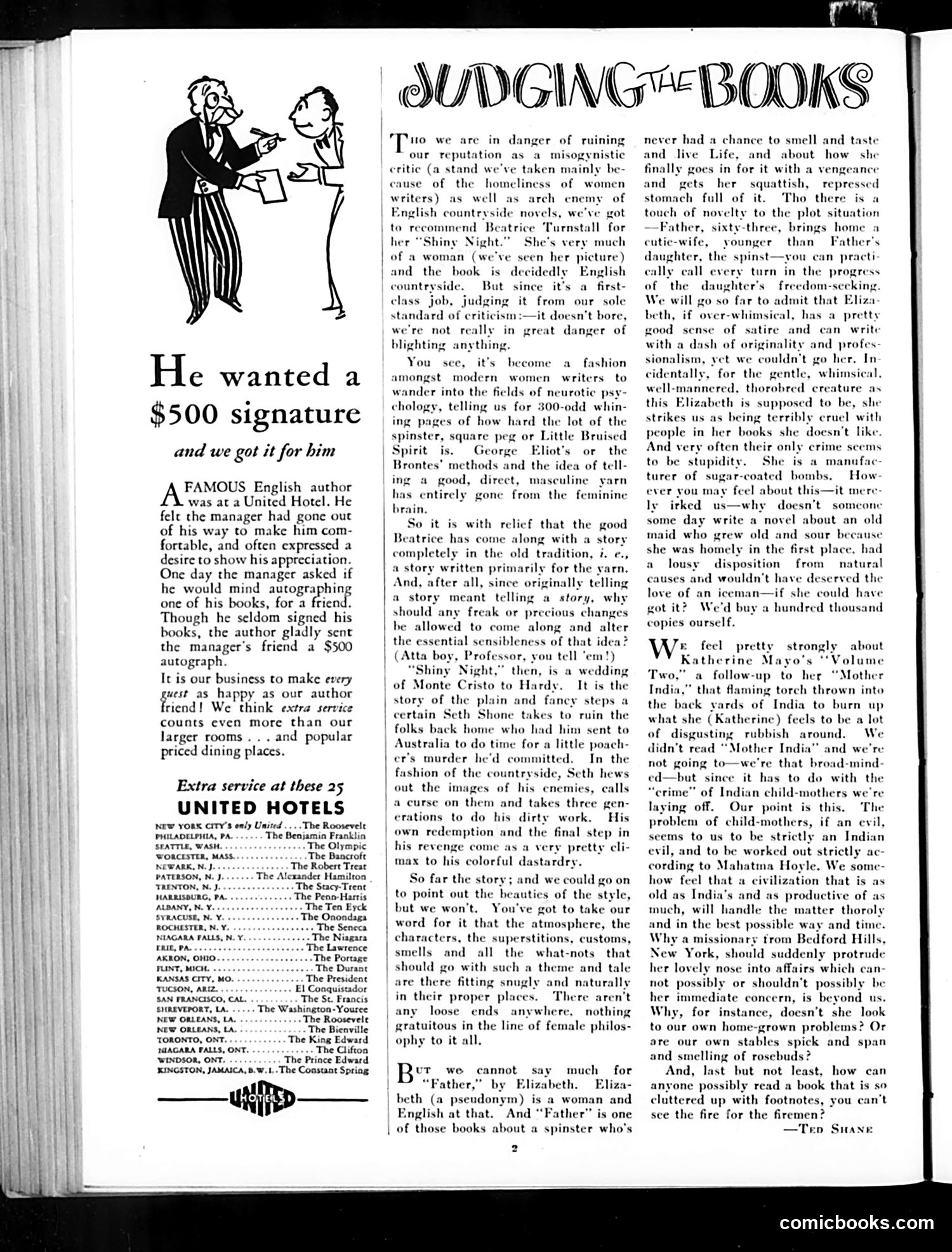
# "Judging the Books" - A Publisher's Complaint This page satirizes modern literary criticism and publishing. The cartoon shows a man (apparently a publisher) complaining to a woman about the difficulty of pleasing contemporary critics. The article criticizes female literary critics who've become fashionable among "neurotic psychology" readers, claiming they write tediously about psychological themes rather than actual storytelling. The piece specifically targets the trend of misogynistic criticism toward female writers and English countryside novels. The humor lies in the ironic complaint: a publisher wanting a famous author's $500 signature—suggesting the real goal is profit, not literary merit. The satire mocks both pretentious modern criticism and the commercial book industry's opportunism, while also containing somewhat dismissive attitudes toward female authors and critics typical of the era.
📄 Transcribed text from this page (OCR, searchable)
Machine-transcribed from the original scan — historical spelling and the odd misread are preserved.
He wanted a $500 signature and we got it for him FAMOUS English author was at a United Hotel. He felt the manager had gone out of his way to make him com- fortable, and often expressed a desire to show his appreciation. One day the manager asked if he would mind autographing one of his books, for a friend: Though he seldom signed his books, the author gladly sent the manager's friend a $500 autograph. It is our business to make every guest as happy as our author friend! We think extra service counts even more than our larger rooms... and popular priced dining places. Extra service at these 25 UNITED HOTELS NEW YORK City’s only United... PHILADELPHIA, PA. SEATTLE, WASH. ‘WORCESTER, MASS. NEWARK, NJ. - : The Roosevelt The Benjamin Franklin The Olympic The Bancroft ‘The Robert Treat PATERSON, N. J. The Alexander Hamilton TRENTON, N. J. The Stacy-Trent +» The Penn-Harris «The Ten Eyck +++» The Onondaga siaee The Seneca = The Niagara The Lawrence «-The Portage The Durant The President -- El Conquistador « The Se. Francis +» The Washington-Youree The Roosevelt The Bienville The King Edward MIAGARA FALLS, ONT. .. The Clifton ‘WINDSOR, ONT. - The Prince Edward KINGSTON, JAMAICA, 8.W.1..The Constant Spring NIAGARA FALLS, N.Y. ERIE, PA. AKRON, O10. TUNT, MICH. .. KANSAS CITY, MO. TUCSON, ARIZ. SAN FRANCISCO, CAL. SMREVEPORT, LA. . NEW ORLEANS, LA. NEW ORLEANS, LA. TORONTO, ONT. | of those books a no we are in danger of ruining our reputation as critic (a stand we've taken mainly be- cause of th ess of women writers) as well as arch enemy of | English countryside novels, we to recommend Beatrice Turnstall for her “Shiny Night.” She's very much of a woman (we've scen her picture) | and the book is decidedly English vuntryside. But since it’s a first- class job, judging it from our sole standard of criticism :—it doesn't bore, we're not really in great danger of blighting anything. misogynistic home got You see, it’s become a fashion amongst modern women writers to wander into the fields of neurotic psy- chology, telling us for 300-odd whin- ing pages of how hard the lot of the spinster, square peg or Little Bruised Spirit is. George Eliot's or the Brontes’ methods and the idea of tell- a good, direct, masculine yarn has entirely gone from the feminine brain. So it is with relief that the good atrice has come along with a story completely in the old tradition, i. ., a story written primarily for the yarn. And, after all, since originally telling a story meant telling a story, why should any freak or precious changes be allowed to come along and alter the essential sensibleness of that idea? (Atta boy, Professor, you tell 'em!) Shiny Night,” then, is a wedding of Monte C o to Hardy. It is the | story of the plain and fancy steps a certain Seth Shone takes to ruin the home who had him sent to 1 to do time for a little poach- | er’s murder he'd committed. In the fashion of the countryside, Scth hews out the images of his enemies, Is a curse on them and takes three gen- erations to do his dirty work. His own redemption and the final step in his revenge come as a very pretty cli- max to his colorful dastardry. So far the story; and we could go on to point out the beauties of the style, but we won't. You've got to take our word for it that the atmosphere, the characters, the superstitions, customs, smells and all the what-nots that should go with such a theme and are there fitting snug d nature in their proper places. There ari any loose ends anywhere, nothing gratuitous in the line of female philos- ophy to it all, Be we cannot say much for father,” by Elizabeth. ii a pseudonym) is a woma | English at that. And“ pout a spinster who's JUDGING“ BOOKS never had a chance to smell and taste and live Life, and about how she finally goes in for it with a vengeance and gets her squattish, repressed stomach full of it. Tho. there is a touch of novelty to the plot situation Father, sixty-three, brings home a cutie-wife, younger than daughter, the spinst— Father's uu can practi cally call every turn in the progress of ‘the daughter's freedom-seckit We will go so far to beth, if over-whimsi pretty good sense of satire 1 write with a dash of originality and profes sionalism, yet we couldn't her. In cidentally, for the gentle, whims well-mannered, thorobred creature this Elizabeth is supposed to be, sh strikes us as being terribly cruel with people in her books she doesn’t like. And very often their only crime seems to be stupidity. She is a manufac- turer of sugar-coated bombs. How er you may feel about this—it mere- ly irked us—why doesn’t someon write a novel about an old who grew old and sour because she was homely in the first place, had a lousy disposition from natural causes and wouldn't have deserved the love of an iceman—if she could have got it? We'd buy a hundred thousand copies ourself. ty strongly about atherine Mayo's ‘Volume a follow-up to her “Mother that flaming torch thrown into the back yards of India to burn up what she (Katherine) feels to be of disgusting rubbish around. didn’t read “Mother India’ and we're not going to—we're that broad-mind- ed but since it has to do with the “crime” of Indian child-mothers we're laying off. Our point is this. The problem of child-mothers, if an evil, seems to us to be strictly an Indian evil, and to be worked out strietly ac- cording to Mahatma Hoyle. how feel the old as Ind much, will handle th and in the best possible way and time. Why a missionary from Bedford Hills, York, should suddenly protrude her lovely nose into affairs which can- not possibly or shouldn't possibly be her immed ‘oncern, is beyond us. Why, for instance, doesn’t she look to our own home-grown problems? Or are our own stables spick and span and smelling of rosebuds? And, last but not least, how can anyone possibly read a book that is so cluttered up with footnotes, you can’t see the fire for the firemen? W —Trep Sitane comicbooks.com