
Judge, 1931-06-27 · page 18 of 37
Judge — June 27, 1931 — page 18: what you’re looking at
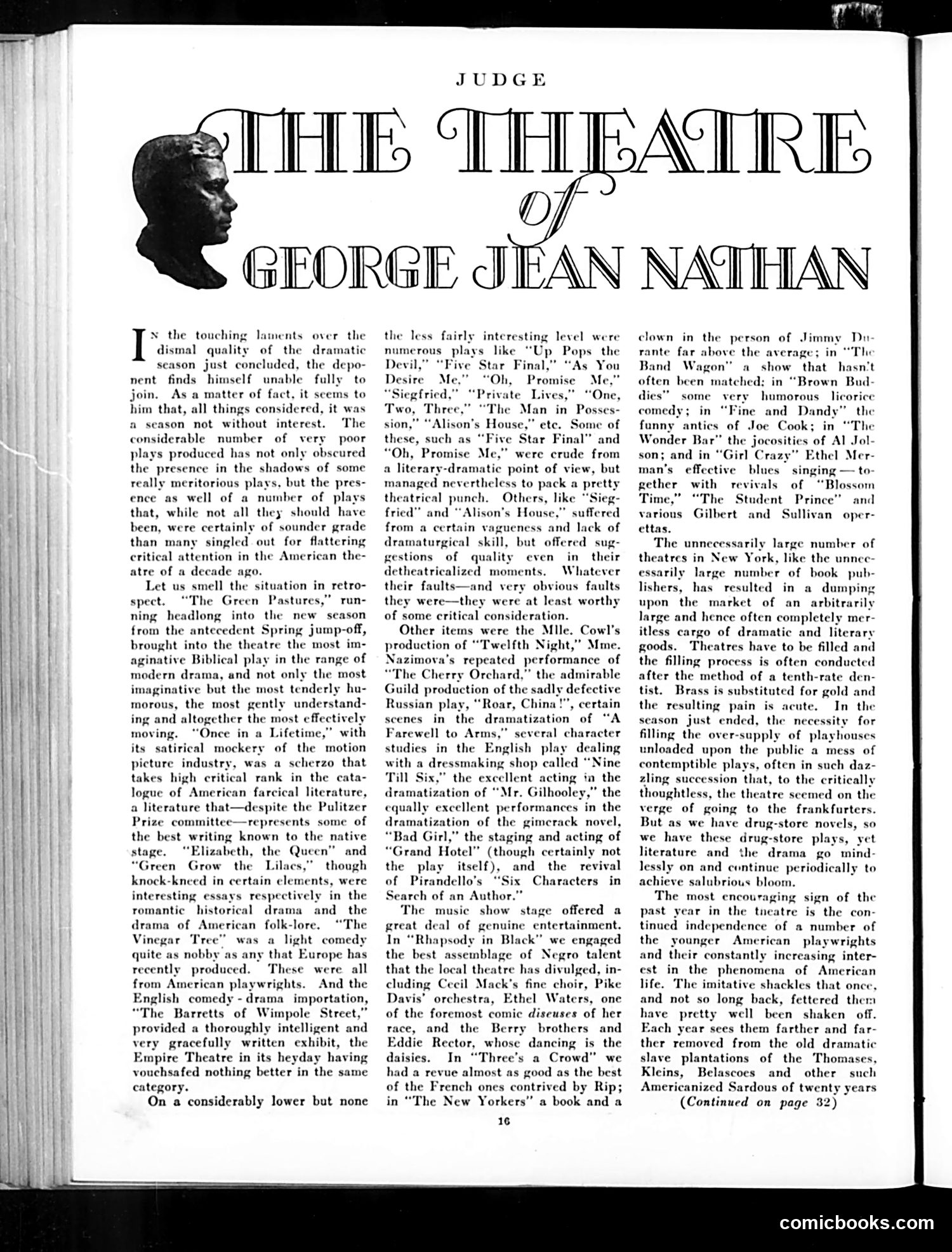
A restored page from Judge, 1931-06-27. Page through the whole issue in the reader above.
📄 Transcribed text from this page (OCR, searchable)
Machine-transcribed from the original scan — historical spelling and the odd misread are preserved.
— N the touching laments over the dismal quality of the dramatic season just concluded, the depo- nent finds himself unable fully to join. As a matter of fact, it scems to him that, all things considered, it was a season not without interest. The considerable number of very poor plays produced has not only obscured the presence in the shadows of some really meritorious plays, but the pres- ence as well of a number of pl that, while not all they should have been, were certainly of sounder grade than many singled out for flattering critical attention in the American the- atre of a decade ago. Let us smell the situation in retro- spect. “The Green Pastures,” run- ning headlong into the new season from the antecedent Spring jump-off, brought into the theatre the most im- aginative Biblical play in the range of modern drama, and not only the most imaginative but the most tenderly hu- morous, the most gently understand- ing and altogether the most effectively moving. “Once in a Lifetime,” with its satirical mockery of the motion picture industry, was a scherzo that takes high critical rank in the cata- logue of American farcical literature, a literature that—despite the Pulitzer Prize committee—represents some of the best writing known to the native stage. “Elizabeth, the Queen” and “Green Grow the Lilacs,” though knock-kneed in certain elements, were interesting essays respectively in the romantic histori drama and the drama of American folk-lore. “The Vinegar Tree” was a light comedy quite as nobby as any that Europe has recently produced. These were all from American playwrights. And the English comedy - drama importation, “The Barretts of Wimpole Street,” provided a thoroughly intelligent and very gracefully written exhibit, the Empire Theatre in its heyday having vouchsafed nothing better in the same category. On a considerably lower but none JUDGE O GEORGE J the less fairly interesting level were numerous plays like “Up Pops the Devil,” “* tar al,” “As You Desire ‘Oh, Promise Me,” “Siegfried,” “Private Lives,” “One, Three,” “The Man in Posses- Alison's House,” ete. Some of these, such as “Five Star Final” and “Oh, Promise Me,” were crude from a literary-dramatie point of view, but aged nevertheless to pack a pretty atrical punch. Others, like “Sieg fried” and “Alison’s House,” suffered from a certain vagueness and lack of dramaturgical skill, but. off gestions of quality even detheatricalized moments. Whatever their faults—and very obvious faults they were—they were at least worthy of some critical consideration. Other items were the Mlle. Cowl’s production of “Twelfth Night,” Mme. zimova's repeated performance of The Cherry Orchard,” the admirab Guild production of the sadly defecti Russian play, “Roar, China!", certain scenes in the dr: tion of “A Farewell to Arms,” several character studies in the English play dealing Till Six,” the excellent acting in the dramatization of “Mr. Gilhoole the equally excellent performances in the dramatization of the gimcrack novel, “Bad Girl,” the staging and acting of “Grand Hotel” (though certainly not the play itself), and the revival of Pirandello’s Characters in Search of an Author.” The music show stage offered a great deal of genuine entertainment. In “Rhapsody in Black” we engaged the best assemblage of Negro talent that the lc theatre has divulged, in- cluding Cecil Mack's fine choir, Pike Davis’ orchestra, Ethel Waters, one of the foremost comic diseuses of her race, and the Berry brothers and Eddie Rector, whose dancing is the daisies. In “Three’s a Crowd” we had a revue almost as good as the best of the French ones contrived by Rip; in “The New Yorkers” a book and a 16 rer, AIRE NACIIHIAN clown in the person of Jimmy Du rante far above the average; in Band Wagon" a show that hasn't often been matched: in “Brown Bud- dies” some very humorous licorice comedy; in “Fine and Dandy” the funny antics of Joe Cook; in “The Wonder Bar” the jocosities of Al Jol- son; and in “Girl Crazy” Ethel Mer- man's effective blues singing — to- gether with revivals of “Blossom Time,” “The Student Prince’ and various Gilbert and Sullivan oper- ettas. The unnecessarily large number of theatres in New York, like the unnee- essarily large number of book pub- lishers, has resulted in a dumping upon the market of an_ arbitrarily large and hence often completely mer- itless cargo of dramatic and literary goods. Theatres have to be filled and the filling process is often conducted after the method of a tenth-rate den- tist. Brass is substituted for gold and the resulting pain is acute. In the season just ended, the necessity for filling the over-supply of playhouses unloaded upon the public a mess of contemptible plays, often in such daz- zling succession that, to the critically thoughtless, the theatre seemed on the verge of going to the frankfurters. But as we have drug-store novels, so we h these drug-store plays, yet literature and the drama go mind- lessly on and continue periodically to achieve salubrious bloom. The most encouraging sign of the past year in the tneatre is the con- tinued independence of a number of the younger American playwrights and their constantly increasing inter- est in the phenomena of American life. The imitative shackles that once, and not so long back, fettered ther have pretty well been shaken off. Each year sees them farther and far- ther removed from the old dramatic slave plantations of the Thomases, Kleins, Belascoes and other such Americanized Sardous of twenty years (Continued on page 32) comicbooks.com