
Judge, 1931-06-20 · page 27 of 36
Judge — June 20, 1931 — page 27: what you’re looking at
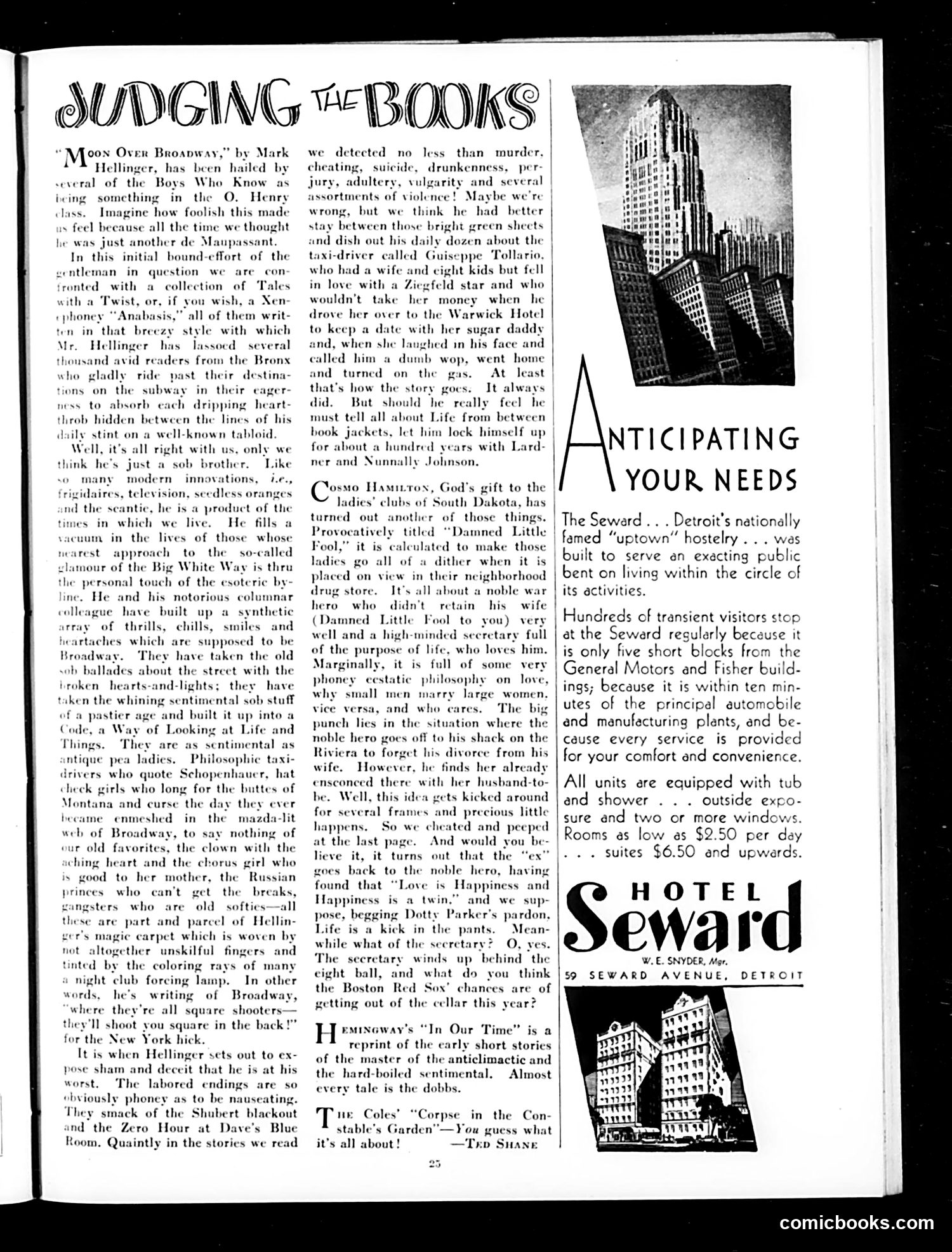
A restored page from Judge, 1931-06-20. Page through the whole issue in the reader above.
📄 Transcribed text from this page (OCR, searchable)
Machine-transcribed from the original scan — historical spelling and the odd misread are preserved.
Broapway,” by Mark r, has been hailed by Boys Who Know as something in the O. Henry class. In ne how foolish this made s feel because all the time we e thought he was just another de } In this initial bound-effe gentleman in) question w with a collection of Twist, or, if you wish, a Xen all of them writ- several of thy being fronted with a phoney “Anabasis,” ten in that breezy style with which Mr. Hellinger has lassoed several thousand avid readers from the Bronx dly ride past their dest tions on the subw in their e absorb each dripping | throb hidden between the lines of his daily stint on a well-known tabloid. Well, it’s all right with us, only we think he’s just a sob brother. Like so many modern innovations, i.e ness to aires, television, seedless oranges 1 the scantie, he is a product of the es in which we live. He fills a scuum in the lives of those whose nearest approach to the so-called glamour of the Big White Way is thru the personal touch of the esoteric by- colleague uray of nd his notorious columnar have built up a synthetic thrills, chills, smiles and heartaches which are supposed to be Broadway. They have taken the old sob ballades about the street with the broken hearts-and-lights; they have taken the whining sentimental sob stuff ofa pastier age and built it up into a Code, a Way of Looking at Life and Things. They are as sentimental as ntique pea ladies, Philosophie taxi- drivers who quote Schopenhaucr, hat check girls who long for the buttes of Montana ¢ became enmeshed in’ the web of Broadway, to say nothing of our old favorites, the clown with the ching heart and the chorus girl who is good to her mother, the Russian princes who can't get the breaks, who are old softies—all re part and parcel of Hellin- uer's n carpet which is woven by not altogether unskilful fingers and tinted by the coloring rays of many night club forcing lamp. In other words, writing of Broadway, where they're all square shoo! they'll shoot you square in the back !” for the New York hick. It is when Hellinger sets out to ex- pose sham and deceit that he is at his worst. The labored endings are so obviously phoney as to be nauseating. They smi of the Shubert blackout and the Zero Hour at Dave's Blue m. Quaintly in the stories we read gangsters these he's rs— than murder, cheating, suicide, drunkenness, per- jury, adultery, vulgarity and several assortments of violence! Maybe we're think he had better stay between those bright green sheets and dish out his daily dozen about the taxi-driver called Guiseppe Tollario, who had a wife and cight kids but fell in love with a Ziegfeld star and who wouldn't take her money when he drove her over to the Warwick Hotel to keep a date with her sugar daddy and, when she laughed an his face and called him a dumb wop, went home and turned on the gus. At least that’s how the story goes. It always did. But should he really feel he must tell all about Life from between book jackets, let him lock himself up for about a hundred years with Lard- ner and Nunnally J dno less wrong, but we inson. oso Haatron, God's gift to the ladies’ clubs of South Dakota, has turned out another of those things. Provocatively titled “Damned Little Fool,” it is calculated to make those ladies go all of « dither when it is placed on view in their neighborhood drug store. It’s all about pble war hero who didn't’ retain his. (Damned Little Fool to you) very well and a high-minded secretary fuil of the purpose of life, who loves him, Marginally, it is full of some very phoney cestatic philosophy on love, y small men marry large res. women, The big punch lies in the situation where the noble hero goes off to his shack on the Riviera to forget his divorce from his wife. However, he finds her already ensconced there with her hus' be. Well, this idea gets kicked around for several frames and precious little happens. So we cheated and peeped at the last And would you be- lieve it, it turns ont that the goes back to the noble hero, ha found that “Love is Happiness and Happiness is a twin,” and we sup- pose, begging Dotty Parker's pardon, Life is a kick in the The secretary winds up behind ‘the eight ball, and what do you think the Boston Red Sox’ chances are of getting out of the cellar this year? is a H emtnoway's “In Our Time” reprint of the early short stories of the master of the anticlimactic and the hard-boiled sentimental. every tale is the dobbs. T r “Corpse in the Con- stable’s Garden"—You guess what it’s all about! —Trp Suane Almost Coles’ The Seward . NTICIPATING YOUR NEEDS . Detroit's nationally famed “uptown” hostelry . . . was built to serve an exacting public bent on living within the circle of | its activities. wife | Hundreds of transient visitors stop at the Seward regularly beceuse it is only five short blocks from the General Motors and Fisher build- ings; because it is within ten min- utes of the principal automobile and manufacturing plents, and be- cause every service is provided for your comfort and convenience. All units ere equipped with tub and shower . . . outside expo- sure and two or more windows. Rooms as low as $2.50 per day ... Suites $6.50 and upwerds. 59 SEWARD AVENUE, DETROIT comicbooks.com