
Judge, 1931-06-20 · page 18 of 36
Judge — June 20, 1931 — page 18: what you’re looking at
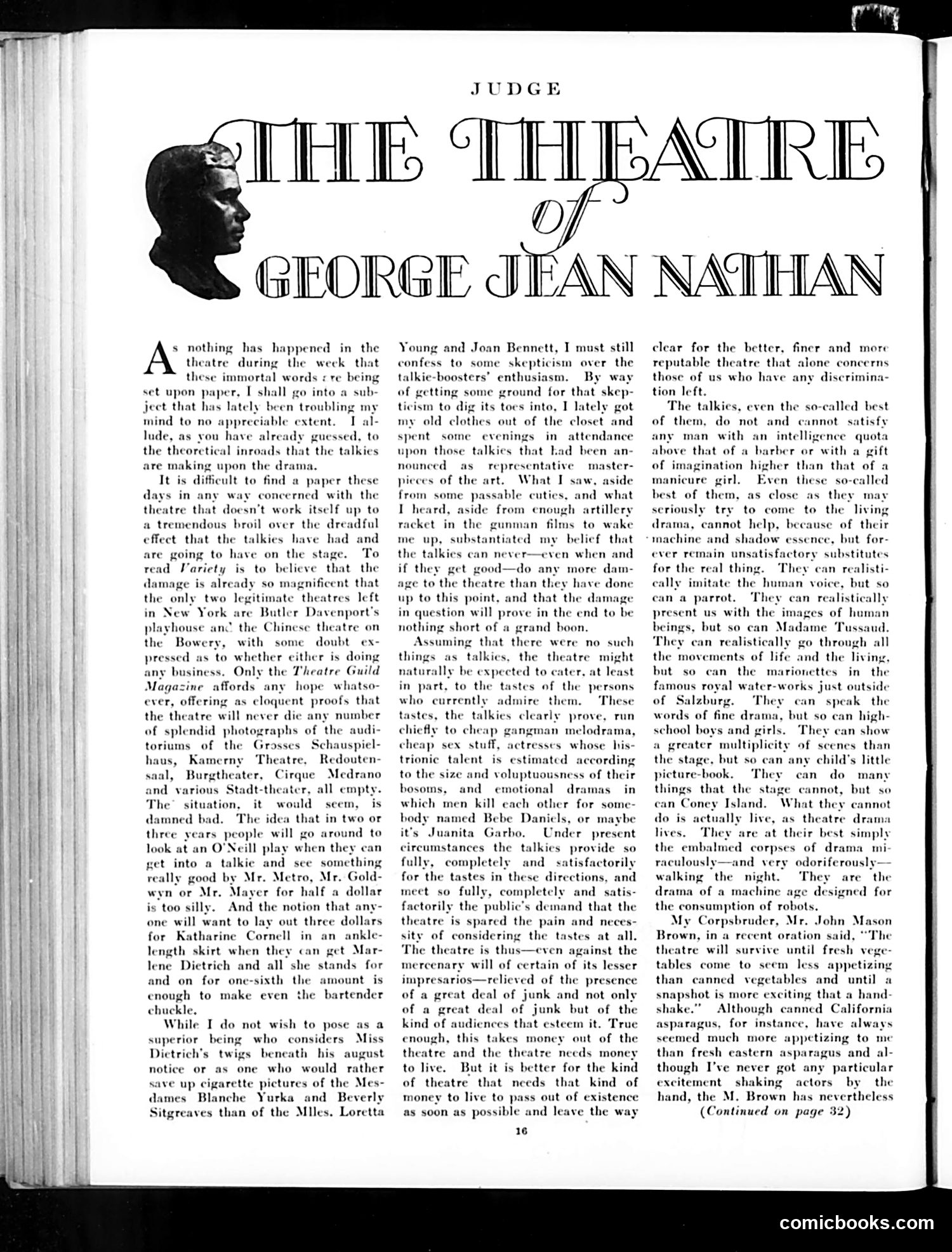
A restored page from Judge, 1931-06-20. Page through the whole issue in the reader above.
📄 Transcribed text from this page (OCR, searchable)
Machine-transcribed from the original scan — historical spelling and the odd misread are preserved.
s nothing has happened in. the theatre during the weck that these immortal words ¢ re being set upon paper, I shall go into a sub- ject that has lately been troubling my tind to no appreciable extent. 1 al- lude, as you have already guessed, to the theoretical inroads that the talkies are making upon the drama. It is difficult to find a paper these days in any way concerned with the theatre that doesn’t work itself up to a tremendous broil over the dreadful effect that the talkies have had and are going to have on the stage. To read Variety is to believe that the already so magnificent that two legitimate theatres left in New York are Butler Davenport's yhouse anc the Chinese theatre on the Bowery, with some doubt ex- pressed as to whether either is doing y business. Only the Theatre Guild Magazine affords any hope whatso- ever, the theatre will never die any number of splendid photographs of the audi- toriums of the Grosses Schauspiel- haus, Kamerny Theatre, Redouten- saal, Burgtheater, Cirque Medrano and various Stadt-theater, all empty fering as eloquent proofs that The’ situatio it would seem, is damned bad. The idea that in two or three years people will around to look at an O'Neill play when they can get into a tal and see somethin really good by Mr. Metro, Mr. Gold- wyn or Mr. Mayer for half a dollar is too silly. And the notion that any- one will want to lay out three dollars for Katharine Cornell in an ankle- length skirt when they can get Mar- lene Dietrich and all she stands for and on for one-sixth the amount is enough to make even the bartender chuckle, While I do not wish to pose superior being who Dietrich’s twigs b sa Miss ath his august would rather considers who save up cigarette pictures of the Mes- notice or as one dames Blanche Yurka and Beverly Sitgreaves than of the Mlles. Loretta JUDGE ks GEORGE JE 0 Young and Joan Bennett, I must still confess to some skepticism over the talkie-boosters’ enthusiasm. By way of getting some ground for that skep- ticism to dig its toes into, I y got my old clothes out of the closet and spent some evenings in’ attendar upon those talkies that kad been nounced as representative pieces of the art. What I saw, aside from some passable cuties. and what I heard, aside from enough artille 7 racket in the gunman films to wake me up, substantiated my belief that the talkies can never—even when and if they get good—do any more dam- age to the theatre than they have done up to this point, and that the damage in question will prove in the end to be nothing short of a grand boon. Assuming that there were no such things as talkies, the theatre might naturally be expected to cater, at least in part, to the tastes of the persons who currently admire them. These tastes, the talkies clearly prove, run chiefly to cheap gangman melod cheap sex stuff, actresses whos: trionic to the size 4 ma, 1 nt is estimated according nd voluptuousness of their bosoms, and emotional dramas in which men kill each other for some- body named Bebe Daniels, or 1 it’s Juanita Garbo. Under present circumstances the talkies provide so fully, completely and satisfactorily for the tastes in these directions, and meet so fully, comple and satis- factorily the public’s demand that the theatre is spared the pain and ne sity of considering the ts The theatre is thus—even a mercenary will of certain of its lesser impresarios—relieved of the presence of a great deal of junk and not only of a great deal of junk but of the kind of audiences that esteem it. True enough, this takes money out of the theatre and the theatre necds money to live. But it is better for the kind of theatre that needs that kind of money to live to pass out of existence as soon as possible and leave the wa 16 ACIIR J NACHIIAN clear for the better, finer and more reputable theatre t those of us who have any discrimina- tion left. The talkies, even the so-called best of them, do not and cannot satisfy any man with an intelligence quota above that of a barber or with a gift of imagination higher than that of a manicure girl, Even these so-c best of them, as close as they may seriously try to come to the living dr cannot help, because of their nd shadow essence, but for- isfactory substitutes hine for the r cally imits can a parrot. They present us with the im: beings, but so can M They can realistically go thr the movements of life and the 1 but so n the marionettes in’ the famous royal water-works just outside of Salzburg. They can’ speak the words of fine drama, but so can high- school boys and girls. They ean show ter multiplicity of scenes than iy child's little an do many innot, but soe What they cannot n realisti- things t the can Coney Island. do is actually live, as theatre drama They are at their best simply the embalmed corpses of drama mi aculously—and very odoriferously— king ‘the night. They are ‘the drama of a machine designed for the consumption of robots. My Corpsbruder, Mr. John Mason Brown, in a recent oration said, ‘The theatre will survive until fresh vege tables come to seem less appe' than canned vegetables and snapshot is more exciting that a hand- shake.” Although canned California asparagus, for instance, have always seemed much more appet than fresh eastern asparagus and al- though I’ve never got any particular excitement shaking actors by the and, the M. Brown has nevertheless (Continued on page 32) lives. zing until a comicbooks.com