
Judge, 1931-06-13 · page 18 of 36
Judge — June 13, 1931 — page 18: what you’re looking at
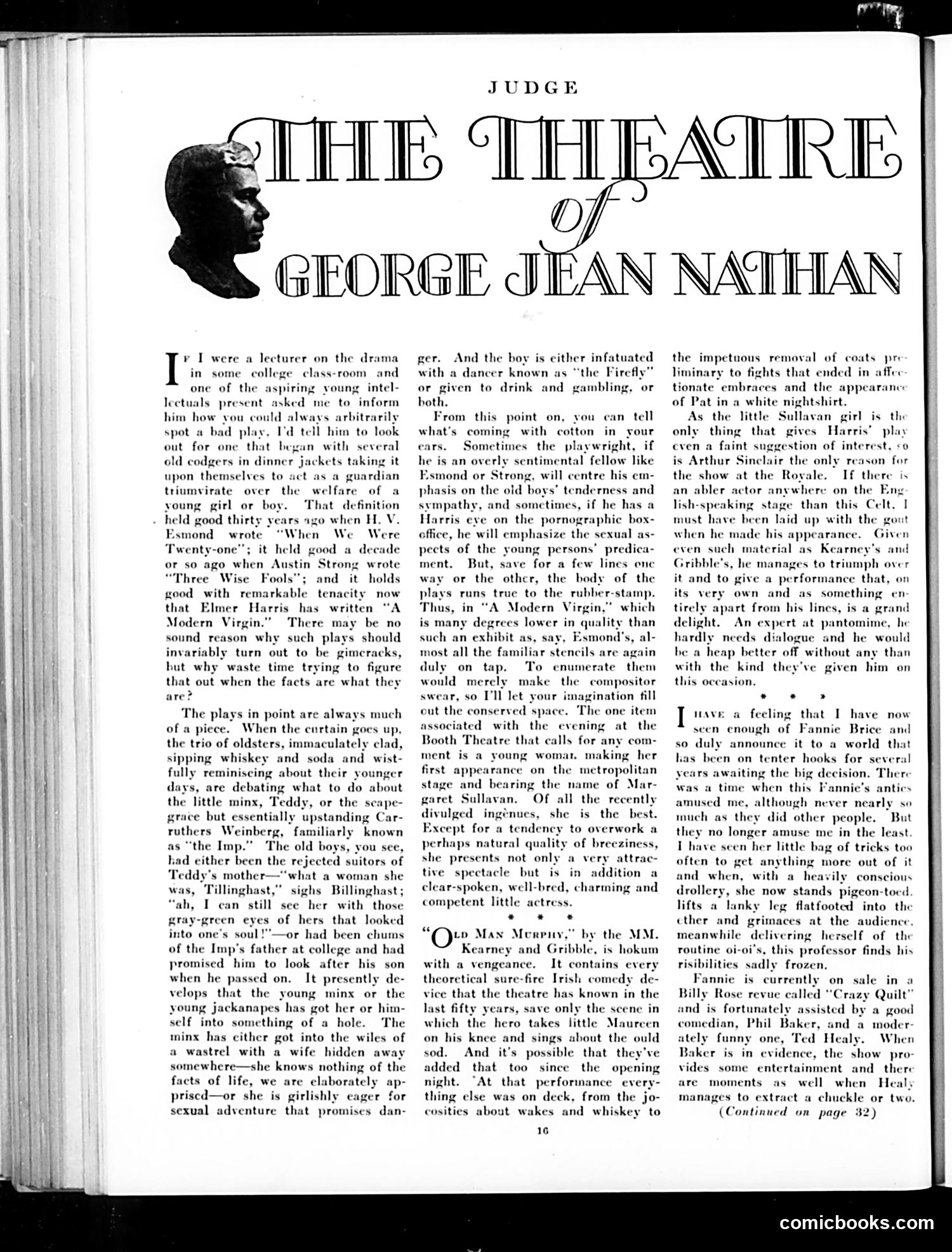
A restored page from Judge, 1931-06-13. Page through the whole issue in the reader above.
📄 Transcribed text from this page (OCR, searchable)
Machine-transcribed from the original scan — historical spelling and the odd misread are preserved.
a lecturer on the drama in some college class-room and one of the aspiring young intel- lectuals present asked me to inform him how you could always arbitrarily spot a bad play, I'd tell him to look out for one that began with several old codgers in dinner jackets taking it upon themselves to act as a guardian triumvirate over the welfar young girl or boy. definition when H. V. Esmond wrote We Were Twenty-one"; it held good a decade or so ago when Austin Strong wrote “Three Wise Fools”; and it holds good with remarkable tenacity now that Elmer Harris has written “A Modern Virgin.” There may be no sound reason why such plays should invariably turn out to be gimeracks, but why waste time trying to figure that out when the facts are what they are y I were The plays in point are always much of a piece. When the curtain goes up, the trio of oldsters, immaculately c| sipping whiskey and soda and wist- fully reminiscing about their younger days, are debating what to do the le minx, Teddy, or the seape- grace but essentially upstanding Car- ruthers Weinberg, familiarly known as “the Imp The old boys, had cither been the rejected suitors of Teddy's mother—“‘what a woman she illinghast,” sighs Billin I can still see her with those grcen eyes of hers that looked into one’s soul!""—or had been chums of the Imp’s father at college and had promised him to look after his son when he passed on. It presently de- velops that the young minx or the young jackanapes has got her or him- self into something of a hole. The minx has cither got into the wiles of a wastrel with a wife hidden away somewhere—she knows nothing of the facts of life, we ap- priscd—or she is girlishly eager for sexual adventure that promises dan- ‘ou see, JUDGE kb GEORGE J © ger. And the boy is either infatuated with a dancer known as “the Firefly” or given to drink and gambling, or both From this point on, you can tell what's coming with cotton in your ears. Sometimes the playwright, if he is an overly sentimental fellow like Esmond or Strong, will centre h phasis on the old boys’ tenderness sympathy, and sometimes, if he has a Harris eye on the pornogra office, he will emphasize the sexual pects of the young persons’ predi ment. But, save for a few lines one way or the other, the body of the ys runs true to the rubber-stamp. Thus, in “A Modern Virgin,” which is many degrees lower in quality than such an exhibit as, say, Esmond’s, al- most all the familiar st duly on tap. To would merely make swear, so I'll let your out the conserved 5} associated with the evening at the Booth Theatre that cally for any com- ment is a young womat making her first appearance on the metropolitan stage and bearing the name of Mar- garet Sullavan. Of all the recently divulged ingénues, she is the best. Except for a tendency to overwork a perhaps natural quality of breeziness, she presents not only a very tive spectacle but is in clear-spoken, well-bred, competent little actress. * * « “Ow Man Merpuy,” by the MM. Kearney and Gribl is hokum with a vengeance. It contains every theoretical sure-fire Irish comedy de- vice t the theatre has known in the last fifty years, save only the scene in which the hero takes little Maureen on his knee and sings about the ould sod. And it’s possible that they've added that too since the opening night. “At that perforinance every- thing else was on deck, from the jo- cosities about wakes and whiskey to them compositor ination fill ce. The one item trac- idition a ming and 16 ACRE NATHAN the impetuous removal of coats pre liminary to fights that ended in affec tionate embraces and the appearanc: of Pat in a white nightshirt. As the little Sullavan girl is. the only thing that gives Harris’ play even a faint suggestion of interest, <0 is Arthur Sinclair the only reason for the show at the Royale. If there is an abler actor anywhere on the Ey lish-speaking stage than this Celt. 1 must have been laid up with the ge when he made his appearance. Given even such material as Kearney’s and Gribble’s, he mz ges to triumph over it and to give a performance that, on its very own and as something en tirely apart from his lines, is a grand delight. An expert at pantomime, he hardly needs dialogue and he would be a heap better off without any than with the kind they've given him on this occasion. * 8 » I nave a feeling that I have now n enough of Fannie Brice and so duly announce it to a world that non tenter hooks for several iting the big decision. Ther: was a time when this Fannie’s antics amused me, although never nearly so much as they did other people. “But they no longer amuse me in the least I have seen her little bag of tricks too often to anything more out of it and when, with a heavily conscious drollery, she now stands pigeon-toed lifts a lanky leg flatfooted into thi ether and grimaces at the audience. meanwhile delivering herself of the routine oi-oi's, this professor finds his risibilities sadly frozen. Fannie is current Billy Rose revue calle and is fortunately ted by a good comedian, Phil Baker, and a moder ately funny one, Ted Healy. When Baker is in evidence, the show pro- vides some entertainment and_ there are moments as well when He manages to extract a chuckle or two. (Continued on page on sale in a 1“Crazy Quilt” comicbooks.com