
Judge, 1931-06-06 · page 18 of 36
Judge — June 6, 1931 — page 18: what you’re looking at
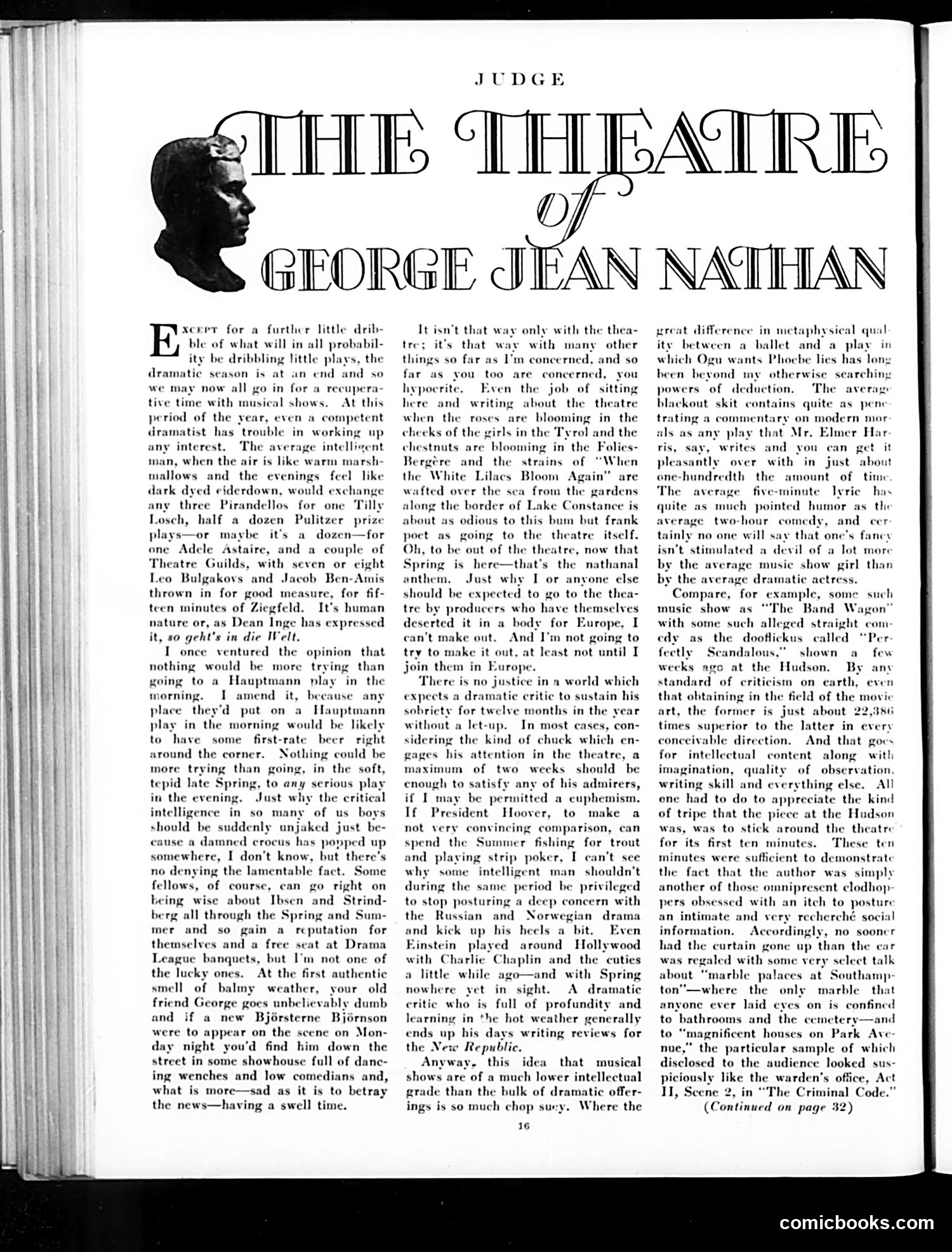
A restored page from Judge, 1931-06-06. Page through the whole issue in the reader above.
📄 Transcribed text from this page (OCR, searchable)
Machine-transcribed from the original scan — historical spelling and the odd misread are preserved.
JUDGE Is “(MAAR E: O FORGE J xcert for a further little drib- E ble of what will in all probabil- ity be dribbling little plays, the dramatic season is at an end and so we may now all go in for a recupera- tive time with musical shows. At this period of the year, even a competent dramatist has trouble in. working up any interest. > intelligent man, when the air is like warm marsh- mallows and the evenings feel like dark dyed eiderdown, would exchange any three Pirandellos for one Tilly Losch, half a dozen Pulitzer prize plays—or maybe it's a dozen—for one Adele Astaire, and a couple of Theatre Guilds, with seven or eight Leo Bulgakovs and Jacob Ben-Amis thrown in for good measure, for fif- teen minutes of Ziegfeld. It's human nature or, as Dean Inge has expressed it, so geht’s in die Welt, I once ventured the opinion that nothing would be more trying than going to a Hauptmann play in the morning. I amend it, beeause any place they'd put on a Hauptmann play in the morning would be likely to have some first-rate beer right around th Nothing could be more trying than going, in the soft, tepid late Spring, to any serious play in the evening. Just why the critical intelligence in so many of us boys should be suddenly unjaked just be- cause a damned crocus has popped up somewhere, I don’t know, but there's no denying the lamentable fact. Some fellows, of course, can go right on being wise about Ibsen and Strind- berg all through the Spring and Sum- mer and so gain a reputation for themselves and a free seat at Drama League banquets, but I'm not one of the lucky ones, At the first authentic smell of balmy weather, your old friend George goes unbelievably and if a new Bjérsterne were to appear on the scene on Mon- day night you'd find him down the street in some showhouse full of danc- ing wenches and low comedians and, what is more—sad as it is to betray the news—having a swell time. The avera corner. It isn’t that way only with the th tre; it’s that way with many things so far as I'm concerned, and so far as you too are concerned, you hypocrite. Even the job of sitting here and writing about the theatre when the roses are blooming in the cheeks of the girls in the Tyrol and the chestnuts are blooming in the F. Bergére and the strains of * the White Lilacs Bloom Agair wafted over the sea from the along the border of Lake Cons about as odious to this bum but fi poet as going to the theatre itself. Oh, to be out of the theatre, now t Spring is here—that’s the nathanal anthem. Just why I or anyone else should be expected to go to the thea- tre by producers who have themselves deserted it in a body for Europe, I can’t make out. And I'm not going to try to make it out, at Jeast not until I join them in Europe. There is no justice in a world which expects a dramatic critic to sustain h sobriety for twelve months in the without a let-up. In most cases, con- sidering the kind of chuck which en- gages his attention in the theatre, a maximum of two weeks should be enough to satisfy any of his admirers, if I may be permitted a euphemism. If President Hoover, to make a not very convincing comparison, can spend the Summer fishing for trout and playing strip poker, I can't see why some intelligent man shouldn't during the same period be privileged to stop posturing a deep concern with the Russian and Norwegian drama and kick up his heels a bit. Even Einstein played around Hollywood with Charlie Chaplin and the cuties a little while ago—and with Spring nowhere yet in sight. A dramatic critic who is full of profundity and learning in *he hot weather generally ends up his days writing reviews for the New Republic. Anyway, this idea that musical shows are of a much lower intellectual grade than the bulk of dramatic offer- ings is so much chop sucy. Where the other NACHIHIAN great difference in metaphysical qual ity between a ballet and a play in which Ogu wants Phoebe lies has long been beyond my othe powers of deduction. kout skit contains quite as pene trating a commentary on modern mor als as any play that Mr. Elmer Har ris, say, writes and you can get it pleasantly over with in just about one-hundredth the of time The erage five-minute lyrie has quite as much pointed humor as the ve two-hour ainly no one will say t isn’t stimulated a devil of a lot more by the average music show girl than by the average dramatic actress. Compare, for example, some such music show as he Band Wagon with some such alleged straight com- edy as the dooflickus called “Per fectly Scandalous,” shown few weeks ago at the Hudson. By any standard of criticism on earth, that obtaining in the field of the m art, the former is just about : times superior to the latter in every conceivable direction. And that goes for intellectual content along with quality of observation. and everything else. All 1 to do to appreciate the kind of tripe that the piece at the Hudson was, was to stick around the theatre for its first ten minutes. These ten minutes were sufficient to demonstrate the fact that the author was simply another of those omnipresent clodhop pers obsessed with an itch to posture an intimate and very recherché social information. no sooner had the curtain gone up than the ear led with some very select talk “marble palaces at Southamp where the only marble that anyone ever laid eyes on is confined to bathrooms and the cemetery— to “magnificent houses on Park Ave- nue,” the particular sample of which disclosed to the audience looked sus- piciously like the warden’s offi II, Scene 2, in “The Criminal Code.” (Continued on page 32) searching avers amount comedy, and cer one’s faney ven According comicbooks.com