
Judge, 1931-05-23 · page 6 of 36
Judge — May 23, 1931 — page 6: what you’re looking at
What you’re looking at
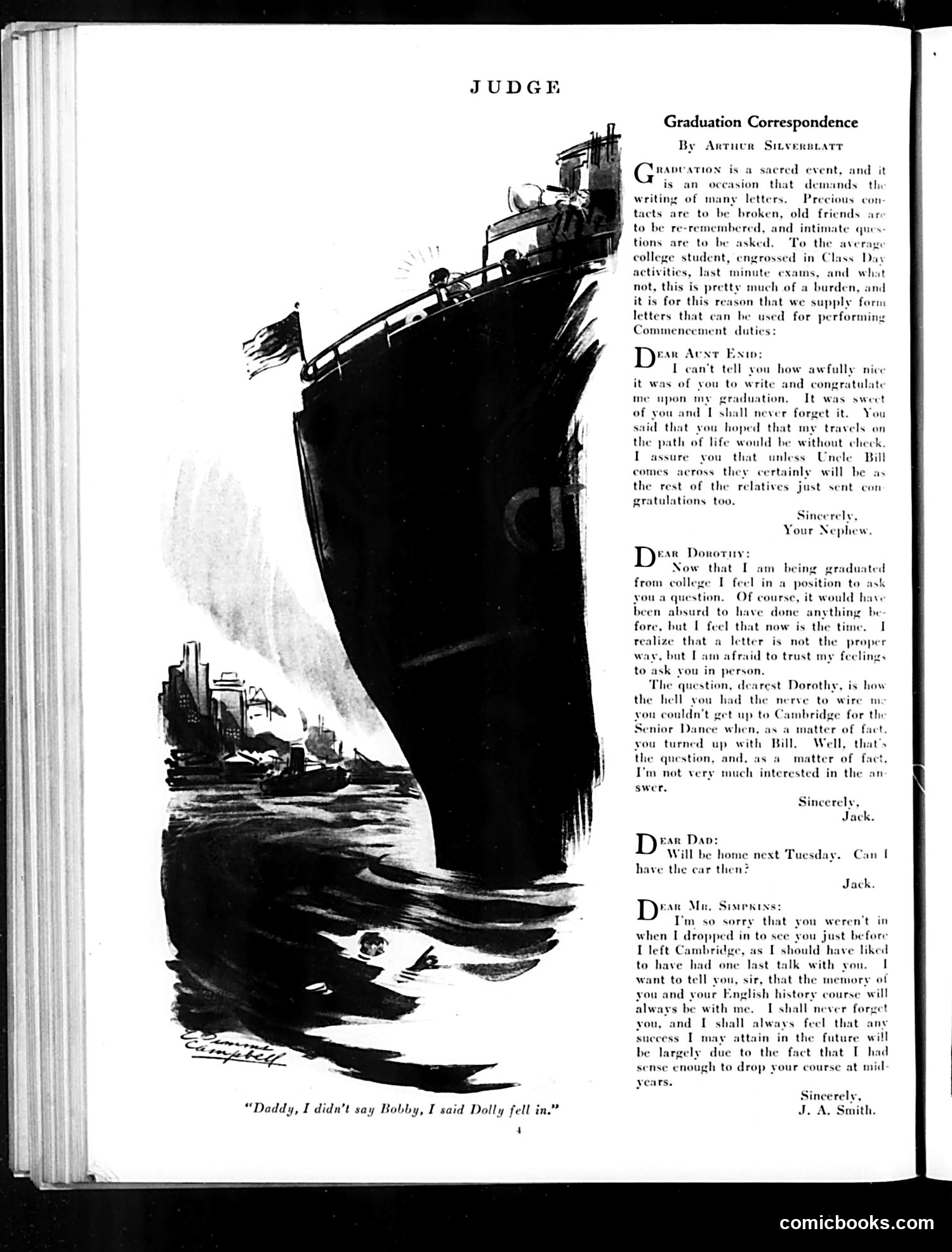
# Analysis This page from *Judge* presents "Graduation Correspondence" by Arthur Silverblatt—sample letters for college graduates to send during commencement season. The accompanying illustration shows a large ship's bow looming over a small tugboat, captioned "Daddy, I didn't say Bobby, I said Dolly fell in." The cartoon's humor relies on mishearing: a father believes his son said someone named "Bobby" fell overboard, when he actually said "Dolly"—likely a girlfriend. The joke plays on parental anxiety and miscommunication during an awkward phone conversation about a serious accident. The sample letters below address relatives with humorous updates about post-graduation plans and social events, using the correspondence as a satirical vehicle for poking fun at typical graduate etiquette and family dynamics.
📄 Transcribed text from this page (OCR, searchable)
Machine-transcribed from the original scan — historical spelling and the odd misread are preserved.
JUDGE Graduation Correspondence By Anruce Stuvenstarr Gm ATION is a sacred event, and it is an occasion that demands the writin f many letters. Precious con tacts are to be broken, old friends ar to be re-remembered, and intimate ques tions are to be asked. To the average college student, engrossed in Class Day activities, last minute exams, and what not, this is pretty much of a burden, and it is for this reason that we supply form letters that can be used for performing Commencement duties: D™ Aunt Eni: I can't tell you how awfully it was of you to write and congratulate me upon my graduation, It was swe of you and [ shall never forget it. You said that you hoped that my travels on the path of life would be without cheek. IT assure you that unless Unele Bill comes across they certainly will be as the rest of the relatives just sent. co: atulations too. Sincerely, Your Nephew. D nr Dorotiy: Now that [am being graduated from college I feel in a position to ask you a question. Of course, it would hav: been absurd to have done anything be fore, but [feel that now is the time. I realize that a letter is not the proper way, but Lam afraid to trust my feelings to ask you in person, The question, dearest Dorothy, is how the hell vou had the nerve to wire m you couldn't get up to Cambridge for the Senior Dance when, as a matter of fact you turned up with Bill, Well, that’s the question, and, as a matter of fact, I'm not very much interested in the an swer. Sincerely D™ Dap: Will be home next Tuesday. Can I have the car then? D' an Mn. Simpntns: I'm so sorry that you weren't in when I dropped in to sce you just befor: I left Cambridge, as I should have liked ad one last talk with you. I want to tell you, sir, that the memory of Jack. nd your English history course will s be with me. [shall never forget you, and [ shall always feel that any success I y attain in the future will be largely due to the fact that [had sense enough to drop your course at mid years. Sincerely, “Daddy, I didn't say Bobby, I said Dolly fell in.” J. A. Smith. ‘ comicbooks.com