
Judge, 1931-05-23 · page 15 of 36
Judge — May 23, 1931 — page 15: what you’re looking at
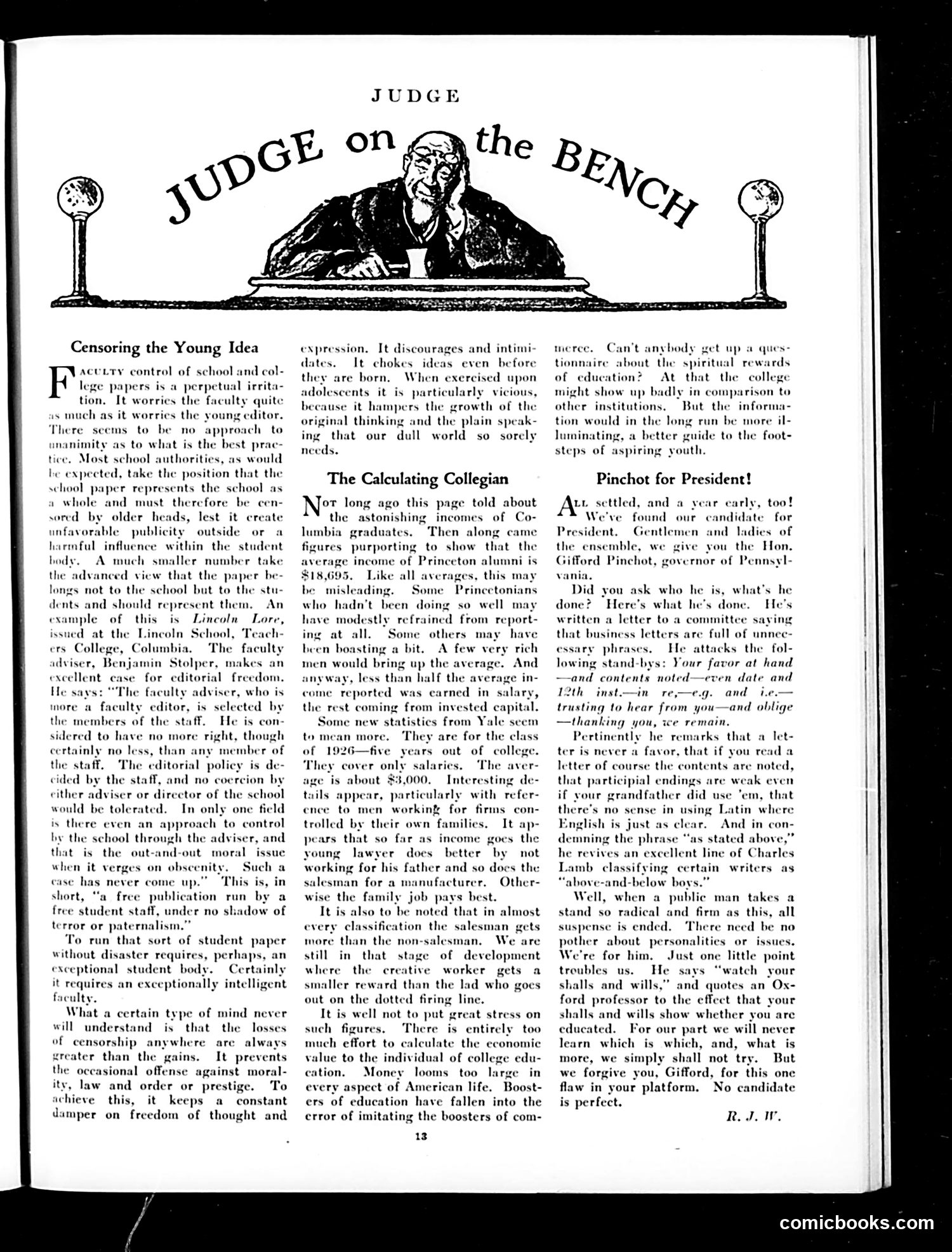
A restored page from Judge, 1931-05-23. Page through the whole issue in the reader above.
📄 Transcribed text from this page (OCR, searchable)
Machine-transcribed from the original scan — historical spelling and the odd misread are preserved.
JUDGE Censoring the Young Idea acuLty control of school and col- lege papers ix a perpetual irrita- tion, It worries the faculty quite 1s much as it worries the young editor. There seems to be no approach to imity as to what is the best prae- tice. Most school authorities, as would he expected, take the position that the school paper represents the school as 1 whole and must therefore be sored by older heads, lest it er unfavorable publicity outside or harmful influence within the student body. A much smaller number tak the advanced view that the paper be- longs not to the school but to the stu- dents and should represent them, An example of this ix Lincoln Lore, issued at the Lincoln School, Teach- ers College, Columbia. The faculty adviser, Benjamin Stolper, makes an excellent case for editorial freedom, He says: “The faculty adviser, who is more a faculty editor, is selected by the members of the staff. sidered to have no more right, though certainly no less, than any member of the staff. The editorial policy is de- cided the staff, and no coercion by cither adviser or director of the schoo! would be tolerated. In only one field is there nan approach to control by the school through the adviser, and that is the out-and-out moral issue when it verges on obscenity, Such a case has never come up.” This is, in short, “a free publication run by a free student staff, under no shadow of terror or 7 To run that sort of student paper without disaster requires, perhaps, an exceptional student body. Certainly it requires an exceptionally intelligen faculty. What a certain type of mind never will understand is that the losses of censorship anywhere are always greater than the gains. It prevents the occasional offense against moral , law and order or prestige. To ichieve this, it keeps a constant damper on freedom of thought and cen: He is con- expression. It discourages and intimi dates. It chokes ideas even before they are b When exercised upon adolescents it is particularly vicious, because it hampers the growth of the original thinking and the plain speak- ing that our dull world so sorely needs. The Calculating Collegian N= long ago this page told about the astonishing incomes of Co- lumbia graduates. Then along came figures purporting to show that the » income of Princeton alumni is Like all « verages, this may ding. Some Princetonians who hadn't been doing so well may have modestly refrained from report- ing at all. “Some others may heen boasting a bit. A few very rich men would bring up the ave anyway, less than half the come reported was carned in the rest coming from Some new statistics from Yale seem to mean more. They are for the class of 1926—five out of coll They cover only salaries. The aver- is about $3,000. Interest) de- . particularly with refer- ence to men working for firms con- trolled by their own families, It ap- pears that so far as income goes the young lawyer does better by not working for his father and so does the salesman for a manufactu Other- wise the family job pays best. so to be noted that in almost ssification the salesman gets We are tails appe more than the non-salesman, still in that of development where the creative worker gets a smaller reward than the lad who gocs out on the dotted firing line. It is well not to put great stress on such figures. much effort to vu stage is entirely too © the economic ue to the individual of college edu- Money looms too large in every aspect of American life. Boost- ers of education have fallen into the crror of imitating the boosters of com- 13 cation, merece. Can't anybody get up a ques- tionnaire about the spiritual rewards of education? At that the coll it show up badly in comparison to other institutions, But the inforn tion would in the long run be mo) luminating, a better guide to the foot- steps of aspiring youth. Pinchot for President! L settled, and a year e: We've found our candidate President. Gentlemen and |: the ensemble, we give you the Hon, fford Pinchot, governor of Pennsyl- vania. Did you ask who he is, what's he done? Here’s what he’s done. He's written a letter to a committ aying, that business let ¢ full of unr essary phrases. tacks the nr He lowing stand-bys: Your favor at hand fol- and contents noted—even date and 12th inst.—in re—e.g. and trusting to hear from you—and oblige ie —thanking you, we remain. Pertinentiy he remarks that a let- ter is never a favor, that if you read a letter of course the contents are noted, that participial endings are weak even if your grandfather did use ‘em, that there's no sense in using Latin where English is just as clear. And in col demning the phrase “as stated above he revives an excellent line of Charles Lamb classifying certain writers as “ahove-and-below boys.” Well, when a public man takes a stand so radical and firm as this, all suspense is ended. There need be no pother about personalities or issues. We're for him. Just one little point troubles us. He says “watch your shalls and wills,” and quotes an Ox- ford professor to the effect that your shalls and wills show whether you are educated. For our part we will never learn which is which, and, what is more, we simply shall not try. But we forgive you, Gifford, for this one flaw in your platform. No candidate is perfect. RIL W, comicbooks.com