
Judge, 1931-05-23 · page 10 of 36
Judge — May 23, 1931 — page 10: what you’re looking at
What you’re looking at
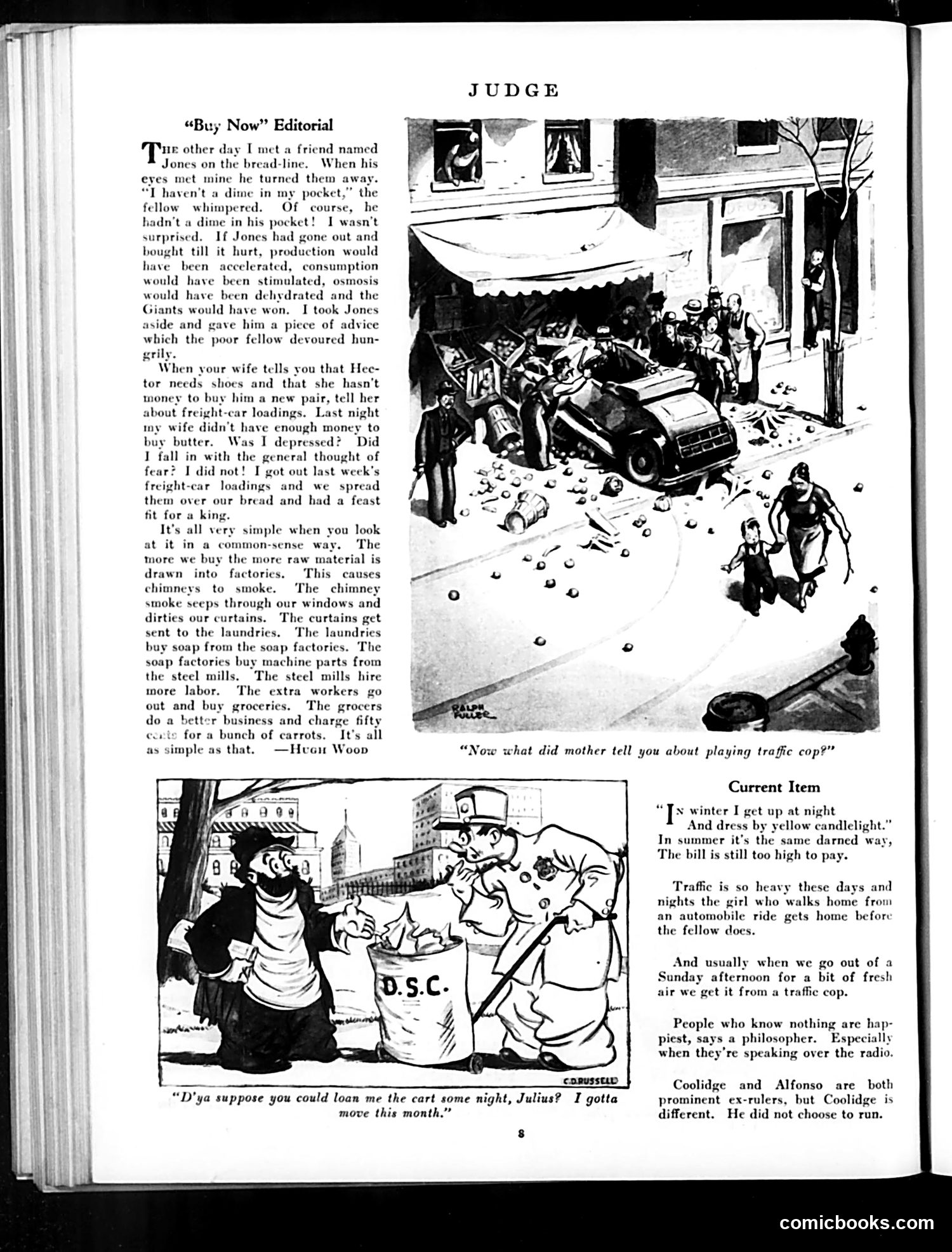
# Judge Magazine Satire Analysis This page contains two distinct satirical pieces: **"Buy Now" Editorial (top):** A mock-serious argument advocating frivolous consumption as economic stimulus. The writer humorously suggests buying unnecessary items—even on credit—stimulates production, which creates jobs, which creates demand. The absurdist logic (that buying butter creates chimney smoke that dirties curtains, requiring laundry soap, enriching steel mills) satirizes contemporary economic arguments promoting consumer spending as a cure-all. It mocks both the "buy now" messaging of the era and economic theory that treats consumption as inherently beneficial. **Lower cartoons:** The street scene depicts children playing "traffic cop" amid automobile chaos—satirizing dangerous urban traffic conditions and the era's new automobile culture. The second cartoon shows figures labeled "D.S.C." (possibly a relief organization), satirizing economic hardship and the need for loans, contrasting with the upper editorial's consumption advocacy. **The "Current Item" section** briefly discusses winter electricity bills and traffic dangers, likely contemporary social complaints. Overall: the page satirizes 1920s consumer culture, automobile problems, and economic inequality through ironic exaggeration.
📄 Transcribed text from this page (OCR, searchable)
Machine-transcribed from the original scan — historical spelling and the odd misread are preserved.
“Buy Now” Editorial ne other day I met a friend named Jones on the bread-line. When his eyes met mine he turned them “T haven't a dime in my pocket fellow whimpered. Of course, hadn't a dime in his pocket! 1 wasn’t surprised. If Jones had gone out and bought till it hurt, production would have been accelerated, consumption would have been stimulated, osmosis would have been dehydrated and the Giants would have won. I took Jones aside and gave him a piece of advice which the poor fellow devoured hun- grily. When your wife tells you that Hee- tor needs shoes and that she hasn't money to buy him a new pair, tell her about freight-car loadings. Last ni my wife didn't have enough mone} buy butter. Was I depressed? Did I fall in with the general thought of fear? I did not! I got out last week's freight-car loadings and we spread them over our bread and had a feast fit for a king. It's all very simple when you look at it in a common-sense w The more we buy the more raw material is drawn into factorie: This causes chimneys to smoke. ‘The chimney smoke seeps through our windows and dirties our curtains. The curtains get sent to th a i The laundries buy soap p factories. The soap factories buy ine parts from the steel mills. The steel mills hire more labor. The extra workers go out and buy groceries. The grocers do a better business and charge fifty for a bunch of carrots. It’s all imple as that. —Hwvoi Woop “Now what did mother tell you about playing traffic cop?” Current Item winter I get up at night And dress by yellow candlelight.” In summer it’s the same darned way, The bill is still too high to pay. Traffic is so heavy these days and nights the girl who walks home from an automobile ride gets home befor: the fellow does. And usually when we go out of a Sunday afternoon for a bit of fresh air we get it from a traffic cop. People who know nothing are hs piest, says a philosopher. Especial) when they’re speaking over the radio. me ae Ld Coolidge and Alfonso are both “D'ya suppose you could loan me the cart some night, Julius? I gotta prominent ex-rulers, but Coolidge is move this month.” different. He did not choose to run. 8 comicbooks.com