
Judge, 1931-05-09 · page 9 of 36
Judge — May 9, 1931 — page 9: what you’re looking at
What you’re looking at
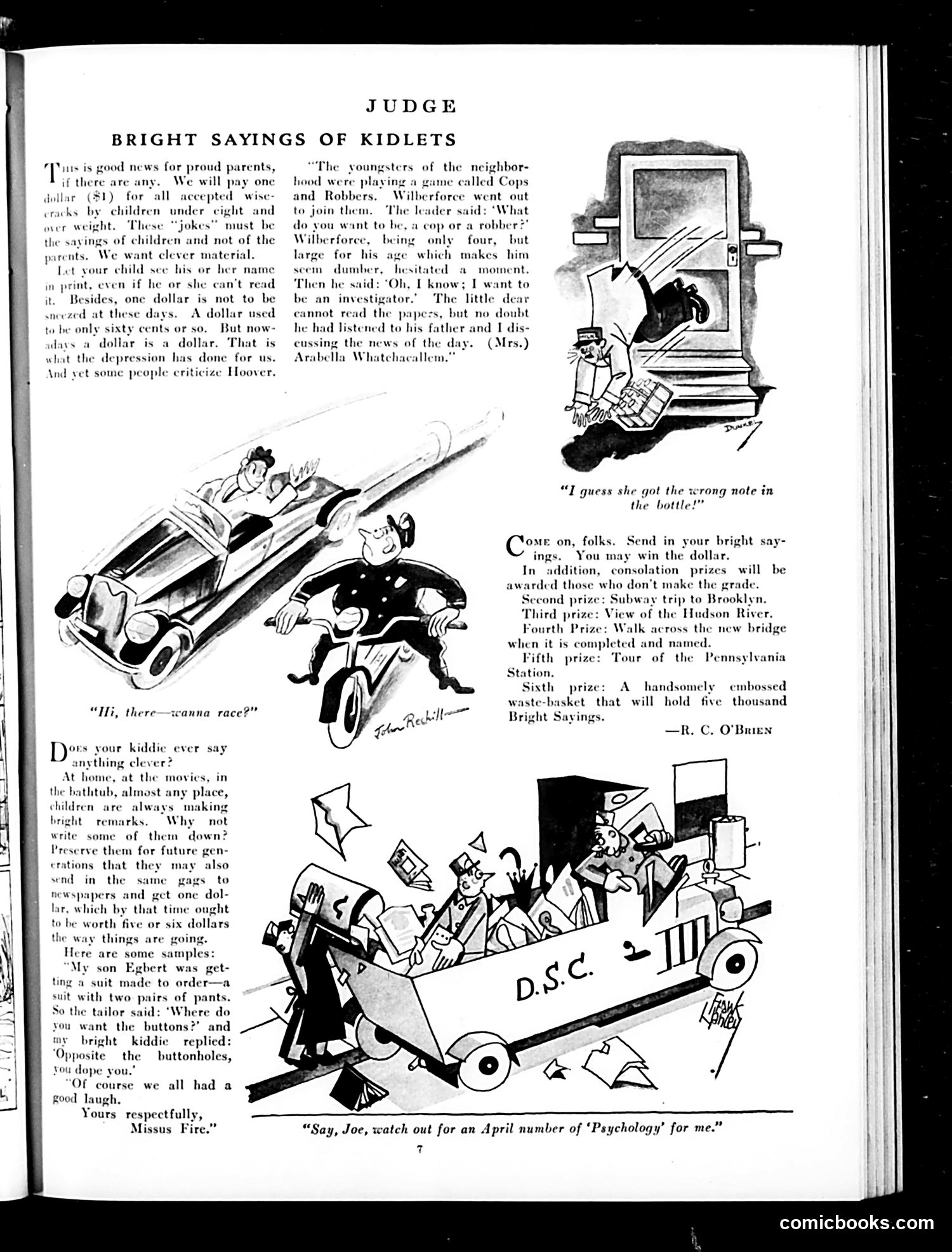
# "Bright Sayings of Kidlets" — Judge Magazine Analysis This page is a **humor column** soliciting witty remarks from children under eight years old, offering $1 payment per accepted submission—presented as generous during the Depression era. The satire operates on multiple levels: **The Setup:** Judge claims to celebrate children's unfiltered wisdom while clearly acknowledging parents actually write these submissions, undercutting the premise immediately. **The Jokes:** Three examples illustrate children's innocent logic ("I want to be an investigator" instead of cop or robber), malapropisms, and accidental insults ("Opposite the buttonholes, you dope you"). **The Social Context:** The column mocks Depression-era economics—a dollar was once worth sixty cents, now it's just a dollar; people criticize President Hoover despite economic hardship. The "consolation prizes" (subway trips, bridge walks, a waste-basket) satirize how little $1 actually represents. **The Cartoons:** Show children racing and a chaotic scene labeled "D.S.C." (unclear reference), reinforcing the theme of childish mischief and parental amusement. The overall tone is gentle mockery of middle-class sentimentality about children's "wisdom."
📄 Transcribed text from this page (OCR, searchable)
Machine-transcribed from the original scan — historical spelling and the odd misread are preserved.
JUDGE BRIGHT SAYINGS OF KIDLETS "Pras is good news for proud parents, if there are any. We will pay one dollar ($1) for all accepted ‘wise- cracks by children under eight and over weight. These “j must be the sayings of children and not of the parents. We want clever materi Let your child see his or her in print, even if he or she can't read it. Besides, one dollar is not to be zed at these days. A dollar used tsorso. But now- days a dollar is a dollar. 1 tu be only sixty hat is what the depression has done for us. And yet some people criticize Hoover. “Hi, there—wanna race?” Dots sour kiddie ever say anything clever? At home, at the movies, in the bathtub, almost any pl. children are always making bright remarks. Why not write some of them down? Preserve them for future gen- erations that they may also send in’ the same newspapers and get one dol- lar, which by that time ought to be worth five or six dollars the way things are suit with two So the tailor s. you want the buttons? ay bright kiddie replied: “Opposi the — buttonholes, you dope you.’ Of course we all had a sood laugh. Yours respectfully, Missus Fire.” “The youngsters of the neighbor- hood were playing and Robbers. game called Cops Wilberforce went out to join them, The leader said: ‘What do you want to be, a cop or a robber?" Wilberforce, being only large for his s seem dumber, hesitated but which makes him moment, Then he said: ‘Oh, I know; I want to be an investigator.’ The little dear cannot read the papers, but no doubt he had listened to his father and I dis- cussing the news of the da Arabella Whatchacallem. (Mrs.) “I guess she got the wrong note in the bottle!” lox on, folks. Send in your bright say- ings. You may win the dollar. In addition, consolation prizes will be awarded those who don’t make the grade. Second prize: Subway trip to Brookly w of the Hudson River. Fourth Pr k across the new bridge when it is completed and named. Fifth prize: Tour of the Pennsylvania Station. Sixth prize: A handsomely embossed waste-basket that will hold five thousand Bright Sayings. —R. C. O'Brien “Say, Joe, watch out for an April number of ‘Psychology’ for me.” 7 comicbooks.com