
Judge, 1931-05-09 · page 12 of 36
Judge — May 9, 1931 — page 12: what you’re looking at
What you’re looking at
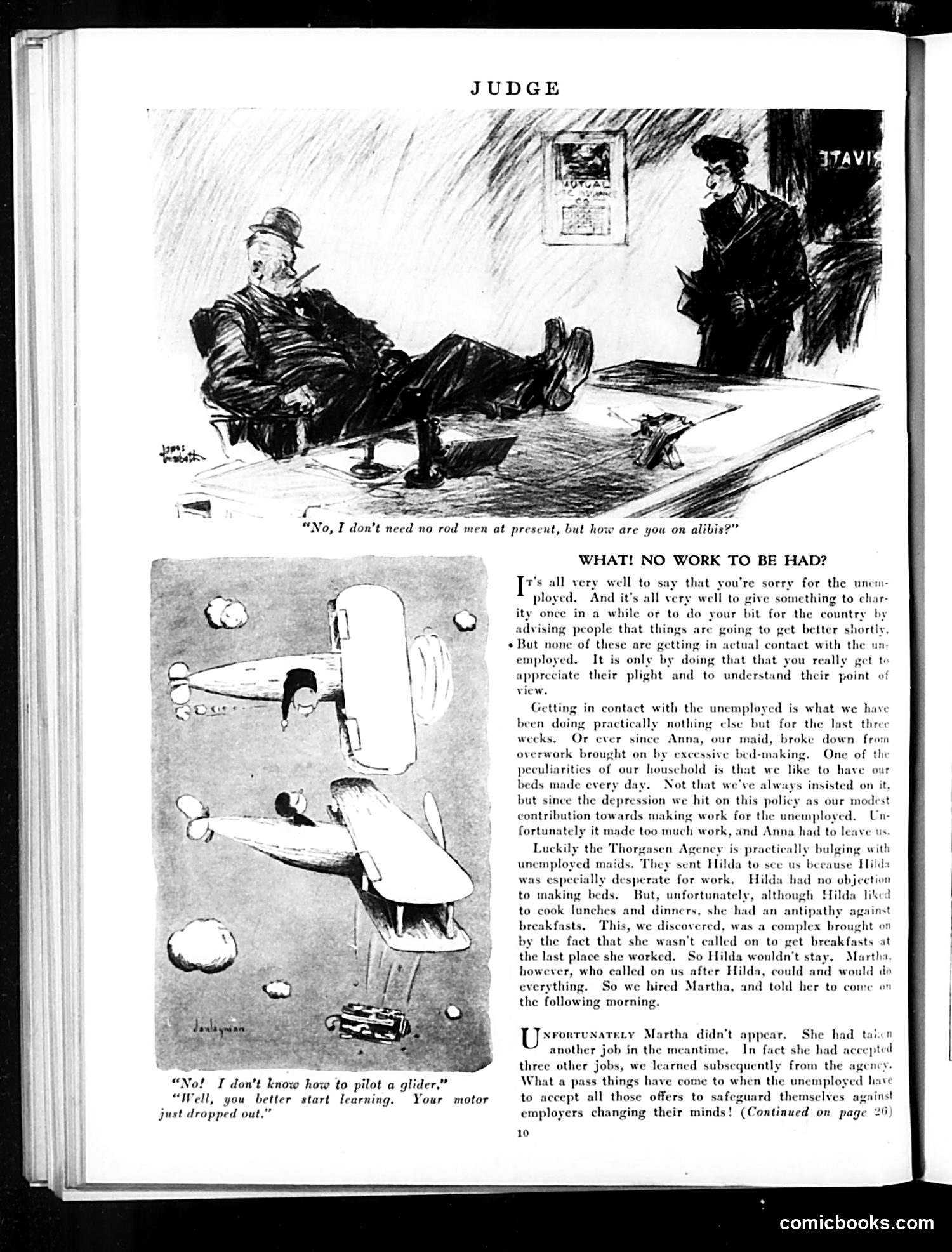
# Analysis for Modern Readers This Judge magazine page satirizes Depression-era employment desperation through two interconnected cartoons and accompanying article. **Top cartoon:** A man reclines while interviewing someone, asking if they need "rod men" but inquiring about their "alibis"—suggesting employers were hiring people willing to commit crimes or provide false testimony, not legitimate workers. **Bottom cartoon:** A flying instructor tells a student, "You better start learning. Your motor just dropped out"—visual metaphor for unemployment's chaos. **The article** describes the author's household hiring unemployed maids through an agency. Each prospect—Hilda, Martha—either quits due to psychological quirks or accepts multiple competing job offers simultaneously to secure income. The satire targets both the absurdity of Depression unemployment and the desperation forcing jobless people to accept any work offered, even contradictory positions. The point: unemployment has become so severe that the distinction between employed and unemployed has collapsed; even "employed" people maintain multiple precarious jobs simultaneously out of fear.
📄 Transcribed text from this page (OCR, searchable)
Machine-transcribed from the original scan — historical spelling and the odd misread are preserved.
“No, I don’t need no rod men at present, but how are you on alibis?” WHAT! NO WORK TO BE HAD? t's all very well to say that you're sorry for the unem- ed, And it’s all very well to give something to char- cin a while or to do your bit for the country by i people that things are going to get better shortly. + But none of these are getting in actual contact with the un employed. It is only by doing that that you really get t« appreciate their plight and to understand their point of view. Getting in contact with the unemployed is what we have been doing practically nothing else but for the last. thre: weeks. Or ever since Anna, our maid, broke down from overwork brought on by excessive bed-making. One of the peculiarities of our houschold is that we like to have our beds made every day. Not that we've always insisted on but since the depression we hit on this policy as our modes contribution towards making work for the unemployed. Un- fortunately it made too much work, and Anna had to leave us. Luckily the Thorgasen Agency is practically bulging with uncmployed maids. They sent Hilda to see us because Hilda was especially desperate for work. Hilda had no objection to making beds. But, unfortunately, although Hilda liked to cook lunches and dinners, she had an antipathy against breakfasts. This, we discovered, was a complex brought on by the fact that she wasn’t called on to get breakfasts at the last place she worked. So Hilda wouldn't stay. M however, who called on us after Hilda, could and would do everything. So we hired Martha, and told her to come om the following morning. dele je ee NrortuNnatety Martha didn’t appear. She had taht i another job in the meantime. In fact she had accepted ; Ne three other jobs, we learned subsequently from the agency. “No! I don’t know how to pilot a glider.” What a pass things have come to when the unemployed have “Well, you better start learning. Your motor to accept all those offers to safeguard themselves inst just dropped out.” employers changing their minds! (Continued on page 26 10 comicbooks.com