
Judge, 1931-05-02 · page 15 of 36
Judge — May 2, 1931 — page 15: what you’re looking at
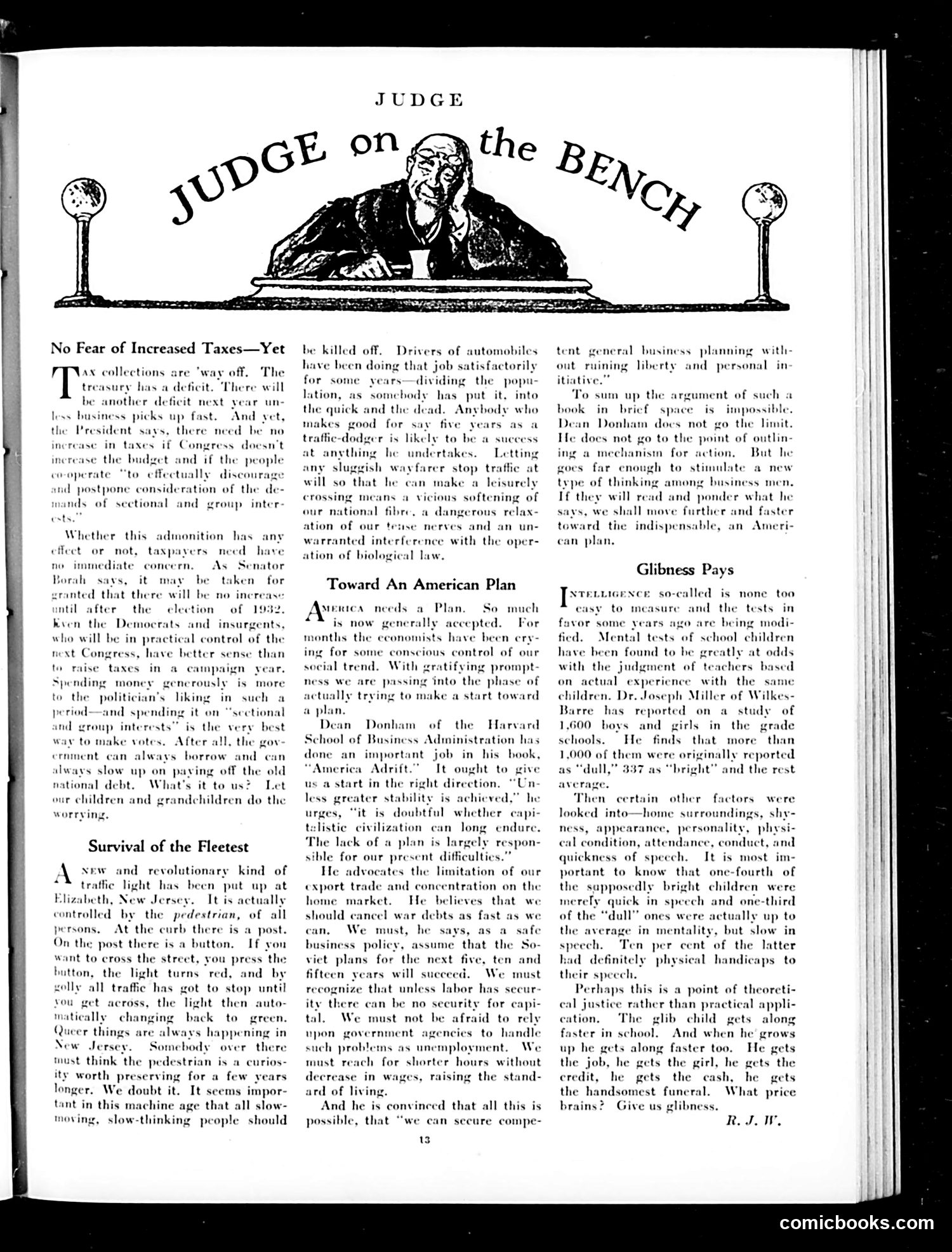
A restored page from Judge, 1931-05-02. Page through the whole issue in the reader above.
📄 Transcribed text from this page (OCR, searchable)
Machine-transcribed from the original scan — historical spelling and the odd misread are preserved.
No Fear of Increased Taxes—Yet "way off. The Ax collections 2 Tr asury has a deficit, There will be another deficit next year un- less business picks up fast. And vet, the President says, there need be no increase in taxes if Congress doesn't t and if the people 0 effectually discour snd postpone consideration of the de- inds of sectional and group inter coroperate Whether this admonition has effect or not, no immediate Borah says, it) may be granted that there will be ntil after the cleetion of 1s kven the Democrats and insurgents, who will be in practical control of the next Con to raise need hay concern, As Senator taken for no inerea taxpayers ress, have better sense than taxes in a Spending money campaign year, generously is more to the politician's liking in’ such a period nd gr way tom nd spending it on “sectional ip interests’ is the very best ke votes. After all, the gov ernment can always borrow and can slways slow up on paying off the old national debt. What's it to us? Let our children and grandchildren do the worrying, Survival of the Fleetest \ New and revoluti kind of +” tratlic light has n put up at Elizabeth, New Jer: It is actually controlled by the pedestrian, of 4 persons. At the curb there is a post. On the post there is a button. If you want to cross the street, you press the button, the light turns red, and by xolly all traffic has got to stop until you get across, the light then auto- matically changing back Queer things are al New Jersey. to green. s happening in Somebody over there must think the pedestrian is a curios- ity worth preserving for a few years longer. We doubt it. It seems impor- tant in this machine age that all slow- moving, slow-thinking people should JUDGE be killed off. Drivers of automobiles have been doing that job satisfactorily for some dividing the lation, as somebody has put it. into the quick and the dead. Anybody who makes good for say five years as a traffic-dodger is likely to be a success he undertakes. Letting gish wayfarer stop traffic at that he can make a leisurely crossing means a vicious softening of our national fibre, ation of our terse years popau- a dangerous relax- nerves and an un- warranted interference with the oper- ation of biological law. Toward An American Plan needs a Plan. So much w generally accepted. For months the economists have been cry- ing for some conscious control of our social trend. With gratifying prompt- passing into the phase of actually trying to make a start toward a plan. Dean Donham of the Harvard School of Business Administration has done an important job in his book, “America Adrift.” It ought to give us a start in the right direction. “Un less greater stability is achieved,” he urges, “it is doubtful whether ¢: telistic civilization can long endure. The lack of a plan is largely respon- sible for our present difficulties.” He advocates the lim n of our export trade and concentration on the home market. He that we should cancel war debts as fast as we We mu Psa s a safe business policy, assume that the viet plans for the next five, ten and i years will succeed. We must t unless labor has secur- in be no security for capi- We must not be afraid to rely pon government agencies to handle We h for shorter hours without ising the stand- ness we believes such problems as unemployment. must res decrease in wages, ard of living. And he is convinced that all this is possible, that “we 13 in sccure compe- tent general business planning with- out ruining liberty and personal in itiative.” To sum up the argument of such a book in. brief space is impossible. Dean Donham does not go the limit. Ife does not go to the point of outlin- But he a new echanisin: for action, enough to stimulate linking among business men. If they will read and ponder what he says, we shall move further and faster toward the indispensable, an Ameri- can plan, ing ay Glibness Pays so-called is none too I STELLIGENCE tests in easy to measure and the favor some years odi- fied. Mental tests of school children have been found to be greatly at odds with the judgment of teachers based on actual experience with the same children. Dr. Joseph Miller of Wilkes- Barre reported on a study of 1,600 boys and girls in the schools. He finds that 1,000 of them were as “dull, average. Then certain other factors were looked into—home surroundings, shy- hess, appearance, personality, physi- cal condition, attendance, conduct, and quickness of speech. It is most im- portant to know that one-fourth of the sapposedly bright children were merely quick in speech and one-third of the “dull” ones were actually up to the average in mentality, but slow in speech. Ten per cent of the latter had definitely physical handicaps. to their speech. are bein has ade than lly reported nd the rest more 37 as “bright Perhaps this is a point of theoreti cal justice rather than practical appli- cation. The glib child gets along faster in school. And when he’ grows up he gets along faster too. He gets the job, he gets the girl, he gets the credit, he gets the cash, he the handsomest funeral. brains? Give us glibness. gets What price R.dILW, comicbooks.com