
Judge, 1931-04-25 · page 20 of 36
Judge — April 25, 1931 — page 20: what you’re looking at
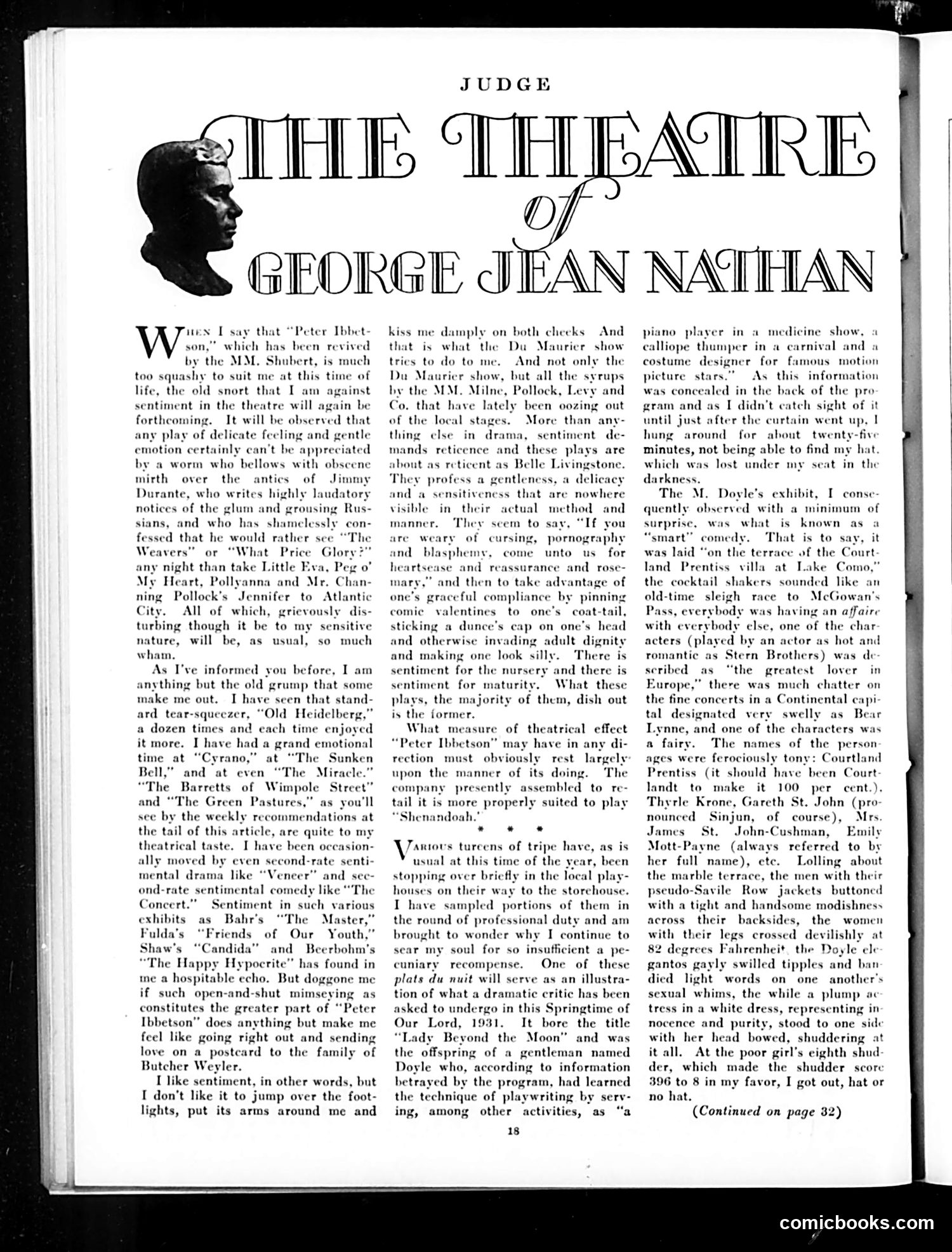
A restored page from Judge, 1931-04-25. Page through the whole issue in the reader above.
📄 Transcribed text from this page (OCR, searchable)
Machine-transcribed from the original scan — historical spelling and the odd misread are preserved.
wex [say that “Peter Ibbet- son,” which has been revived by the MM. Shubert, is much too squashy to suit me at this time of life, the old snort that I am sentiment in the theatre will a forthcoming. It will be observed that any play of delicate feeling and gentle emotion certainly can't be appreciated by a worm who bellows with obscene mirth over the antics of Jimmy Durante, who writes highly laudatory notices of the glum and grousing Rus- sians, and who has shamelessly con- fessed that he would rather se The Weavers” or “What Pr Glor. any night than e Little Eva, Peg o My Heart, Pollyanna and Mr. Chan- Pollock's Jennifer to Atlantic City. All of which, grievously dis- turbing though it be to my sensitive nature, will be, as usual, wham. As I've informed you before, I am anything but the old grump that some make me out. I have seen that stand- ard tear-squeczer, “Old Heidelberg,” a dozen times and each time enjoyed it more. I have had a grand emotional time at “Cyrano,” at “The Sunken Bell,” and at even “The Miracle. “The Barretts of Wimpole Street” and “The Green Pastures,” as you'll see by the weekly recommendations at the tail of this article, are quite to my theatrical taste. I have been oc ally moved by ever z mental drama like ond-rate sentimental comedy like“ Concert.” Sentiment in such various exhibits Bahr’s “The Master,” Fulda’s iends of Our Youth,” Shaw's “Candida” and Beerbohm's “The Happy Hypocrite” has found in me a hospitable echo. But de if such open-and-shut mimsey constitutes the greater part of Ibbetson” does anything but make me feel like going right out and sending love on a postcard to the family of Butcher Weyler. I like sentiment, in other words, but I don't like it to jump over the foot- lights, put its arms around me and so much asion- > senti- JUDGE O kiss me damply on both cheeks And that is what the Du Maurier show tries to do to me. And not only the Du Maurice show, but all the syrups by the MM. Milne, Pollock, Levy and Co. that have lately be of the loc thing els: oozing out I stag More than any- in drama, sentiment de- mands reticence and these plays are about as reticent as Belle Livingstone. They profess a gentleness, a delicacy and a sensitiveness that are nowhere visible in their actual method and manner. They seem to s: “If you are weary of cursing, pornography and blasphemy, come unto us for heartsease and reassur. and rose- “and then to take advantage of "s graceful compliance by pinning comic valentines to one’s t-tail, sticking a dunce's cap on one's head and otherwise invading adult dignity and making one look silly. There is sentiment for the nursery and there is sentiment for maturity. What these plays, the majority of them, dish out is the former. What measure of theatric “Peter Ibbetson” may hi rection must obviously rest upon the manner of its doing. npany presently assembled to. re- 1 it is more properly suited to p' Shenandoah.’ * * « VJstiows tureens of tripe have, as is usual at this time of the year, been stopping over briefly in the lécal play houses on their way to the storchous I have sampled portions of them in the round of professional duty and am brought to wonder why I continue to sear my soul for so insufficient a pe- cuniary recompense. One of these plats du nuit will serve as an illustra- tion of what a dramatic critic has been asked to undergo in this Springtime of Our Lord, 1931. It bore the title “Lady Beyond the Moon” and was the offspring of a gentleman named Doyle who, according to information betrayed by the program, had learned the technique of playwriting by serv- ing, among other activities, as “a 18 ne 1 effect NACHHIAN piano player in a medicine show, 1 calliope thumper in a carnival and a costume designer for famous motion picture stars.” As this information led in the back of the pro gram and as [ didn’t catch sight of until just after the curtain went up, 1 hung around for a minutes, not being able to find my hat. which was lost under my seat in the darkness. The M. Doyle’s exhibit, I conse- quently observed with a minimum of surprise, was what is known as a “smart” comedy, That is to say, it was laid “on the terrace of the Court land Prentiss villa at Ls Como,” the cocktail shakers sounded like an old-time sleigh race to McGow s, everybody was having an affaire with everybody else, one of the char acters (played by an actor as hot and romantic as Stern Brothers) was de scribed as “the greatest. lover in Europe,” there was much chatter on the fine concerts in a Continental eapi tal designated very swelly as Bear Lynne, and one of the characters was a fairy. The names of the person ages were ferociously tony: Courtland Prentiss (it should have been Court landt to make it 100 per cent.). Thyrle Krone, Gareth St. John (pro nounced Sinjun, of course), Mrs. James St. John-Cushman, Emily Mott-Payne (always referred to by her full name), ete. Lolling about the marble terrace, the men with their pseudo-Savile Row jackets buttoned with a tight and handsome modishness across their backsides, the women with their legs crossed devilishly 2 degrees Fahrenheit. the Doyle ele gantos gayly swilled tipples and ban died light words on one another's sexual whims, the while a plump a tress in a white dress, representing in nocence and purity, stood to one side with her head bowed, shuddering at it all. At the poor girl's eighth shud der, which made the shudder score 396 to 8 in my favor, I got out, hat or no hat. (Continued on page 32) was conce: GEORGE J iE comicbooks.com