
Judge, 1931-04-11 · page 15 of 36
Judge — April 11, 1931 — page 15: what you’re looking at
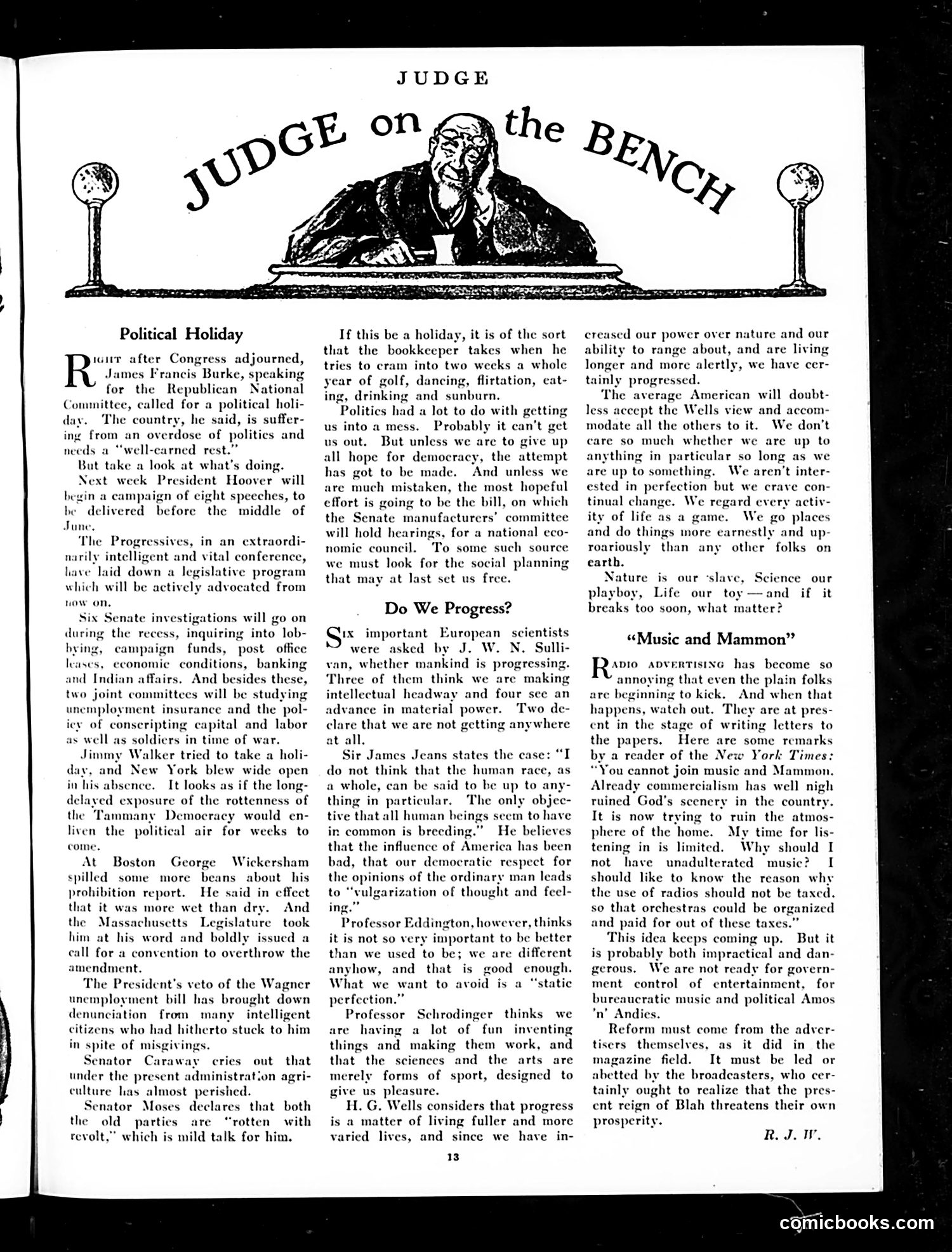
A restored page from Judge, 1931-04-11. Page through the whole issue in the reader above.
📄 Transcribed text from this page (OCR, searchable)
Machine-transcribed from the original scan — historical spelling and the odd misread are preserved.
Political Holiday taut after Congress adjourned, R James Francis Burke, speaking for the Republican National Committee, called for a political holi- day. The country, he said, is suffer- ing from an overdose of politics and needs a “well-earned rest.” But take a look at what's doing. Next weck President Hoover will begin a campaign of eight speeches, to be delivered before the middle of June. The Progressives, in an extraordi- narily intelligent and vital conference, have laid down a legislative program which will be activ now on, Six Senate investigations will go on during the ree bying, campa ss, inquiring into lob- funds, post office and India two joint committe unemployment insurance a icy of conscripting capital and labor as well as soldiers in time of war. Jimmy Walker tried to take a holi- y, and New York blew wide open in his absence. It looks as if the long- delayed exposure of the rottenness of the Tammany Democracy would en- liven the political air for weeks to come. At Boston George Wickersham spilled some more beans about his prohibition report. He said in effect that it was more wet than dry. And the Ma husetts I slature took him at his word and boldly issued a call for a convention to overthrow the amendment. The President's veto of the Wagner unemployment bill has brought down denunciation from many intelligent ens who had hitherto stuck to him in spite of misgivings. Senator Caraway cries out that under the present administration agri- culture las almost perished. Senator Moses declares that both the old parties are “rotten with revolt,” which is mild talk for him. If this be a holiday, it is of the sort that the bookkeeper takes when he tries to cram into two weeks a whole year of golf, dancing, flirtation, cat- ing, drinking and sunburn. Politics had a lot to do with getting us into a mess. Probably it can’t get us out. But unless we are to give up all hope for democracy, the attempt has got to be made. And unless we are much mistaken, the most hopeful effort is going to be the bill, on which the Senate manufacturers’ committee will hold hearings, for a national eco- nomic council. To some such source we must look for the social planning that may at last set us free. Do We Progress? Ss" important European scientists he were asked by J. W. N. Sulli- van, whether mankind is progressing. Three of them think we are making intellectual headway and four see an advance in material power. Two de- clare that we are not getting anywhere at all, Sir James Jeans states the case: “I do not think that the human race, as a whole, can be said to be up to any- thing in particular. The only obje tive that all human bein; nm to hav in common is breeding.” He believes that the influence of America has been bad, that our democratic respect for the opinions of the ordinary man leads to “‘vulgarization of thought and feel- ing.” Professor Eddington, however, thinks it is not so very important to be better than we used to be; we are different anyhow, and that is good enough. What we want to avoid is a “static perfection Professor are Schrodinger thinks we having a lot of fun inventing things and making them work, and that the sciences and the arts are merely forms of sport, designed to give us pleasure. H. G. Wells considers that progress is a matter of living fuller and more varied lives, and since we have in- 13 creased our power over nature and our ability to range about, and longer and more alertly, we tainly progressed. The average American will doubt- less accept the Wells view and accom- modate all the others to it. We don’t care so much whether we are up to anything in particular so long as we are up to something. We aren't inte ested in perfection but we crave tinual change. We regard every activ- ity of life as a game. We go places and do things more earnestly and up- roariously than any other folks on earth. Nature is our ‘slave, Science our playboy, Life our toy —and if it breaks too soon, what matter? are living con- “Music and Mammon” R DIO ADVERTISING has become so annoying that even the plain folks are beginning to kick. And when that happens, watch out. They are at pres- ent in the stage of writing letters to the papers. Here are some remarks by a reader of the New York Times: “You cannot join music and Mammon. Already commercialism has well nigh ruined God's scenery in the country. It is now trying to ruin the atmos- phere of the home. My time for lis- tening in is limited. Why should I not have unadulterated music? I should like to know the reason why the use of radios should not be taxed. so that orchestras could be organized and paid for out of these taxes.” This idea keeps coming up. But it is probably both impractical and dan- gerous. We are not ready for govern- ment control of entertainment, for bureaucratic music and political Amos ‘n’ Andies. Reform must come from the adver- tisers themselves, as it did in the magazine field. It must be led or abetted by the broadcasters, who cer- tainly ought to realize that the pres- ent reign of Blah threatens their own prosperity. R.J.W, [email protected]