
Judge, 1931-04-04 · page 26 of 36
Judge — April 4, 1931 — page 26: what you’re looking at
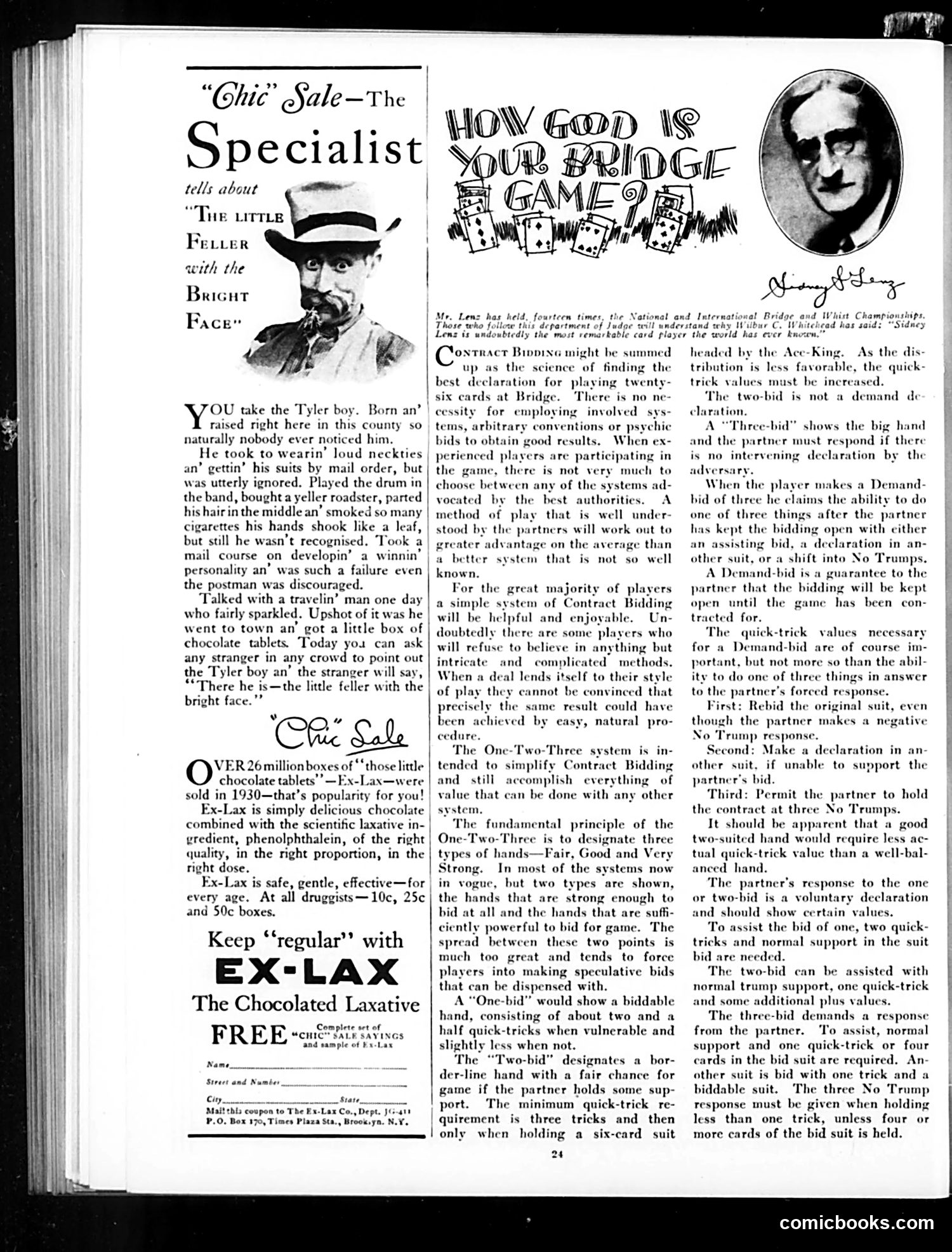
A restored page from Judge, 1931-04-04. Page through the whole issue in the reader above.
📄 Transcribed text from this page (OCR, searchable)
Machine-transcribed from the original scan — historical spelling and the odd misread are preserved.
“Ohi ] c’ Sale—The Specialist tells about “Tae LITTLE , Fei with the R Bricut Face” OU take the Tyler boy. Born an’ raised right here in this county so naturally nobody ever noticed him. He took to wearin’ loud neckties an’ gettin’ his suits by mail order, but was utterly ignored. Played the drum in the band, boughta yeller roadster, parted his hairin the middle an’ smoked so many cigarettes his hands shook |; a leaf, but still he wasn’t recognised. Took a mail course on developin’ a winnin’ personality an’ was such a failure even the postman was discouraged. Talked with a travelin’ man one day who fairly sparkled. Upshot of it was he went to town an’ got a little box of | chocolate tablets. Today you can ask any stranger in any crowd to point out the Tyler boy an’ the stranger will say, “*There he is—the little feller with the | bright face.’’ VER 26 millionboxes of ‘those little chocolate tablets’’ —Ex-Lax—were sold in 1930—that’s popularity for you! Ex-Lax is simply delicious chocolate combined with the scientific laxative in- | yredient, phenolphthalein, of the right quality, in the right proportion, in the right dose. Ex-Lax is safe, gentle, effective—for every age. At all druggists —10c, 25¢ and 50c boxes. Keep “‘regular’’ with EX-LAX The Chocolated Laxative FREE cemeatiatives ‘and sample of bx-Lax 0., Dept. J Brook.ya. ). Box 470, Times Plaz: HOW GD \e SG ra PRIDGE Mr. Lenz ha. Those who Lenz is undo fourteen times, th is department of Judo ly the most remarkable te Costeacr Bippine might be summed up as the science of findin best declaration for pl six cards at Bridge. for employing involved sys- tems, arbitr: cessi conventions or psychic bids to obtain good results. When ex- perienced players are participating in the game, there is not very much to choose between any of the systems ad- yocated by the best authorities. method of play that is well under- stood by the partners will work out to -ater advantage on the average than a better system that is not so well known. For the great majority of p } a simple system of Contract Bidding will be helpful doubtedly there nd enjoyable. Un- some players who a anything but complicated methods. Js itself to their style innot be convinced that the same result could have ved by easy, natural pro- will refuse to believe intricate and cedure. The One-Two-Three system is in- tended to simplify Contract and still value that ¢ system. The fundamental principle of the One-Two-Three is to designate three types of hands—Fair, Good Strong. In most of the but two types are shown, the hands that are strong enough to bid at all and the hands that are suffi- ciently powerful to bid for game. ‘The spread between these two points is much too great and tends to force players into making speculative bids that can be dispensed with. A “One-bid” would show a biddable hand, consisting of about two and a half quick-tricks when vulnerable and slightly less when not. The “Two-bid” designates a bor- der-line hand with a fair chance for game if the partner holds some sup- port. The minimum quick-trick re- quirement is three tricks and then only when holding a six-card suit ding smplish everything of n be done with any other in vogue, at and International Bridge and Whist Champ till underst card player the world has ever know d thy Wilbur C. Whitehead has said: headed by the Ace-King. As the dis- tribution is less favorable, the quick- trick values must be increased. The two-bid is not a demand de claration. A “Three-bid” shows the big hand and the partner must respond if there is no intervening declaration by the adversary. When the pla makes a Demand- bid of three he claims the ability to do one of three things after the partner has kept the bidding open with either an assist bid, a declaration in an- other suit, or a shift into No Trumps. A Demand-bid is ntee to the partner that the bidding will be kept open until the game has been con- tracted for, The quick-trick values necessary for a Demand-bid are of course i portant, but not more so than the abil- ity to do one of three things in answer t, even though the 7 es a negative No Trump response. Second: Make a declaration in an- suit, if unable to support the partner's bid. Third: Permit the partner to hold the contract at three No Trumps. It should be apparent that a good two-suited hand would require less ac- tual quick-trick value than a well-bal- anced hand. The partner's response to the one or two-bid is a volunt. and should show certain values. To assist the bid of one, two quick- tricks and normal support in the suit bid are needed. The two-bid can be assisted with normal trump support, one quick-trick and some additional plus values. The three-bid demands a response from the partner. To assist, normal support and one quick-trick or four ‘ds in the bid suit are required. An- ther suit is bid with one trick and a biddable suit. The three No Trump response must be given when holding less than one trick, unless four or more cards of the bid suit is held. comicbooks.com