
Judge, 1931-04-04 · page 20 of 36
Judge — April 4, 1931 — page 20: what you’re looking at
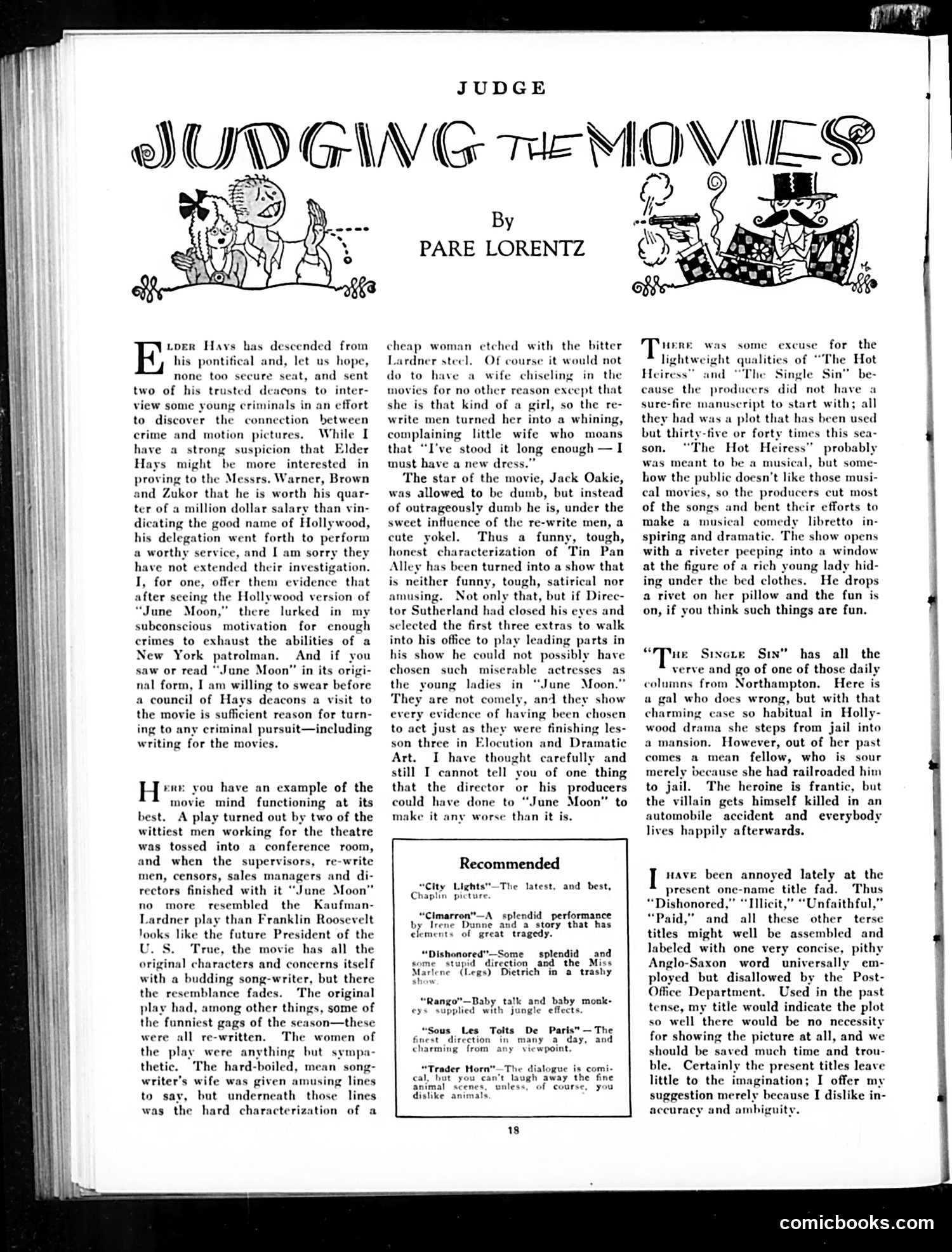
A restored page from Judge, 1931-04-04. Page through the whole issue in the reader above.
📄 Transcribed text from this page (OCR, searchable)
Machine-transcribed from the original scan — historical spelling and the odd misread are preserved.
Loer Hays bas descended from his pontifical and, let us hope, none too secure seat, and sent two of his trusted deacons to inter- view some young criminals in an effort to discover the connection between crime and motion pictures. While I have a strong suspicion that Elder Hays might be more interested in proving to the Messrs. Warner, Brown and Zukor that he is worth his quar- ter of a million dollar salary than vin- dicating the good name of Hollywood, his delegation went forth to perform a worthy service, and I am sorry they have not extended the I, for one, offer them evidence that after seeing the Hollywood version of “June Moon,” there lurked in my subconscious motivation for enough crimes to exhaust the abilities of a New York patrolman. And if you saw or read “June Moon” in its origi- nal form, I am willing to swear before a council of Hays deacons a visit to the movie is sufficient reason for turn- ing to any criminal pursuit—including writing for the movies. ou have an example of the e mind functioning at its best. A play turned out by two of the wittiest men working for the theatre was tossed into a conference room, and when the supervisors, re-write men, censors, sales managers and di- rectors finished with it “June Moon” no more resembled the Kaufman- Lardner play than Franklin Roosevelt ‘ooks like the future President of the U.S. True, the movie has all the original characters and concerns itself with a budding song-writer, but there the resemblance fades. The original play had, among other things, some of the funniest gags of the s were all ason—these re-written. The women of the play were anything but sympa thetic. The hard-boiled, mean song- writer's wife was given amusing lines to say, but underneath those was the hard characterization lines of a JUDGE By PARE LORENTZ cheap woman etched with the bitter Lardner steel. Of course it would not do to have a wife chiseling in the movies for no other reason except that she is that kind of a girl, so the re- write men turned her into a whini complaining little wife who moans that “I've stood it long enough —I must have a new dress.” The star of the movie, Jack Oakie, was allowed to be dumb, but instead of outrageously dumb he is, under the sweet influence of the re-write men, a cute yokel. Thus a funny, tough, honest characterization of Tin Pan Alley has been turned into a show that is neither funny, tough, satirical nor amusing. Not only that, but if Direc- tor Sutherland had closed his eyes and selected the first three extras to walk into his office to play leading parts in his show he could not possibly have chosen such miserable actresses as the young ladies in “June Moon.” They are not comely, and they show every evidence of having been chosen to act just as they were finishing les- son three in Elocution and Dramatic Art. I have thought carefully and still I cannot tell you of one thing that the director or his producers could have done to “June Moon” to make it any worse than it is. Recommended Lights"—The latest, pict and best, “Cimarron”—A splendid performance by Irene Dunne and a story that has elements of great tragedy. “Dishonored"—Some some stupid Marlene splendid and direction and the Miss (Legs) Dietrich in a trashy “Rango"—Baby talk and baby monk- lied with jungle effects. us Les Tolts De est direction in. many harming from any Paris” — The a day, and viewpoint, “Trader Horn” Th cal, but you can't la animal scene dislike animal jalogue is comi- away the fine of course, you gr MG mHeE™ OV [SP excuse for the ities of “The Hot Single Sin” be- icers did not have a sure-fire manuscript to start with; all they had was a plot that has been used irty-five or forty times this sea- son. “The Hot Heiress” probably was meant to be a musical, but some- how the public doesn’t like those musi- cal movies, so the producers cut most of the songs and bent their efforts to make a musical com libretto in- spiring and dramatic. The show opens with a riveter peeping into a window at the figure of a rich young lady hid- ing under the bed clothes. He drops a rivet on her pillow and the fun is on, if you think such things are fun. “Tue Sixcre Sin” has all the verve and go of one of those daily columns from Northampton. Here i a gal who does wrong, but with that charming case so habitual in Holly- wood drama she steps from jail into a mansion. However, out of her past comes a mean fellow, who is sour merely because she had railroaded him to jail. The heroine is frantic, but the villain gets himself killed in an automobile accident and everybody lives happily afterwards. I nave been annoyed lately at the present one-name title fad. Thus “Dishonored,” “Illicit,” “Unfaithful,” “Paid,” and all these other terse titles might well be assembled and labeled with one very concise, pithy Anglo-Saxon word universally em- ployed but disallowed by the Post- Office Department. Used in the past tense, my title would indicate the plot so well there would be no necessity for showing the picture at all, and we should be saved much time and trou- ble. Certainly the present titles leave little to the imagination; I offer my suggestion merely because I dislike in- accuracy and ambiguity. HERE was some cause the pr i comicbooks.com