
Judge, 1931-03-14 · page 3 of 36
Judge — March 14, 1931 — page 3: what you’re looking at
What you’re looking at
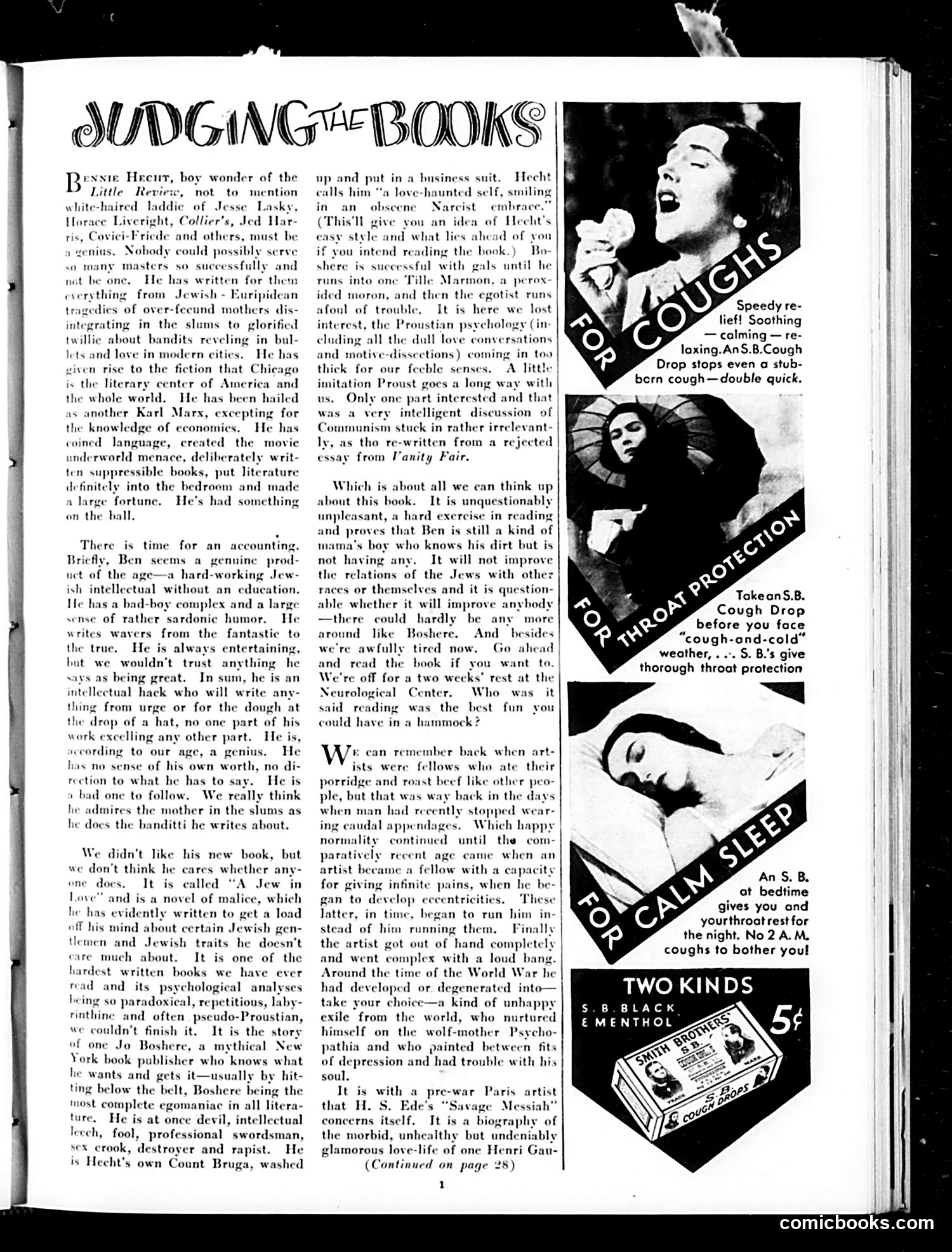
# Analysis This page is primarily a **book review section** titled "Judging the Books," not a political cartoon. The main content critiques works by Jewish author Bysshe Hecht and others, discussing novels about Jewish life and experience. The reviewer dismisses one work as "A Jest in Love" (a novel of malice), criticizing its treatment of Jewish themes and relations with other groups. The **right side contains vintage product advertisements** (cough drops, throat lozenges, sleeping aids) typical of 1920s-30s magazines—not satirical content. There is **no clear political cartoon** on this page. The satirical element, if any, lies in the book reviews themselves, which appear to critique overly sentimental or poorly-handled literary treatments of Jewish subject matter and identity.
📄 Transcribed text from this page (OCR, searchable)
Machine-transcribed from the original scan — historical spelling and the odd misread are preserved.
AUDGING™ BOOKS B' xxie Hecut, boy wonder of the Little Review, not to ntion white-haired Iaddie of Jesse Lasky, Horace I ht, Collier’s, Jed Har- and others, must be Nobody could possibly serve ris, Covici- 1 genius, so many masters so successfully and ne. He has written for them everything from Jewish - Euripidean lies of over-fecund mothers dis- ating in the slums to glorified vout bandits reveling in bul- lets and love in modern cities. He I uiven rise to the fiction that Chi is the literary center of America and the whole world. He has been hailed Karl Marx, excepting for twillie 1s anothe the know! coined lang underworld me P, liberate ten suppressible books, put liters definitely into the bedroom and made fortune. He's had something all. a large on th accounting. genuine prod- There is time for an Briefly, Ben seems a uct of the a hard-working Jew- ish intellectual without an education. He has a bad-boy complex and a large sense of rather sardonic humor. He writes wavers from the fantastic to the true, He is always entertaining, hut we wouldn't trust anything he says as being great. In sum, he is an intellectual hack who will write any- thing from urge or for the dough at the drop of a hat, no one part of his work excelling any other part. He is, weording to our age, a genius. He has no sense of his own worth, no di- rection to what he has to He is 1 bad one to follow. We really think he admires the mother in the slums as he does the banditti he writes about. We didn’t like his new book, but we don’t think he cares whether any- does. It is called “A Jew in Love” and is a novel of malice, he has evidently written to get off his mind about cert: tlemen and Jewish traits he doesn’t much about. It is one of the hardest written books we have ever read and its psychological analyses heing so paradoxical, repetitious, laby- rinthine and often pseudo-Proustian, we couldn't finish it. It is the story of one Jo Boshere, a mythical New York book publisher who knows what he wants and gets it—usually by ting below the belt, Boshere being the tnost complete egomaniac in all litera- ture. He is at once devil, intellectual leech, fool, professional swordsman, sex erook, destroyer and rapist. He is Hecht's own Count Bruga, washed one which load in Jewish care up and put in a business suit. Hecht calls him “a love-haunted self, smilin in an Narcist. embra (This'l give you an idea of Hecht's y ostyle and what lies ahead of you you intend reading the book.) Bo- e is successful with gals until he runs into one Tille Marmon, a perox ided moron, and then the egotist runs afoul of troubl It is here lost interest, the Proustian psychology (in cluding all the dull love conve ns and motive-dissections) coming in too thick for our feeble A little imitation Proust y with Only one part interested and that was a very intelligent discussion of Communism stuck in rather irrelevant- ly, as tho re-written from a rejected essay from Vanity Fair. we senses. roes a long w us. Which is about all we can think up about this b It is unquest ly unpleasant, a hard exerc and proves that Ben is still a kind of mama's boy who knows his dirt but is not having any. It will not improve the relations of the Jews with other races or themselves and it is question- able whether it will improve anybody could hardly be any’ more around like Boshere. And besides we're awfully tired now. Go ahead and read the book if you want to. We're off for a two weeks’ rest at the Neurological Center. Who was it said r was the best fun you could have in a hammock? —there r can remember back when art- ists were fellows who ate their porridge and roast beef like other peo- ple, but that was way back in the ges. W ag ich happy until continued the com- recent age came when an artist be 1 fellow with a capacity for giving infinite pains, when he be- gan to develop cecentricities. These latter, in time, began to run him in- stead of him running them. Finally the artist got out of hand comple and went complex with a loud bang. Around the time of the World War he had developed or degenerated into— take your choice—a kind of unhappy exile from the world, who nurtured himself on the wolf-mother Psycho- pathia and who painted between fits of depression and had trouble with his soul, lity parative It is with a pre Paris artist that H. S. Ede’s age Messiah” concerns itself. It is a biography of the morbid, unhealthy but unde niably glamorous love-life of one Henri Gau- (Continued on page 28) 1 Speedy re- lief! Soothing — calming — re- laxing.AnS.B.Cough Drop stops even a stub- bern cough—double quick. TakeanS.B. Cough Drop before you face “cough-and-cold” weather, . .-. S. B.'s give thorough throat protection at bedtime gives you and yourthroat rest for the night. No2 A.M. coughs to bother you! $.B.BLACK € MENTHOL comicbooks.com