
Judge, 1931-02-28 · page 24 of 36
Judge — February 28, 1931 — page 24: what you’re looking at
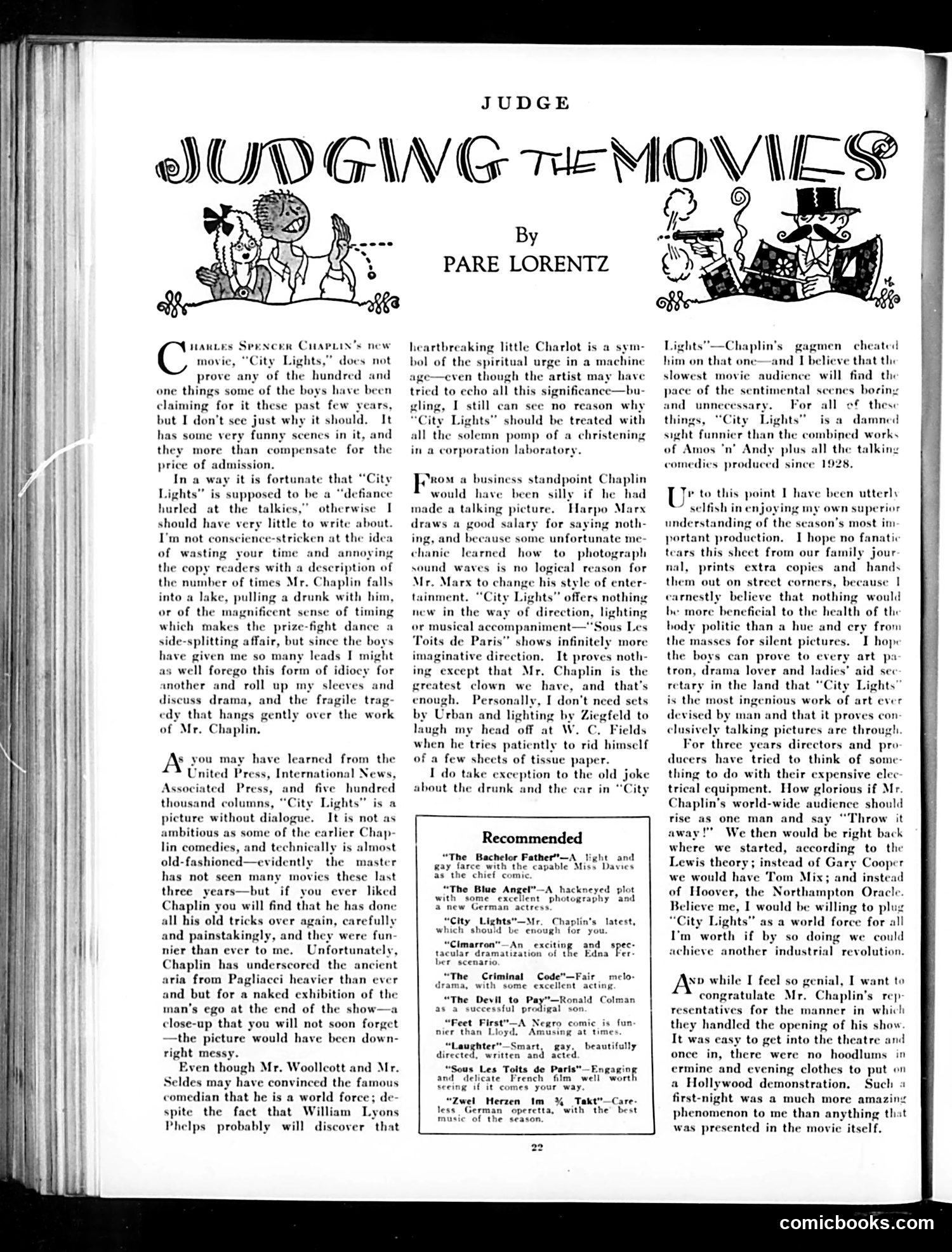
A restored page from Judge, 1931-02-28. Page through the whole issue in the reader above.
📄 Transcribed text from this page (OCR, searchable)
Machine-transcribed from the original scan — historical spelling and the odd misread are preserved.
nantes Spencer Cuaprin’s new C movie, “City Lights,” does prove any of the hundred and one things some of the boys have been claiming for it these past few y but I don't see just why it should. It has some very funny scenes in it, and they more than compensate for the price of admission. In a way it is fortunate that “City Lights” is supposed to be a “defiance hurled at the talkies,” otherwise I should have very little to write about. onscience-stricken at the idea your time and annoying Jers with a description of the number of times Mr. Chaplin falls into a lake, pulling a drunk with him, or of the magnificent sense of timing which makes the prize-fight dance a side-splitting affair, but since the boys have given me so many leads I might as well forego this form of idiocy for inother and roll up my sleeves and discuss drama, and the fragile trag- edy that hangs gently over the work of Mr. Chaplin. AX sou may have Tearned from the United Press, International News, Associated Press, and five hundred thousand columns, “City Lights” is a ture without dialogue. It is not as ambitious as some of the earlier Chap- lin comedies, and technically Imost old- fashioned— evidently the master has not seen many movies these three years—but if you ever liked Chaplin you will find that he has done all his old tricks over again, carefully and painstakingly, and they were fun- nier than ever to me. Unfortunately, Chaplin has unde rscored the ancient aria from Pagliace and but for a naked exhibition of the man’s ego at the end of the show—a close-up that you will not soon forget —the picture would have been down- right messy Even though Mr. Woollcott and Mr. Seldes may have convinced the f. comedian that he is a world force; de- spite the fact that William Lyons Phelps probably will discover that nous: JUDGE By PARE LORENTZ heartbreaking little Charlot is a sym- bol of the spiritual urge in a ma age—even though the artist may -d to echo all this significance gling, I still can see no reason why “City Lights” should be treated with all the solemn pomp of a christening in a corporation laboratory. frre a business standpoint Chaplin would have n silly if he had de a talking picture. Harpo Marx aws a good salary for saying noth- use some unfortunate me- arned how to photograph sound waves is no logical reason for Mr. Marx to change his style of enter- ainment. “City Lights” offers nothing new in the way of direction, lighting or musical accompaniment—"Sous Les Toits de Paris” shows infinitely more imaginative direction. It proves noth- ing except that Mr. Chaplin is the greatest clown we have, and that’s chanic Personally, I don't need sets n and lighting by Ziegfeld to y head off at W. C. Fields when he tries patiently to rid himself of a few sheets of tissue paper. I do take exception to the old joke about the drunk and the car in “C Recommended “The Bachelor Father"—A light and gay farce with the capable Aiea as the chief comic “The Blue Angel—A hackneyed plot with some excellent photography and a new German actress “City Lights"—Mr. Chaplin's latest, which should be enough for you. “Cimarron”—An exciting and spec: tacular dramatization of the Edna Fer- ber scenario, “The Criminal Code"—Fair _ melo- drama, with some excellent acting “The Devil to Pay”—Ronald Colman as a successful prodigal son. “Feet Fir nier than I mic is fun Kat times “Laughter"—Smart, gay, beautifully directed, written and acte “Sous Les Tolts de Paris" Engaging and delicate French film well. worth seeing if it comes your way. “Zwel Herzen tm % Takt"—Care- German operetta, ‘with the best music of the season JUVGIWG TH MOV’ LS him on that one slowest movie audience will find th pace of the sentimental se and. une thing: sight funnier than the combined works of Amos ‘n’ Andy plus all the talking comedies produced since 1928. Tr to this point I have been utterly ? selfish in enjoying my own superior understanding of the season’s most im. portant production. I hope no fs tears this sheet from our family jour nal, prints extra copies and hands them out on street corners, because | earnestly believe that nothing would be more beneficial to the health of the body politic than a hue and ery from the masses for silent pictures. I hope the boys can prove to every art pa tron, drama lover and la retary in the land that * is the most ingenious work of art ever devised by man and that it prove clusively talking pictures are through: For three years directors and pro. ducers have tried to think of some- thing to do with their expensive elec trical equipment. How glorious if Mr Chaplin's world-wide audience should rise as one man and say “Throw it away!" We then would be right back where we started, according to the Lewis theory; instead of Gary Cooper we would have Tom Mix; and instead of Hoover, the Northampton Oracl Believe me, I would be willing to plug Lights” as a world force for all I'm worth if by so doing we could achieve another industrial revolution. A pv while I feel so genial, I want to congratulate Mr. Chaplin's rep resentatives for the manner in whicli they handled the opening of his show It was easy to get into the theatre and once in, there were no hoodlums in ermine and evening clothes to put on a Hollywood demonstration, Suc! first-night was a much more amazinz phenomenon to me than anything that was presented in the movie itself. s’ aid sec ity Lights’ con comicbooks.com