
Judge, 1931-02-07 · page 4 of 36
Judge — February 7, 1931 — page 4: what you’re looking at
What you’re looking at
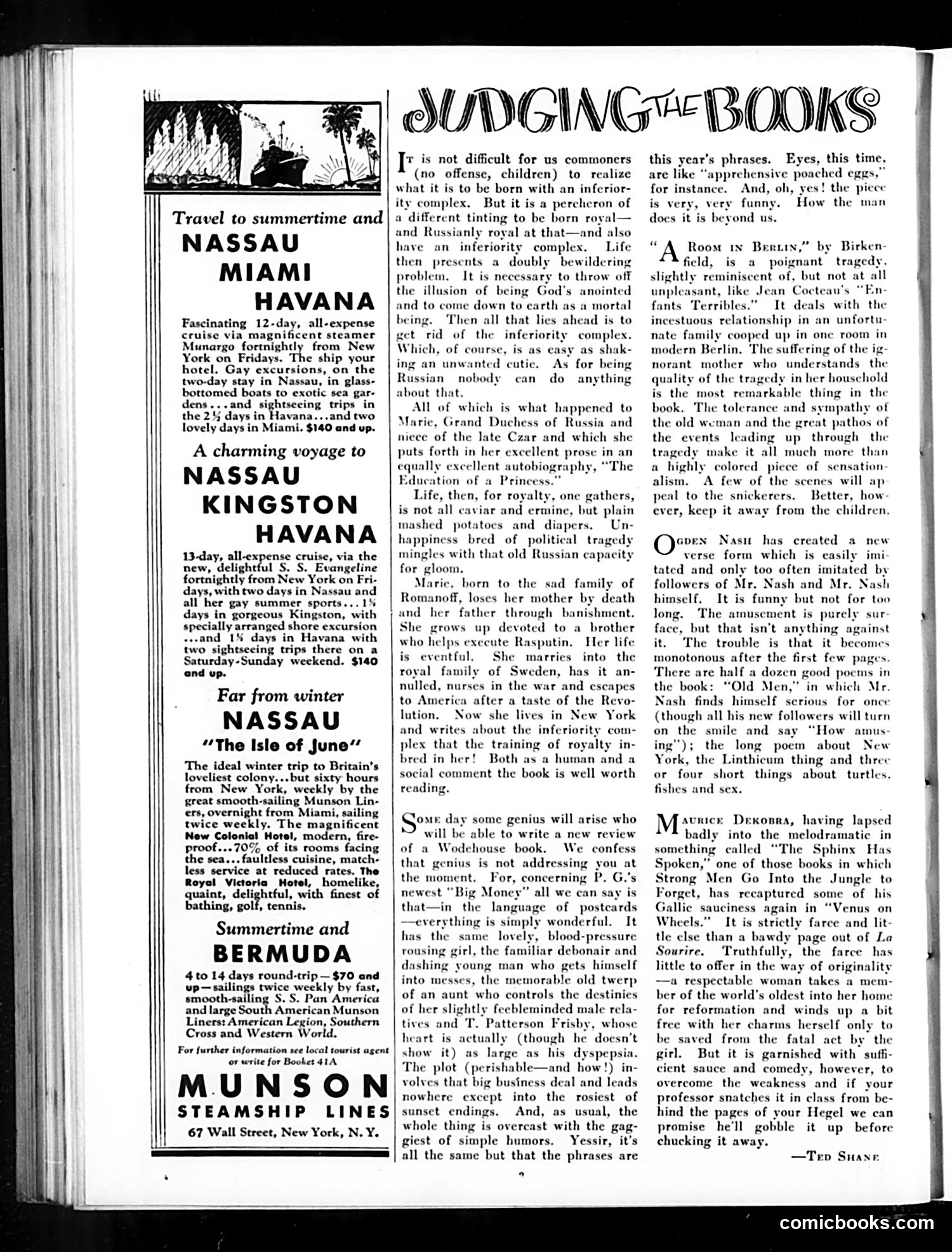
# Analysis of "Judging the Books" Page This page is primarily **book reviews and travel advertising** rather than political satire. The "Judging the Books" column reviews several novels, including works by P.G. Wodehouse and Odgen Nash. The reviews humorously critique plot devices and character types common to popular fiction of the era—such as Wodehouse's romantic entanglements and Nash's lighthearted verse about turtles and sex. The left side features travel advertisements for steamship lines to Nassau, Miami, Havana, Kingston, Bermuda, and other destinations—typical Judge magazine fare mixing editorial content with luxury tourism marketing. **No significant political cartoons or social satire appear on this page.** It represents Judge's format blending literary criticism, humor, and commercial advertisements.
📄 Transcribed text from this page (OCR, searchable)
Machine-transcribed from the original scan — historical spelling and the odd misread are preserved.
Travel to summertime and NASSAU MIAMI HAVANA Fascinating 12-day, all-expense cruise via magnificent steamer Munargo fortnightly from New York on Fridays. The ship your hotel. Gay excursions, on the two-day stay in Nassau, in glass- bottomed boats to exotic sea gar- dens...and sightseeing trips in the 244 days in Havana...and two lovely days in Miami. $140 and up. A charming voyage to NASSAU KINGSTON HAVANA 13-day, all-expense cruise, via the new, delightful S. S. Evangeline fortnightly from New York on Fri- days, with two days in Nassau and all her gay summer sports... 15 days in gorgeous Kingston, with specially arranged shore excursion «sand 1% days in Havana with two sightseeing trips there on a Saturday-Sunday weekend. $140 ‘and up. Far from winter NASSAU “The Isle of June” The ideal winter trip to Britain’s loveliest colony...but sixty hours from New York, weekly by the great smooth-sailing Munson Lin- ers, overnight from Mia‘ iling twice weekly. The magnificent New Colonial Hotel, modern, fire- proof...70% of its rooms facing the sea... faultless cuisine, match- less service at reduced rates. The Royal Victoria Hotel, homelike, quaint, delightful, vith finest of bathing, golf, tennis. Summertime and BERMUDA 4 to 14 days round-trip — $70 and up—sailings twice weekly by fast, smooth-sailing S. S. Pan America and large South American Munson Liners: American Legion, Southern Cross and Western World. For further information see local tourist agent ‘or write for Booket 41A MUNSON STEAMSHIP LINES 67 Wall Street, New York, N. Y. AUDGING™ BOOKS ‘t is not difficult for us commoners (no offense, children) to realize what it is to be born with an inferior- ity complex. But it is a percheron of a different tinting to be born ro and Russianly royal at that—and also have an inferiority complex. Life then presents a doubly bewildering problem, It is necessary to throw off the illusion of being God's anointed and to come down to carth as a mortal being. Then all that lies ahead is to get rid of the inferiority complex. Which, of course, is as easy as ing an unwanted cutie. As for t Russian nobody can do about that. All of which is what happened to ie, Grand Duchess of Russia and niece of the late Czar and which she ing anything puts forth in her excellent prose in an equally excellent autobiography, “The Education of a Princess Life, then, for royalty is not all caviar and ermin mashed potatoes and diapers. Un- happiness bred of political tragedy mingles with that old Russian capacity for gloom. Marie. born to the sad family of Romanoff, loses her mother by death and her father through banishment. She grows up devoted to a brother who helps execute Rasputin. Her life is eventful, She marries into the royal family of Sweden, has it an- nulled, nurses in the war and escapes to America after a taste of the Revo- lution. Now she lives in New York and writes about the inferiority com- plex that the training of royalty in- bred in her! Both as a hur and a ial comment the book is well worth reading. © gathers, but plain Soe day some genius will arise who will be able to write a new review of a Wodehouse book. We confes that genius is not addressing you a the moment. For, concerning P. newest “Big Money” all we can say is at—in the language of postcards hing is simply wonderful. It same lovely, blood-pressure rousing girl, the familiar debonair and dashing young man who gets himself into messes, the memorable old twerp of an aunt who controls th of her slightly feebleminded tives and T. Patterson Frisby, whose heart is actually (though he doesn’t show it) as large as his dyspepsi The plot (perishable—and how!) in- volves that big business deal and leads nowhere except into the rosiest of sunset endings. And, as usual, the whole thing is overcast with the gag- giest of simple humors. Yessir, it’s all the same but that the phrases are this year’s phrases. are like “apprehensive for instance. And, oh, yes! the piece is very, very funny. How the man does it is beyond us. “A Room ix Bertin,” by Birken- field, a poignant’ tragedy. slightly reminiscent of, but not a » like n Coct - fants ‘Terribles.” It deals with the incestuous relationship in an unfortu- © family cooped up in one room in modern Berlin, The suffering of the ig- norant mother who understands the quality of the tragedy in her houschold is the most remarkable thing in the book. The tolerance and sympathy of the old weman and the great pathos of the events leading up through the tragedy make it all much more than a highly colored piece of sensation alism. “A few of the scenes will ap peal to the snickerers. Better, how- ever, keep it away from the children. Overs Nasu has created a verse form which is eas: tated and only too often imita followers of Mr. Nash and Mr. Nash himself. It is funny but not for too long. The amusement is purely sur face, but that isn’t anything against it. The trouble is that it becomes monotonous after the first few pages. There are half a dozen good poems in the book: “Old Men,” in which Mr. Nash finds himself serious for once (though all his new followers will turn on the smile and say “How amus- ing"); the long poem about > York, the Linthicum thing and three or four short things about turtles. fishes and sex. new Maverce Dexosra, having lapsed badly into the melodramatic in something led “The Sphinx Has Spoken,” one of those books in which Strong Men Go Into the Jungle to Forget, has recaptured some of his Gallic sauciness in in “Venus on Wheels.” It is strictly farce and lit- tle else than a bawdy page out of La Sourire. Truthfully, the farce has little to offer in the way of originality —a respectable woman takes a mem- ber of the world’s oldest into her home for reformation and winds up a bit free with her charms herself only to be saved from the fatal act by the girl. But it is garnished with suffi- cient sauce and comedy, however, to overcome the weakness and if your professor snatches it in class from be- hind the pages of your Hegel we can promise he'll gobble it up before chucking it away. —Tep Suanr. comicbooks.com