
Judge, 1931-02-07 · page 18 of 36
Judge — February 7, 1931 — page 18: what you’re looking at
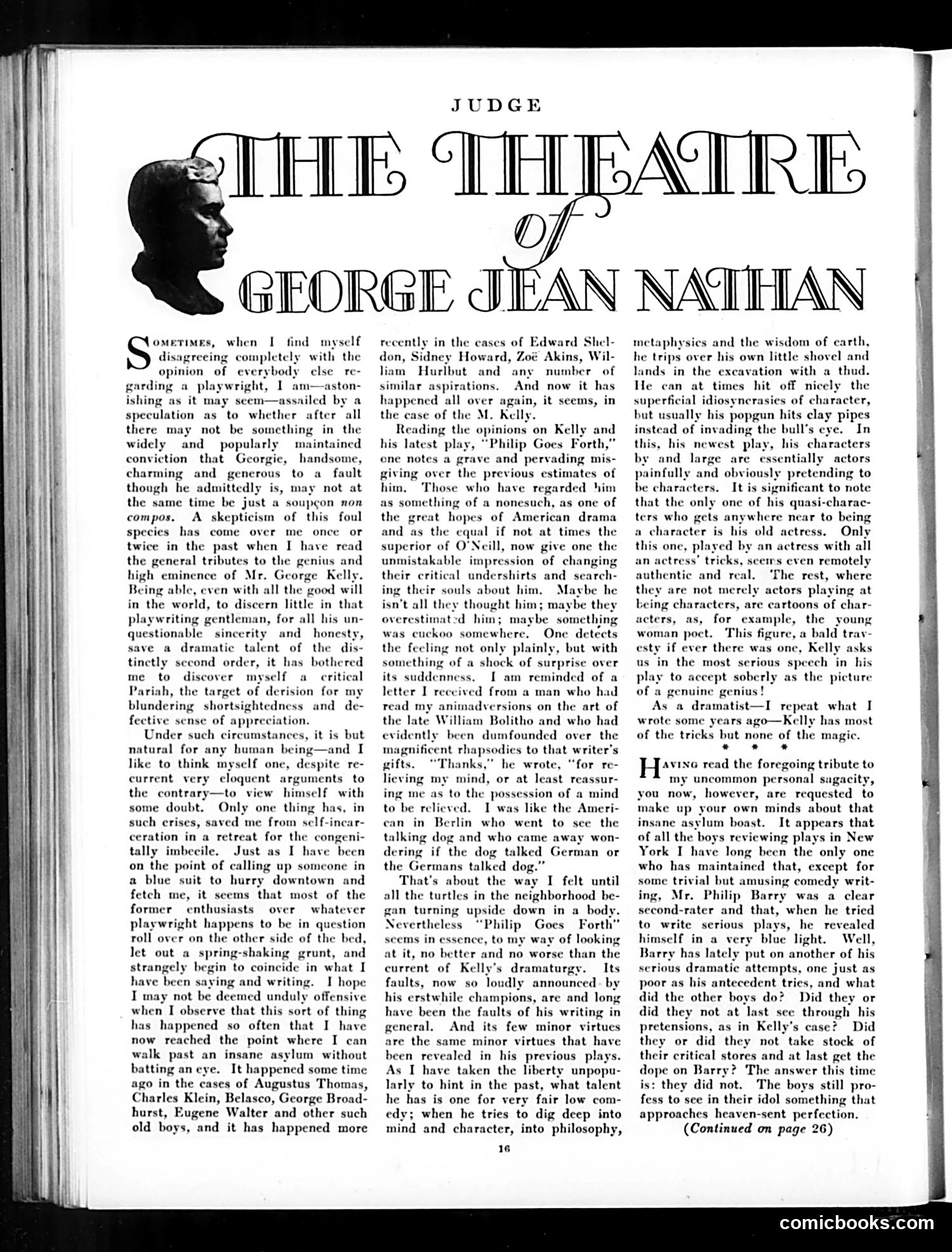
A restored page from Judge, 1931-02-07. Page through the whole issue in the reader above.
📄 Transcribed text from this page (OCR, searchable)
Machine-transcribed from the original scan — historical spelling and the odd misread are preserved.
ometimes, when I find myself S disagreeing completely with the opinion of everybody else re- garding a playwright, I am—aston- ishing as it may seem—assailed by a speculation as to whether after all there may not be something in the widely and popularly maintained conviction that Georgie, handsome, charming and generous to a fault though he admittedly is, may not at the same time be just a soupcon non compos, A skepticism of this foul species has come over me once or twice in the past when I have read the general tributes to the genius and high eminence of Mr. George Kelly. Being able, even with all the good will in the world, to discern little in that playwriting gentleman, for all his un- questionable — sin and honesty, save a dramatic talent of the dis- tinctly second order, it has bothered me to discover myself a critical Pariah, the target of derision for my blundering shortsightedness and de- fective sense of appreciation. Under such circumstances, it is but natural for any human being—and I like to think myself one, despite re- current very eloquent arguments to the contrary—to view himself with some doubt. Only one thing has, in such crises, saved me from self-incar- ceration in a retreat for the congeni- tally imbecile. Just as I have been on the point of calling up someone in a blue suit to hurry downtown and fetch me, it seems that most of the former enthusiasts over whatever playwright happens to be in question roll over on the other side of the b let out a spring-shaking grunt, strangely begin to coincide in what I have been saying and writing. I hope I may not be deemed unduly offensive when I observe that this sort of thing has happened so often that I have now reached the point where I can walk past an insane asylum without batting an eye. It happened some time ago in the cases of Augustus Thomas, Charles Klein, Belasco, George Broad- hurst, Eugene Walter and other such old boys, and it has happened more JUDGE O GEORGE J recently in the cases of Edward Shel- don, Sidney Howard, Zoé Akins, Wil- liam Hurlbut and any number of similar aspirations. And now it has happened all over again, it seems, in the case of the M. Kelly. Reading the opinions on Kelly and his latest play, “Philip Go ene notes a grave and perva giving over the previous estimates of him, Those who have regarded him as something of a nonesuch, as one of the great hopes of American drama and as the equal if not at times the superior of O'Neill, now give one the unmistakable impression of changing their critical undershirts and search- ing their souls about him. Maybe he isn’t all they thought him; maybe they overestimat:d him; maybe something was cuckoo somewhere. One detects the feeling not only plainly, but with something of a shock of surprise over its suddenness. I am reminded of a letter I received from a man who had read my animadversions on the art of the late William Bolitho and who had evidently been dumfounded over the ent rhapsodies to that writer's fts. “Thanks,” he wrote, “for re- eving my mind, or at least reassur- ing me as to the possession of a mind to be relieved. 1 was like the Ameri- can in Berlin who went to see the talking dog and who came dering if the dog talked the ans talked dog.” Th pout the way I felt until all the turtles in the neighborhood be- gan turning upside down in a bod Nevertheless “Philip Goes Forth ns in essence, to my way of looking at it, no better and no worse than the current of Kelly’s dramaturgy. — Its faults, now so loudly announced. by his erstwhile champions, are and long have been the faults of his writing in general. And its few minor virtues are the same minor virtues that ha been revealed in his previous plas As I have taken the liberty unpop' larly to hint in the past, what talent he has is one for very fair low com- edy; when he tries to dig deep into mind and character, into philosophy, 16 won- rman or AIRE: NATHAN metaphysics and the wisdom of earth, he trips over his own little shovel and avation with a thud. rely the : of character, but usually his popgun hits clay pipes instead of invading the bull’s eye. In this, his newest play, his characters large are essentially actors and obviously pretending to s. It is significant to note that the only one of his quasi-charac- ters who gets anywhere near to being a character is his old actress. Only this one, played by an actress with ail an actress’ tricks, seems even remotely authentic and ‘The rest, where e not merely actors playing at cters, are cartoons of char- acters, as, for example, the young woman poet. This figure, a bald trav- esty if ever there was one, Kelly asks us in the most serious speech in his play to accept soberly as the picture of a genuine genius! As a dramatist—I repeat what I wrote some years ago—Kelly has most of the tricks but none of the magic. 8 * Hee read the foregoing tribute to my uncommon personal sagacity, you now, however, are requested to © up your own minds about that insane asylum boast. It appears that of all the boys reviewing plays in New York I have long been the only one who has maintained that, except for some trivial but amusing come ing, Mr. Philip Barry was a clear second-rater and that, when he tried to write serious plays, he revealed himself in a very blue light. Well, Barry has lately put on another of his serious dramatic attempts, one just as poor as his antecedent tries, and what did the other boys do? Did they or did they not at last see through his pretensions, as in Kelly’s case? Did they or did they not take stock of their critical stores and at last get the dope on Barry? The answer this time is: they did not. The boys still pro- fess to see in their idol something that approaches heaven-sent perfection. (Continued on page 26) superfic being ¢ comicbooks.com