
Judge, 1931-02-07 · page 15 of 36
Judge — February 7, 1931 — page 15: what you’re looking at
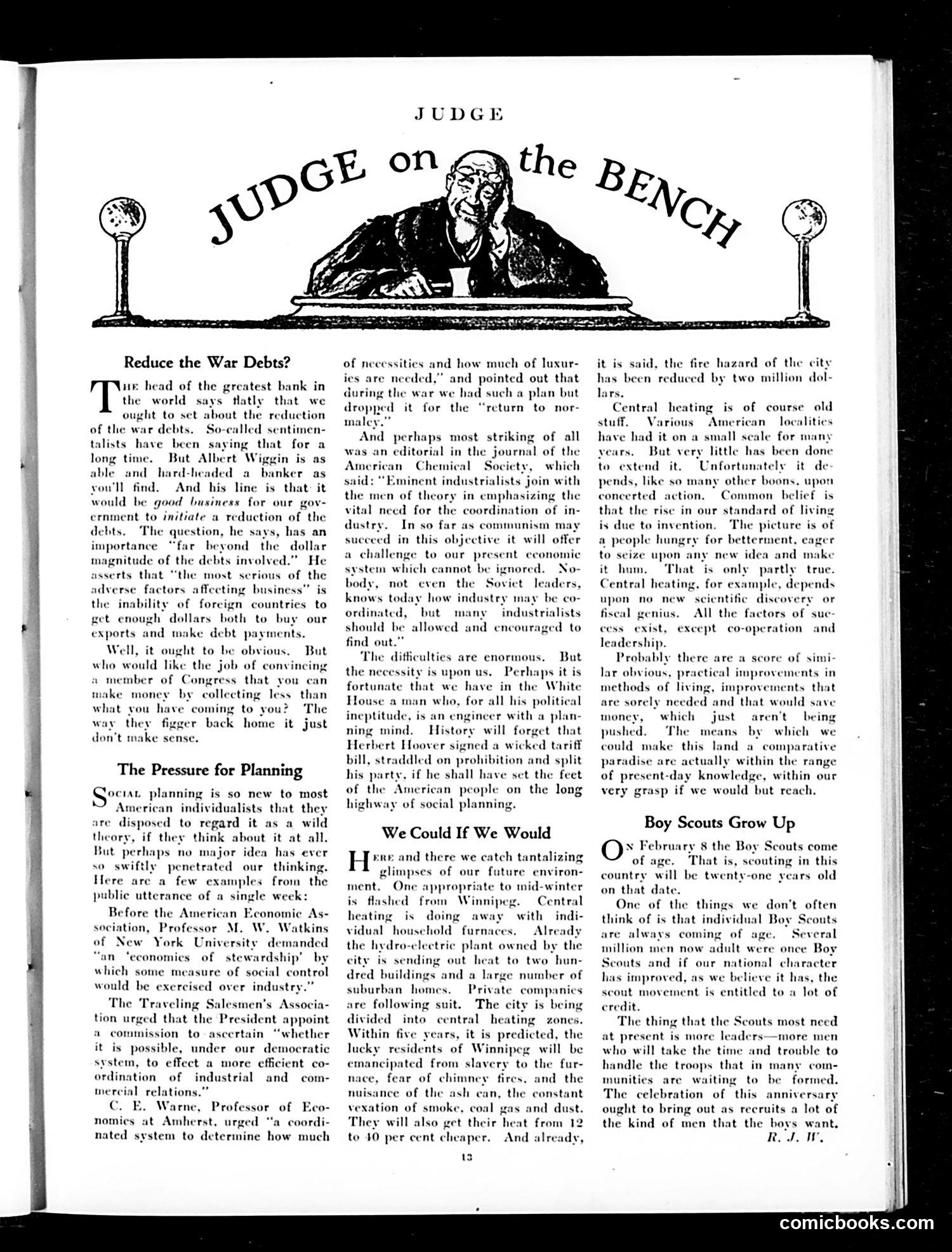
A restored page from Judge, 1931-02-07. Page through the whole issue in the reader above.
📄 Transcribed text from this page (OCR, searchable)
Machine-transcribed from the original scan — historical spelling and the odd misread are preserved.
JUDGE Ti head of the greates ki the world says tlatly that we ought to set about the reduction of the war debts. So-called sentime talists hi been saying that for a long time. But Albert Wiggin is as a and hard-headed a banker as : find. And his line is that: it would be good business for our gov- ernment to initiate a reduction of the debts. The question, he says, has an importance “far beyond the dollar magnitude of the debts involved.” He asserts that “the most serious of the adverse tors affecting business” is the inability of foreign countries to get enou dollars both to buy our exports and make debt paym Well, it ought to be obvious. But who would like the job of convincing Ss. a member of Congress that you can money by collecting less than what you have coming to you? The way they figger back home it just don’t make sense. The Pressure for Planning cist planning is so new to most American individualists that they are disposed to regard it as a wild theory, if they think about it at all. But perhaps no major idea has ever ed our thinking. a few examples from the public utterance of a single week: Here are Before the American Economic As- |,» Professor M. W. Watkins York University demanded ‘economics of stewardship’ by which some measure of social control would be exercised over industry.” The Traveling Salesmen’s Associa- tion urged that the President appoint a commission to ascertain “whether it is possible, under our democratic system, to effect a more efficient ordination of industrial and mercial relations.” C. E. Warne, Professor of Eco- nomics at Amherst, urged “a coordi- nated system to determine how much com- of necessities and how much of luxur- ies are needed,” and pointed out that during the war we had such a plan but dropped it for the “return to nor- maley.” And perhaps most striking of all was an editorial in the journal of the American Ch I ty, which aid: “Eminent industrialists join with the men of theory in emphasizing the vital need for the coordination of in- dustry. In so far as communism may succeed in this objective it will offer Her system which cannot be ignored. No- body, not even the Soviet leaders, knows today how industry may be co- ordinated, but many — industrialists should be allowed and encouraged to find out.” The difficulties are enormous. But -ssity is upon us. Perhaps it is te that we have in the White House a man who, for all his polit ineptitude, is an engineer with a plan- ning mind. History will forget that Herbert Hoover signed a wicked tariff bill, straddled on prohibition and split his party, if he shall have set the feet of the American people on the long ach to our present economic highway of social planning. We Could If We Would ene and there we catch tantal glimpses of our future environ- ment. One appropriate to mid-winter is flashed from Winnipeg. Central heating is doing away with indi- vidual houschold furnaces, Already the hydro-electric plant owned by the city is sending out heat to two hun- dred buildings and a large number of suburban homes. Private companies are following suit. The city is being divided into central heating zones. Within five years, it is predicted, the lucky residents of Winnipeg will be ated from slavery to the fur- nace, of chimney fires, and the nuisance of the ash can, the constant vexation of smoke, coal They will also get the to 40 per cent cheaper. was and dust. heat from 12 And already, it is said, the fire hazard of the city has been reduced by two million dol- lars. Central heating is of course old stuff. Various American localities have had it on a small scale for many years. But very little has been done to extend it. Unfortunately it) de pends, like so many other boons. upot oncerted action, Common belief is that the rise in our standard of living is due to The picture is of nvention a people hungry for betterment, eager to seize upon any new idea and mak« it hum, That is only partly true. Central heating, for example, depends upon no new scientific discovery or All the factors of sue- t, except co-operation and leadership. Probably there are a score of simi- lar obvious, practi: methods of living, improvements that are sorely needed and that would save money, which just pushed. fiseal genius. cess ex lL improvements in aren't being which we could make this land a’ comparative paradise are actually within the range of present-day knowledge, within our very grasp if we would but reach, The means by Boy Scouts Grow Up O February 8 the Boy Scouts come of age. That is, scouting in this country will be twenty-one years old on that date, One of the things we don't often think of is that individual Boy Scouts are always coming of everal million men now adult were once Boy Scouts and if our national cl ter has improved, as we believe it has, the scout movement is entitled to a lot of credit. The thing t the Scouts most need at present is more leaders who will take the t and trouble to handle the troops that in many com- munities are waiting to be formed. The celebration of this anniversary ought to bring out as recruits a lot of the kind of men that the boys want. RILW, more men comicbooks.com