
Judge, 1931-01-31 · page 18 of 36
Judge — January 31, 1931 — page 18: what you’re looking at
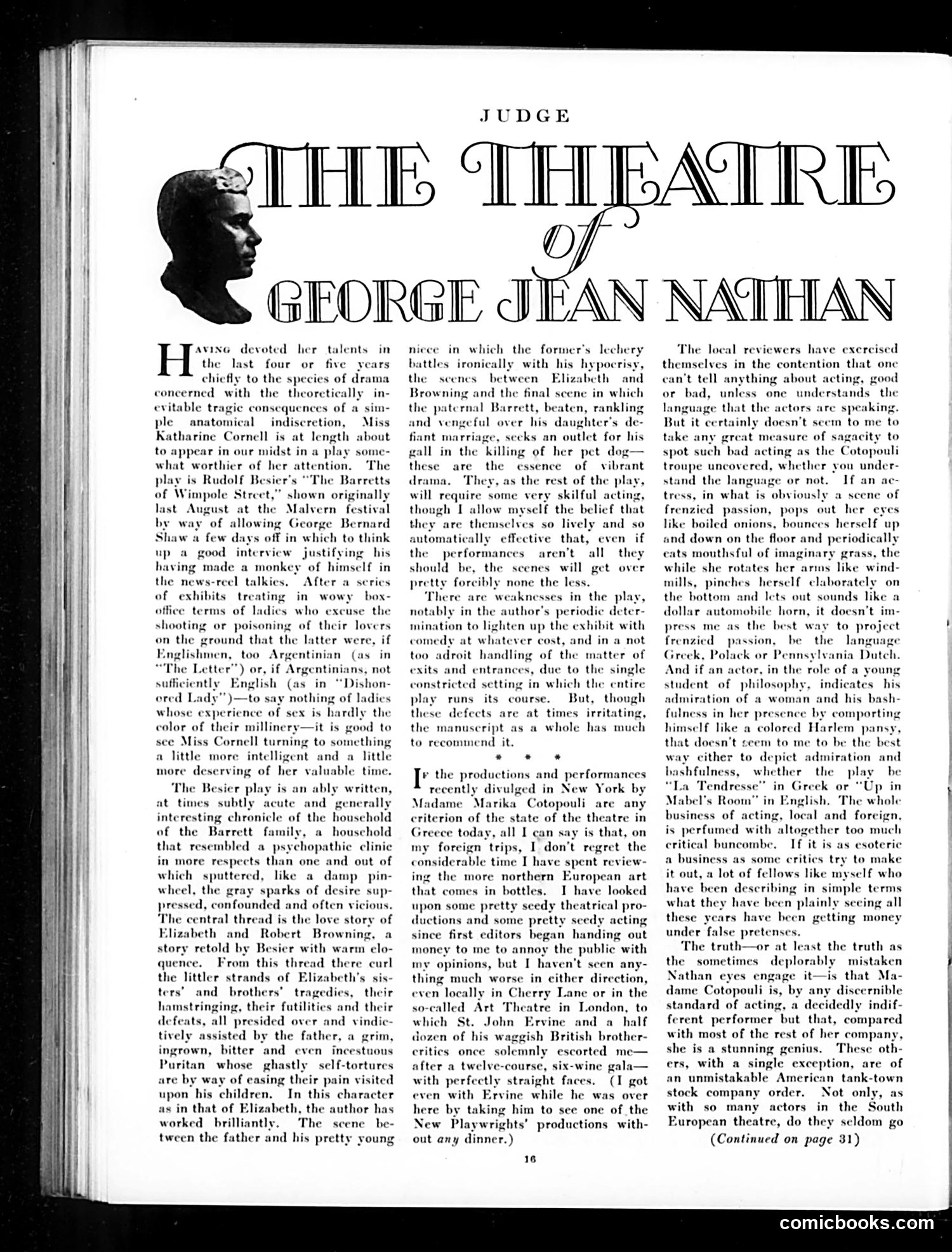
A restored page from Judge, 1931-01-31. Page through the whole issue in the reader above.
📄 Transcribed text from this page (OCR, searchable)
Machine-transcribed from the original scan — historical spelling and the odd misread are preserved.
AVING devoted her talents in chiefly to the species of drama concerned with the theoretically in- evitable tragic consequences of a sim- ple anatomical —indiseretion, Miss Katharine Cornell is at length about to appear in our midst ina play some- what worthier of her attention. The play is Rudolf Besier’s “The Barretts of Wimpole Str shown originally last August at the Malvern festival by way of allowing George Bernard «a few days off in which to think up a good interview justifying his having made a monkey of himself in the new cl talkies, After a series of exhibits treating in wowy box- ce terms of ladics who excuse the shooting or poisoning of their lovers on the ground that the latter were, if Englishmen, too Argentinian (os in “The Letter”) or, if Argentinians, not sufficiently English (as in ‘Dishon- ored Lady"”)—to say nothing of ladies whose experience of sex is hardly the color of their millinery—it is good to see Miss Cornell turning to something a little more intelligent and a little more deserving of her valuable time. The Besier play is an ably written, at times subtly acute and generally interesting chronicle of the household of the Barrett family, a houschold that resembled a psychopathic clinic in more respects than one and out of which sputtered, like a damp pin- wheel, the gray sparks of desire sup- pressed, confounded and often vicious. The central thread is the love story of Elizabeth Robert Browni: story retold by Besier with warm elo- quence. From this thread there curl the littler strands of Elizabeth's: sis- ters’ and brothers’ tragedies, their hamstringing, their futilities and their defeats, all presided over and vindie- tively d by the father, a grim, ingrown, bitter and even incestuous Puritan whose ghastly self-tortures are by of casing their pain visited upon his children, In this character as in that of Elizabeth, the author has worked brilliantly. The scene be- tween the father and his pretty young JUDGE kb GEORGE J O niece in which the former's lechery battles ironically with his hypocrisy, betwee Browning and the final seene in w the paternal Barrett, beaten, rankling and vengeful over his daughter's de- fiant marriage, secks an outlet for his gall in the killing of her pet dog— these are the essence of vibrant drama, They, as the rest of the play, will require some very skilful actin; though I allow myself the belief that they are themselves so lively and so automatically effective that, even if the performances aren't all they should the scenes will get over : forcibly none the less. There are weaknesses in the play, ably in the author's periodic deter- ition to lighten up the exhibit with comedy at whatever cost, and in a not too adroit handling of the matter of exits and entrances, due to the single constricted setting in which the entire play runs its course. But, though these defects are at times irritating, the manuscript as a whole has much to recommend it. “_ * « the scenes I". the productions and performances i w York by recently divu Madame Marika Cotopouli. ; criterion of the state of the theatre in Greece today, all I can say is that, on my foreign trips, I don’t regret the considerable time I have spent review- the more northern European art that comes in bottles. I have looked upon some pretty seedy theatrical pro- ductions and some pretty seedy acting since first editors began handing out money to me to annoy the public with my opinions, but I haven't seen any- thing much worse in either direction, even locally in Cherry Lane or in the alled Art Theatre in London, to which St. John Ervine and a half of his waggish British brother- critics once solemnly escorted me— after a twelve-course, six-wine gala— with perfectly straight faces. (I got even with E while he was over here by taking him to see one of the New Playwrights’ productions with- out any dinner.) 16 ACI Es The local reviewers have exercis themselves in the contention t n't tell anything about acting, good or bad, unless one understands the lang age that the actors are sp ng. But it c nly doesn’t seem to me to any gre: at measure of y to siot such bad acting as the ( otopouli troupe uncovered, whether you under- stand the 1 or not. If an ac- tress, in what is obviously a scene of frenzied passion, pops out her eyes like boiled onions, bounces herself up and down on the floor and periodically eats mouthsful of imaginary grass, the while she rotates her arms like wind- mills, pinches herself elaborately on the bottom and lets out sounds like a dollar automobile horn, it doesn’t press me as the best way to project frenzied passion, be the langu: Greek, Polack or Pennsylvania Dute ch. And if an actor, in the role of a young student of philosophy, indicates his admiration of a woman and his bash- fulness in her presence by comporting himself like a colored Harlem pansy, that doesn’t seem to me to be the best way cither to depict admiration and bashfulness, whether the ] be “La Tendresse” in Greek or “Up in Mabel’s Room” in English, The whole business of a nd foreign, is perfumed with r too much critical buncombe, If it is as esoteric a business as some critics try to make it out, a lot of fellows like myself who have been describing in simple terms what they ha c been plainly seeing all these years have been getting money under false pretenses. The truth—or at least the truth as the sometimes deplorably mistaken Nathan s engage it—is that Ma- dame Cotopouli is, by any discernible standard of acting, a decidedly indif- ferent performer but that, compared with most of the rest of her company, she is a stunning genius. These oth- ers, with a single exception, are of an unmistakable American tank-town stock company order. Not only, as with so many actors in the South European theatre, do they seldom go (Continued on page 31) comicbooks.com