
Judge, 1931-01-31 · page 15 of 36
Judge — January 31, 1931 — page 15: what you’re looking at
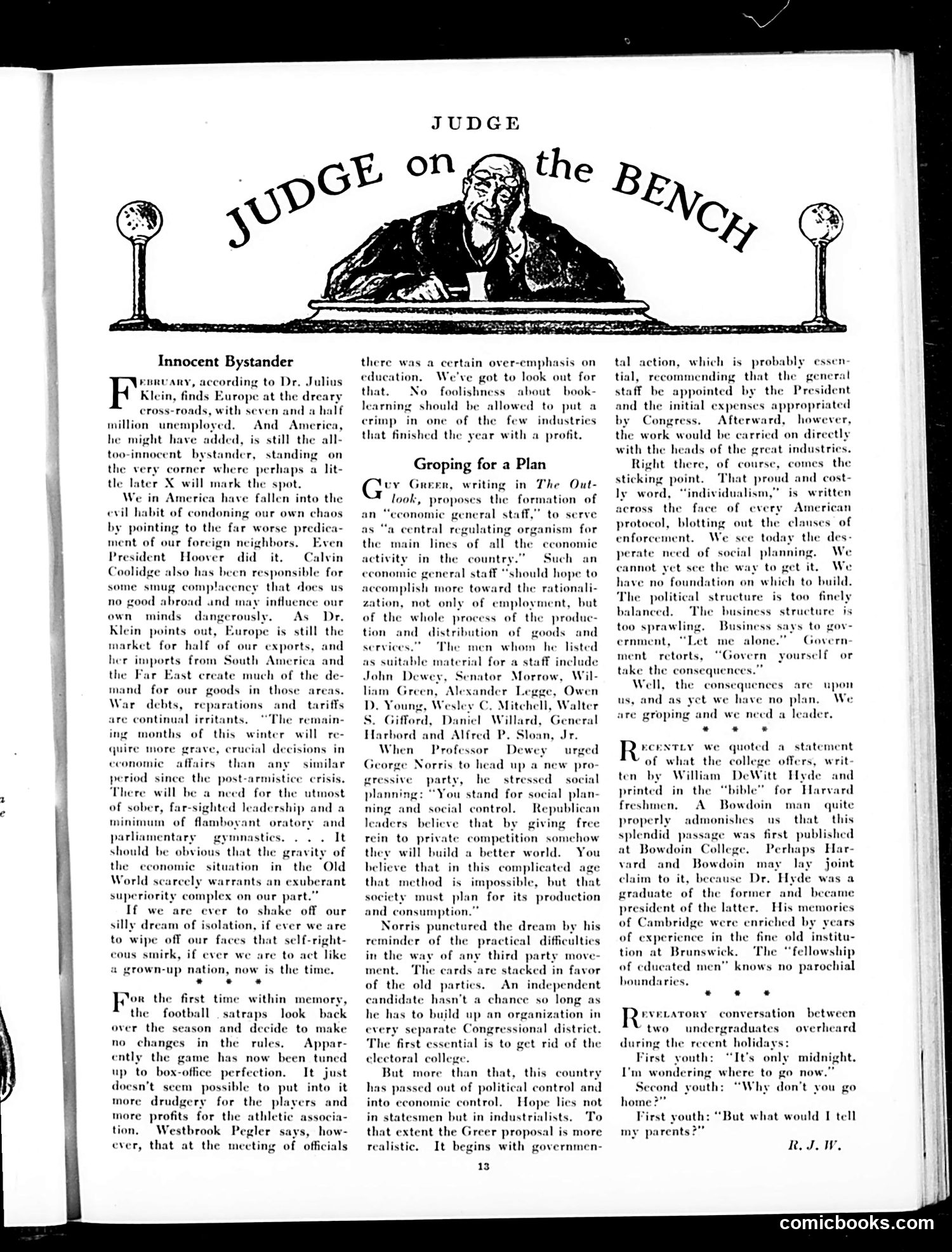
A restored page from Judge, 1931-01-31. Page through the whole issue in the reader above.
📄 Transcribed text from this page (OCR, searchable)
Machine-transcribed from the original scan — historical spelling and the odd misread are preserved.
JUDGE Innocent Bystander runvany, according to Dr. Julius Fikiin finds Europe at the dreary cross-roads, with seven and a half million unemployed. And America, he might have added, is still the all- too-innocent bystander, standing on the very corner where perhaps a lit- tle later X will mark the spot. We in America have fallen into the evil habit of condoning our own c by pointing to the far worse predic: ment of our foreign neighbors. President Hoover did it. Coolidge also has been responsible for some smug comp cency that does us no good abroad and may influence our own minds dangerously. As Dr. Klein points out, Europe is still the market for half of our exports, and her imports from South America and the Far East create much of the de- mand for our goods in War ions and are continual irritants, “The ing months of those areas. iffs remain- IM re- debts, rep this winter quire more grave, crucial deci economic affairs than any similar period since the post-armistice crisis. There will be a need for the utmost of sober, far-sighted leadership and a minimum of flamboyant oratory and parliamentary gymnastics. . . . It should be obvious that the gravity of the economic situation in the Old World scarcely warrants an exuberant superiority complex on our part.” If we are ever to shake off our silly dream of isolation, if ever we are to wipe off our faces that self-right- cous smirk, if ever we are to act like 4 grown-up nation, now is the time. oo. e FRee the first time the footh: within memory, 1 satraps look back over the season and decide to make no changes in the rules. Appar- ently the game has now been tuned up to box-office perfection. It just doesn’t seem possible to put into it more drudgery for the pl more profits for the athlet tion, Westbrook Pegler s ever, that at the meetin i of officials there was a certain over-emphasis on education, We've got to look out for that. No foolishness about book- learning should be allowed to put a crimp in one of the few industries that finished the year with a profit. Groping for a Plan The Out- formation of to serve qr Green, writing in look, proposes the an “economic general staff,’ as. ‘a central regulating organism for the main lines of all the economic activity in the country.” Such an economic general staff “should hope to accomplish more toward the rationali- zation, not only of employment, but of the whole process of the produc- tion service 1 distribution of goods and The men whom he listed as suitable material for a staff include John Dew nator Morrow, Wil- liam Green, Alexander Legge, Owen D. Young, Wesley C. Mitchell, Walter Gifford, Danicl Willard, General Harbord and Alfred P. Sloan, Jr. When Professor Dewey — urged ris to head up a new pro ty, he stressed ou stand for social plan- ning and social control. Republi leaders believe that by giving free rein to private competition somchow they will build a better world. You believe that in this complicated that method is impossible, but that society must plan for its production and consumption.” Norris punctured the dream by his reminder of the practical difficulties in the way of any third party move- ment. The © of the old parties. candidate hasn't a chan he has to build up an org: every separate Congressional district. The first essential is to get rid of the electoral college. But more than that, has passed out of pol into ec in ste social planning so long as tion in this country al control and Hope lies not esmen but in industrialists. To that extent the Greer proposal is more realistic. It begins with governmen- 13 nomic control. : . Which is probably essen tial, recommending that the general staff be appointed by the President and the initial expenses appropriated Afterward, however, the work would be carried on dircetly with the heads of the great industries. Right there, of course, comes the sticking point. That proud and cost- ly word, “individualism,” is writ across the face of every American protocol, blotting out the clauses of enforcement. We see today the erate need of social planning. nnot yet sce the way to get it. ave no foundation on which to build. The politi finely balanced. he business structure is too sprawling. ernment, “Let me ment retorts, take the consequences.” Well, the yet we have no pl roping and we need a leader. “8 Recester we quoted a of what the coll offers, writ- by Congress. il structure is too Business says to ve Govern yourself or alone. “Govern consequences are upon We us, anc are statement ten by William DeWitt: Hyde and printed in the “bible” for Harvard freshmen. A Bowdoin man quite properly admonishes us that this splendid passage at Bowdoin College. vard and Bowdoin claim to it, because graduate of the former and be president of the latter. His memories of Cambridge were enriched by years of experience the fine old institu- tion Brunswick. The “fellowship of educated men” knows no parochial houndaries, was first published Perhaps Har- may lay joint Dr. Hyde was a EVELATORY conversation between two undergraduates overheard during the recent holidays: First youth: “It's only midnight. I'm wondering where to go now.” Second youth: “Why don’t you go home?” First youth: my parents?" “But what would I tell RILW. comicbooks.com