
Judge, 1931-01-24 · page 18 of 36
Judge — January 24, 1931 — page 18: what you’re looking at
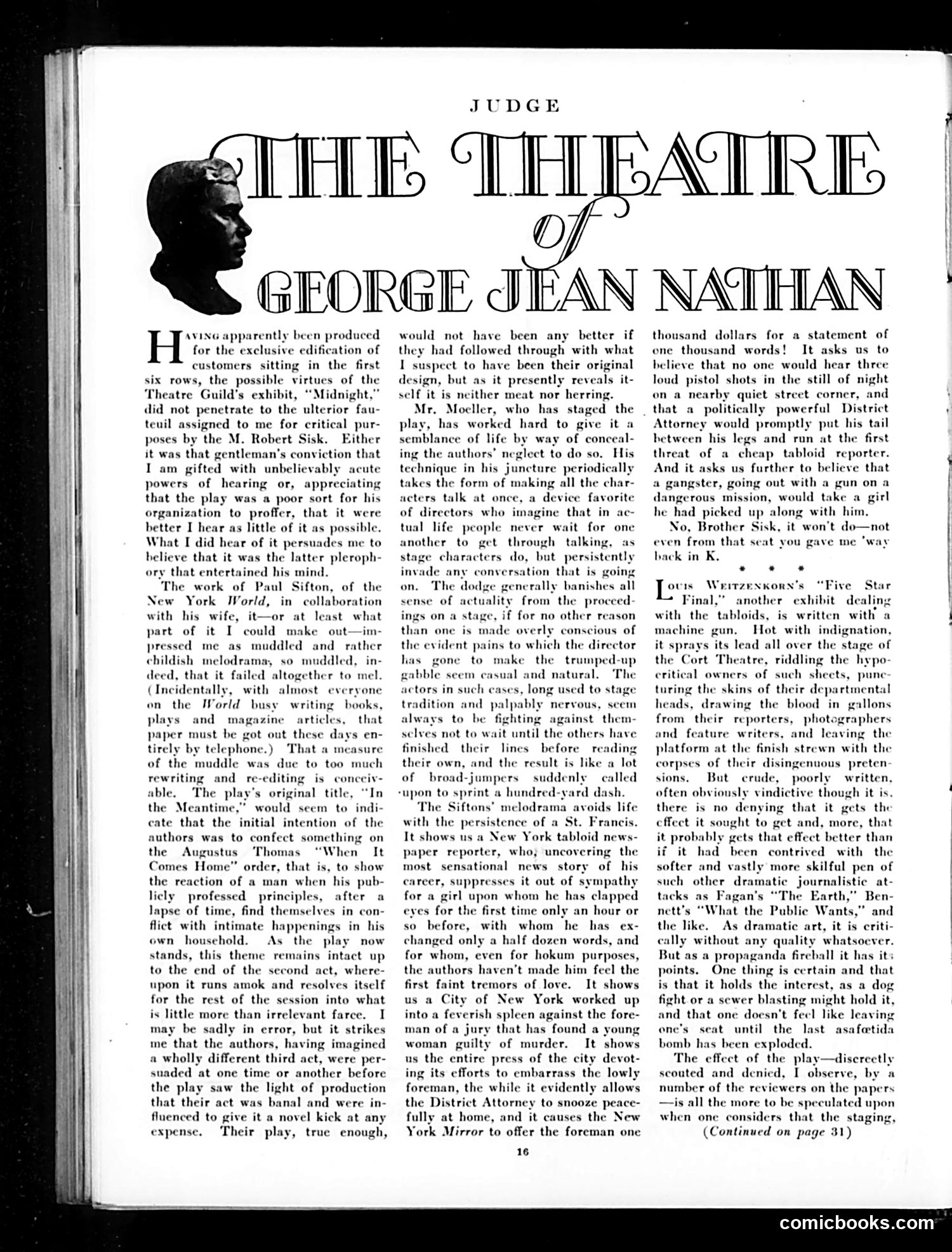
A restored page from Judge, 1931-01-24. Page through the whole issue in the reader above.
📄 Transcribed text from this page (OCR, searchable)
Machine-transcribed from the original scan — historical spelling and the odd misread are preserved.
AVING apparently been produced H for the exclusive edification of customers sitting in the first six rows, the possible virtues of the ‘Theatre Guild's exhibit, “Midnight,” did not penetrate to the ulterior fau- teuil assigned to me for critical pur- poses by the M. Robert Sisk. Either it was that tleman’, I am gifted with unbelievably acute powers of hearing or, appreciating that the play was a poor sort for his organization to proffer, that it were better I hear as little of it as possible. What I did hear of it persuades me to believe that it was the latter pleroph- ory that entertained his mind. The work of Paul Sifton, of the New York World, in collaboration with his wife, it—or at least what part of it I could make out—im- pressed me as muddled and. rather lish melodrama, so muddled, in- deed, that it failed altogether to mel. (Incidentally, with almost everyone on the World busy writing books, plays and m ine articles, that paper must be got out these days en- tirely by telephone.) That a measure of the muddle was due to too much rewriting and re-editin able. The play’s orig’ the Meantime,” would seem to indi- cate that the initial intention of the authors was to confect something on the Augustus Thomas “When It Comes Home” order, that is, to show the reaction of a man when his pub- licly professed after a lapse of time, find themselves in con- flict with intimate happenings in his own household. As the play now stands, this theme remains intact up to the end of the second act, where- upon it runs amok and resolves itself for the rest of the session into what is little more than irrelevant farce. I may be sadly in error, but it strikes me that the authors, ng imagined a wholly different third act, were per- suaded at one time or another before the play saw the light of production that their act was banal and were in- fluenced to give it a novel kick at any expense, Their p! is conceiv- al title, “In principles, true enough, JUDGE GEORGE J © would not have been any better if they had followed through with what I suspect to have been their original design, but as it presently rev i self it is neither meat nor herr Mr. Moeller, who has sta play worked hard to give it semblance of life by way of conceal- ing the authors’ neglect to do so. His technique in his juncture periodically takes the form of making all the cl acters talk at once, a device favorite of directors who im e that in a tual life people never wait for o another to get through talking, as stage characters do, but persistently invade on, TI nishes all sense of actuality from the proceed ings on a stage, if for no other reason than one is m. overly conscious of the evident pains to which the director has gone to make the trumped-up ual and natural. The actors in such cases, long used to stage tradition and palpably nervous, seem always to be fighting against them- s not to wait until the others have hed their lin before reading their own, and the result is like ¢ of broad-jumpers suddenly gabble seem c supon to sprint a hundred-yard dash. The Siftons’ melodrama avoids life with the persistence of a St. It shows us a New York tabloid news- paper reporter, who, uncovering the most sensational news story of his career, suppresses it out of sympathy for a girl upon whom he has clapped eyes for the first time only an hour or so before, with whom he has ex- changed only a half dozen words, and for whom, even for hokum purposes, the authors haven’t made him feel the first faint tremors of love. It shows us a City of New York worked up into a feverish spleen against the fore- an of a jury that has found a young woman guilty of murder. It shows us the entire press of the city devot- ing its efforts to embarrass the lowly foreman, the while it evidently allows the District Attorney to snooze peace- fully at home, and it causes the New York Mirror to offer the foreman one 16 ACRE NATHAN thousand dollars for a statement of one thousand words! It asks us to believe that no one would hear three loud pistol shots in the still of night on a nearby quiet street corner, and that a politically powerful District Attorney would promptly put his tail between his legs and run at the first threat of a cheap tabloid reporter. And it asks us further to believe that a gangster, going out with a gun on a dangerous mission, would take a girl he had picked up along with him. o, Brother Sisk, it won't do—not even from that seat you gave me ‘way back in K, | ts ive Star Final,” another exhibit dealing with the tabloids, is written with a hine gun. Hot with indignation, vs its lead all over the stage of ‘ort Theatre, riddling the hypo- al owners of such sheets, punc turing the skins of their departmental heads, drawing the blood in gallons from their reporters, phote and feature writ * 8 * Wreitzexkorn’s vhers and leaving the platform at the finish strewn with the corpses of their disingenuous preten sions. But crude, poorly written, often obviously vindictive though it is, there is no denying th effect it sought t t it gets the get and, more, that it pro ets that effect better than if it had been contrived with the softer and vastly more skilful pen of such other dramatic journalistic at- tacks as Fagan’s “The Earth,” Ben- nett’s “What the Public Wants,” the like. As dramatic art, i cally without an But as a prop: points. One thing is ce is that it holds the interest, as a de fight or a sewer blasting might hold and that one doesn’t feel like leay one’s seat until the last asafetida bomb has been exploded. The effect of the play—disercetly scouted and denied, I observe, by a number of the reviewers on the papers —is all the more to be speculated upon when one considers that the staging, (Continued on page 31) comicbooks.com