
Judge, 1931-01-24 · page 15 of 36
Judge — January 24, 1931 — page 15: what you’re looking at
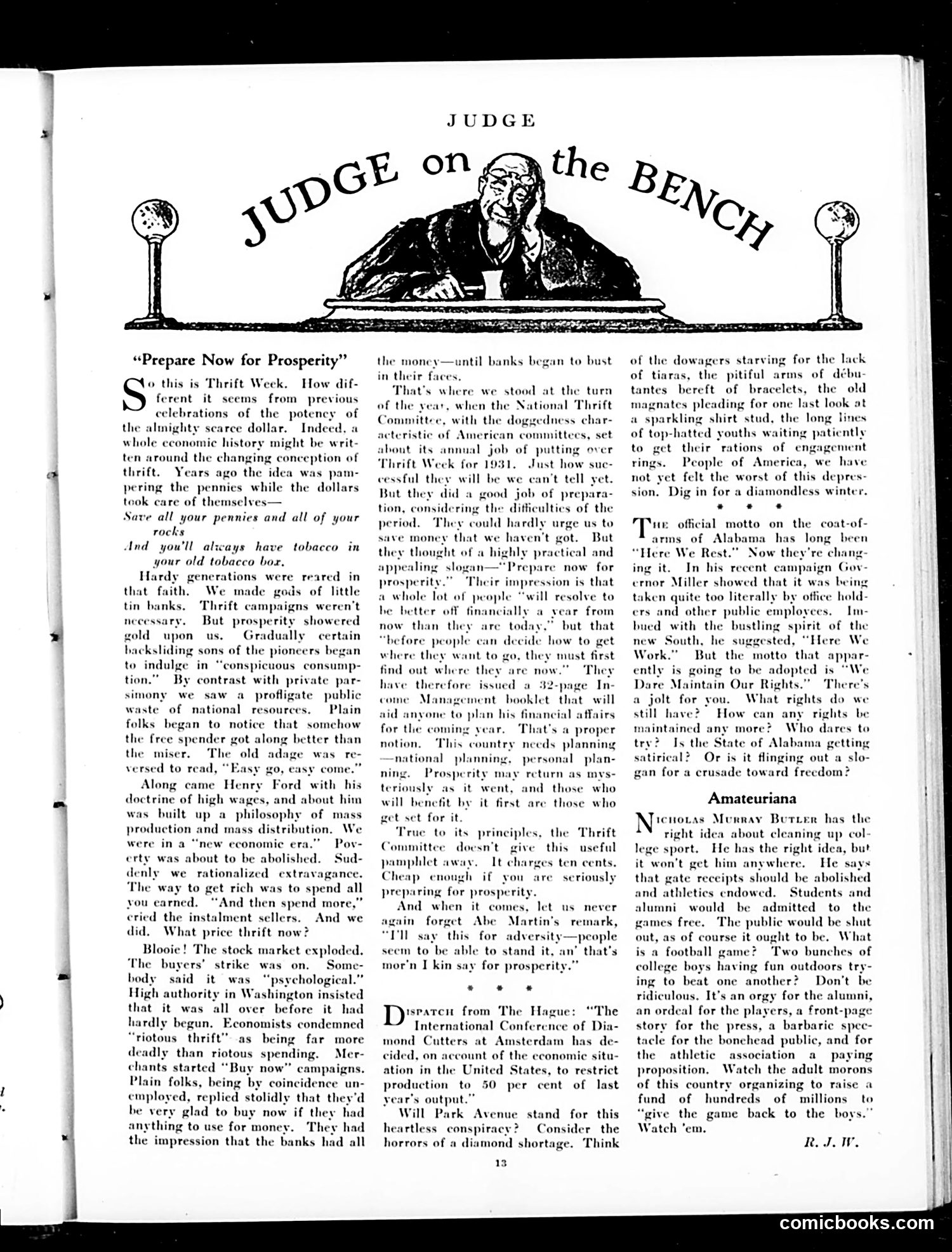
A restored page from Judge, 1931-01-24. Page through the whole issue in the reader above.
📄 Transcribed text from this page (OCR, searchable)
Machine-transcribed from the original scan — historical spelling and the odd misread are preserved.
JUDGE “Prepare Now for Prosperity” o this is Thrift Week. How dif- S ferent it seems from previous celebrations of the potency of the almighty scarce dollar. Indeed, « sle economic history might be writ- ten around the changing ception of thrift. Years ago the idea was pam- pering the pennies while the dollars took care of themselves— Save all your pennies and all of your rock: And you'll always have tobacco in your old tobacco box. Hardy gen rations were reared in that faith, We made gods of little tin banks. Thrift campaigns weren't necessary. But prosperity showered gold upon us. Gradually certain hacksliding sons of the pioncers be to indulge in “conspicuous consump- tion.” By contrast with private par- simony we saw a profligate public waste of national resources. Plain folks began to notice that somehow the free spender got along better th the miser. The was re: versed to read, Pasy come.” Along came Henry Ford with his doctrine of high wages, and about him was built up a philosophy of mass production and mass distribution. We were in a “new economic er: Pov- erty was about to be abolished. Sud- denly we rationalized extravagance. The way to get rich was to spend all you earned. “And then spend mor cried the instalment sellers. And we did. What price thrift now? Blooie! The stock market exploded, The buyers’ strike was on. Some- body said it was “psychological.” High authority in Washington insisted that it was all over before it had hardly begun. Economists condemned “riotous thrift’ as being far more deadly than riotous spending. Mer- chants started “Buy now” campaigns. Plain folks, being by coincidence un- employed, replied stolidly that they'd be very glad to buy now if they had anything to use for money. They had the impression that the banks had all the money—until banks began to bust in their faces, That's where we stood at the turn of the year, when the ional Thrift Commit with the doggedness cl acteristic of American committees, set about its annual job of putting over Thrift Week for 1931, Just how sue- cessful they will be we can’t tell yet. But they did a good job of prepara- tion, considering the diticulties of the period. They could hardly urge us to save money that we haven't got. But they thought of a highly practical and appealing slogan—"Prepare now for prosperity.” Their impression is that a whole lot of people “will resolve to he better off financially year from now than they are today,” but that “before people can decide how to get where they want to go, they must first find out where they are now." They have therefore issued a 32 In- come Management booklet that will aid anyone to plan his fi affairs for the coming year. proper notion. This country needs planning national planning, personal pls Prosperity may return as mys- teriously as it went, and those who t by it first are those who get set for it. Truc to its principles, the Thrift Committee doesn’t give this useful pamphlet away. It charges ten cents. Cheap enough if you are seriously preparing for prosperit And when it comes, let us never again forget Abe Martin's remark, “LM say this for adversity seem to be able to stand it, mor'n I kin say for prosperity. will bene people v” that’s * * «* Date from The F ne: “The International Conference of Dia- mond Cutters at Amsterdam has de- d, on account of the economic situ- ation in the United States, to restrict production to 50 per cent of last *s output.” Il Park Avenue stand for this heartless conspiracy? Consider the horrors of a diamond shortage. Think ers starving for the lack of tiaras, the pitiful arms of débu “ft of bracelets, the old tes pleading for one last look at a sparkling shirt stud, the long lines of top-hatted youths waiting patiently to get their rations of engagement rings. People of America, we have not yet felt the worst of this depres- sion. Dig in for a diamondless winter. * 28 « Te official motto on the coat-of- arms of Alabama has long | “Here We Rest.” Now they're chang ing it. In his ra ve ernor Miller showed that it was bei taken quite too literally by office hold- ers and other public employees. Im- bued with the bustling spirit of the uth, he suggested, “Here We But the motto that appa ently is going to be adopted is “W Dare Maintain Our Rights.” There's a jolt for you. What rights do we still have?” How can any rights be maintained any more? Who dares to try? Is the State of Alabama getting irical? Or is it flinging out a slo- n for a crusade toward freedom? Amateuriana Nictiouss Merray Butcer has the right idea about cleaning up col lege sport. He has the right idea, but it won't get him anywhere. He that gate receipts should be abolished and athletics endowed. Students and alumni would be admitted to the games free. The public would be shut out, as of course it ought to be. What is a football game? Two bunches of college boys having fun outdoors try- ing to beat one another? Don't be ridiculous. It’s an orgy for the alumni an ordeal for the pla story for the press. tacle for the bonchead public, and for the athletic association a paying proposition, Watch the adult morons of this country organizing to raise fund of hundreds of millions to “give the game back to the boys.” Watch ‘em. RIW. comicbooks.com