
Judge, 1931-01-17 · page 18 of 48
Judge — January 17, 1931 — page 18: what you’re looking at
A restored page from Judge, 1931-01-17. Page through the whole issue in the reader above.
📄 Transcribed text from this page (OCR, searchable)
Machine-transcribed from the original scan — historical spelling and the odd misread are preserved.
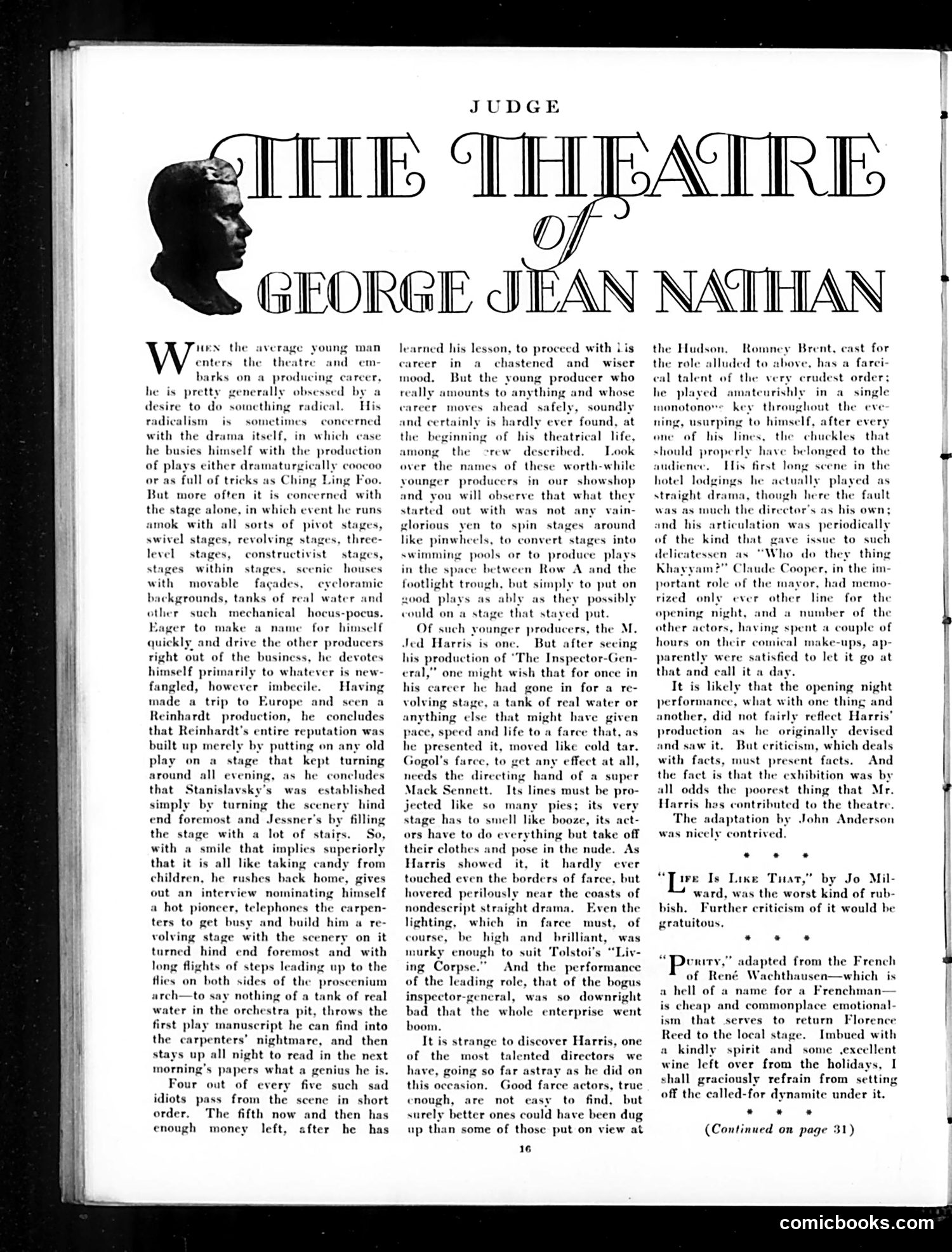
HEN the enters the th avers young man atre and em- barks on a producing carcer, he is pretty generally obsessed by a desire to do something radical, His radicalism is sometimes concerned with the drama itself, in which case he busies himself with the production of plays cither dramaturgically co or as full of tricks as Ching Ling But more often it is cor the stage alone, in which event he runs amok with all sorts of pivot stages, swivel stages, revolving stages, three- level stages, constructivist stages, stages within stages, scenic houses with movable fagades, cyeloramic backgrounds, tanks of real water and oth hanical hocus-pocus. Eager to make a name for himself quickly, and drive the other producers right out of the business, he devotes himself primarily to whatever is new- fangled, however imbecile. Having made a trip to Europe and seen a Reinhardt production, he concludes that Reinhardt's entire reputation was built up merely by putting on any old play on a stage that kept turning around all evening, as he concludes that Stanislavsky’s was established simply by turning the scenery hind end foremost and Jessner’s by filling the stage with a lot of stairs. So, with a smile that implies superiorly that it is all like taking candy from children, he rushes back home, gives out an interview nominating himself hot pioneer, telephones the carpen- ters to get busy and build him a re- volving stage with the scenery on it turned hind end foremost and with long flights of steps leading up to the flies on both sides of the proscenium arch—to say nothing of a tank of real water in the orchestra pit, throws the first play manuscript he can find into the carpenters’ nightmare, and then stays up all night to read in the next morning's papers what a genius he is. Four out of every five such sad idiots pass from the scene in short order. The fifth now and then has enough money left, after he has r such me JUDGE Is GEORGE J O learned his lesson, to proceed with Lis career in a chastened and wiser But the young producer who amounts to anything and whose moves ahead safely, soundly and certainly is hardly ever found, at the beginning of his theatrical life among the crew described. — Look over the names of these worth-while younger producers in our showshop and you will observe that what they started out with was not any vain- glorious yen to spin stages around like pinwheels, to convert stages into swimming pools or to produce plays in the space between Row A and the footlight trough, but simply to put on od plays as ably as they possibly could ona stage that stayed put. Of such younger producers, the M. Jed Harris is one. But after seeing his production of ‘The Inspector-Gen- eral,” one might wish that for once in his career he had gone in for a re- volving stage, a tank of real water or anything else that might have given pace, speed and life to a farce that, as he presented it, moved like cold tar. Gogol’s farce, to get any effect at all, needs the directing hand of a super Mack Sennett. Its lines must be pro- jected like so many pies; its very stage has to smell like booze, its act- ors have to do everything but take off their clothes and pose in the nude. As Harris showed it, it hardly ever touched even the borders of farce, but hovered perilously near the coasts of nondescript straight d Even the lighting, which in must, of course, be t, was murky enough to suit Tolstoi's “Liv- ing Corpse.” And the performance of the leading role, that of the bogus inspector-gencral, was so downright bad that the whole enterprise went boom. mood. reall s farce high and brill It is strange to discover Harris, one of the most talented directors we ve, going so far astray as he did on this occasion. Good farce actors, true cnough, are not easy to find, but surely better ones could have been dug up than some of those put on view at 16 ARES NACIHIAN the Hudson the role alluc eal talent Romney Brent, cast for rd to above, has - the very crudest order; he played amateurishly in a single monotonors key throughout the eve ning, usurping to himself, after every one of his lines, the chuckles that should properly have belonged to the audience. His first lon, hotel lodgings he actually played as straight drama, though here the fault was as much the director's as his own; and his articuls of the kind that gave issue to such delicatessen as “Who do they thing Khayyam?” Claude Cooper, in the im- portant role of the mayor, had memo- rized only ever other line for the opening night, and a number of the other actors, having spent a couple of hours on their comical make-ups, ap- parently were satisfied to let it go at seene in the v ion way periodically that and call it a day. It is likely that the opening night performance, what with one thing and another, did not fairly reflect Harris’ production as he originally and saw it. But criticism, which deals with facts, must present facts. And the fact is that the exhibition was by all odds the poorest thing that Mr. Harris has contributed to the theatre. The adaptation by John Anderson vas nicely contrived. Is Like Tuat,” by Jo Mil- ward, was the worst kind of ru Further criticism of it would be we bish, gratuitous, * 8 © adapted from the French achthausen—which is a hell of a name for a Frenchman. is cheap and commonplace emotional- ism that serves to return Florence Reed to the local stage. Imbued with a kindly spirit and some excellent wine left over from the holidays, I shall graciously refrain from setting off the called-for dynamite under it. “ # (Continued on page 31) comicbooks.com