
Judge, 1931-01-17 · page 15 of 48
Judge — January 17, 1931 — page 15: what you’re looking at
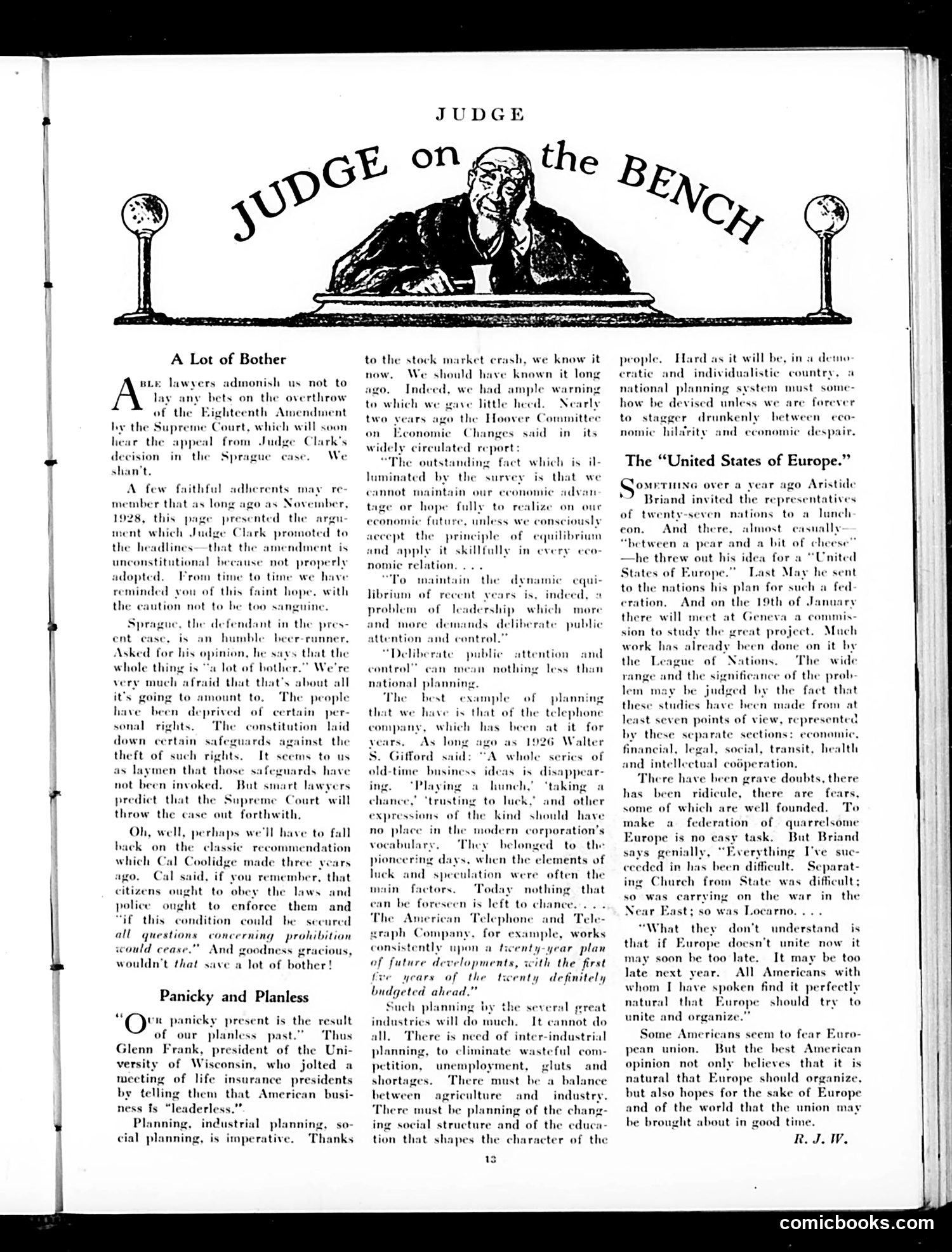
A restored page from Judge, 1931-01-17. Page through the whole issue in the reader above.
📄 Transcribed text from this page (OCR, searchable)
Machine-transcribed from the original scan — historical spelling and the odd misread are preserved.
JUDGE A Lot of Bother nie lawyers admonish us not to A lay any bets on the overthrow of the Eighteenth Amendment hy the Supreme Court, which will soon hear the appeal from Judge Clark's decision in’ the Spr se. We shan't. A few faithful adherents may re nber that as long a 1928, this p: presented the arg ment which Judge Clark promoted to the headlines—that the unconstitutional bees November, amendment. is se not properly adopted. From time to time we have reminded vou of this faint hope, with ition not to be too sanguine. the « ague, the defendant in the pres- ent case, is an humble beer-runner, Asked for his opinion, he says that the whole thing is lot of bother.” We're fraid that that’s about all to amount to. The people been deprived of certain” per- rights. The constitution laid down certain safeguards against the theft of such rights. It seems to us as laymen that those safeguards have not been inv very much it’s goin hav ed. But smart lawyers predict that the Supreme Court. will throw the case out forthwith, Oh, well, perhaps we'll have to fall back on the classic which Cal Coolidge made three ye: go. Cal said, if you remember, t citizens ought to obey the laws and police ought to enforce them and ‘if’ this condition could be secured all questions concerning prohibition would cease.” And wouldn't that save oodness gracious, a lot of bother! Panicky and Planless “Cy)en panicky present is the result O of our planless past.” Thus ank, president of the Uni- of Wisconsin, who jolted a meeting of life insurance presidents by telling them that American. busi- ness fs “leade Planning, Glenn versity to the stock market crash, we know it now, We atiould have known long Indeed, we had ample warning to which we gave little heed. arly two ¥ ago the Hoover Committee Changes said in’ its ly circulated report: : outstanding fact which is il luminated by the survey is that we cannot maintain our © or hoy momic advan fully to realize on our mie future. unless w pt the principle of and apply it: skillfully nomic re psciously quilit in every eco- acc ation. oo omaintain the dynamie equi- librium of recent years is, indeed, problem of leadership which more and more demands deliberate public attention and control.” “Deliberate control” public attention and can mean nothing less than national planning. The best example of planning that we have is that of the telephone company, whieh has 1 at it for years, As long Walter S. Gifford said: series of old-time business ideas is disapp ing. ‘Playing a hunch,’ ‘takin * ‘trusting to luck, and other ssions of the kind should have no place in the modern corporation's pul They belonged to the pioneering days, when the elements of luck and speculation were often the main factors. ‘Today nothing that in be foreseen is left to chance... . he American Telephone and Te ph Company, for example, works consistently upon a ticenty-year plan of future developments, with the first nears of the budgeted ahead.” Such planning by the several great industries will do much. It cannot do Il. There is need of inter-industrial to climinate wasteful com- unemployment, gluts and ss. There must be a balance griculture and industry must be planning of the ch jal structure and of the educa- tion that shapes the character of the une exp ve enty definitely shorta, hetwy 13 Hard as it will be cratic ds individualistic country, a national planning system must some- how be devised unless we a deme people. are forever to stagger drunkenly betw nomic hilarity and economic despair. The “United States of Europe.” Sosetiuse over a year ago Aristide ‘Briand invited the representatives of twenty-seven nations to a lunch eon, And there, “between a pear and a bit of cheese” —he threw out his idea for a “United States of Europe.” Last May he sent to the nations his plan for such a fed eration, And on the 19th of January there will meet at Genev sion to study the work has already the I almost casually commis et. Much en done on it by igue of Nations. The wide nd the si nee of the prob be judged by the fact that these studies have been made from least seven points of view, represented by these separate sections: econor financial, » social, transit, health and intellectual coépera There have been grave doubts, there has been ridicule, there are fes some of which are well founded. To make a federation of quarrelsome Europe is no easy task. But Briand says genially, “Everything I've suc- ceeded in has been difficult. Separat- ing Church from State difficult; carrying on the war in’ the r East; so was Locarno, .. jon, so was don’t understand — is that if Europe doesn't unite now it may soon be too late. It may be too late next y All Americans with whom I have spoken find it perfectly natural that) Europ unite and organ Some An pean union. should try to ricans seem to fear Euro- But the best Amer opinion not only believes that it is natural that Europe should org: but also hopes for the sake of Europe and of the world that the union may he brought about in good time. R.JLW. comicbooks.com