
Judge, 1931-01-03 · page 18 of 36
Judge — January 3, 1931 — page 18: what you’re looking at
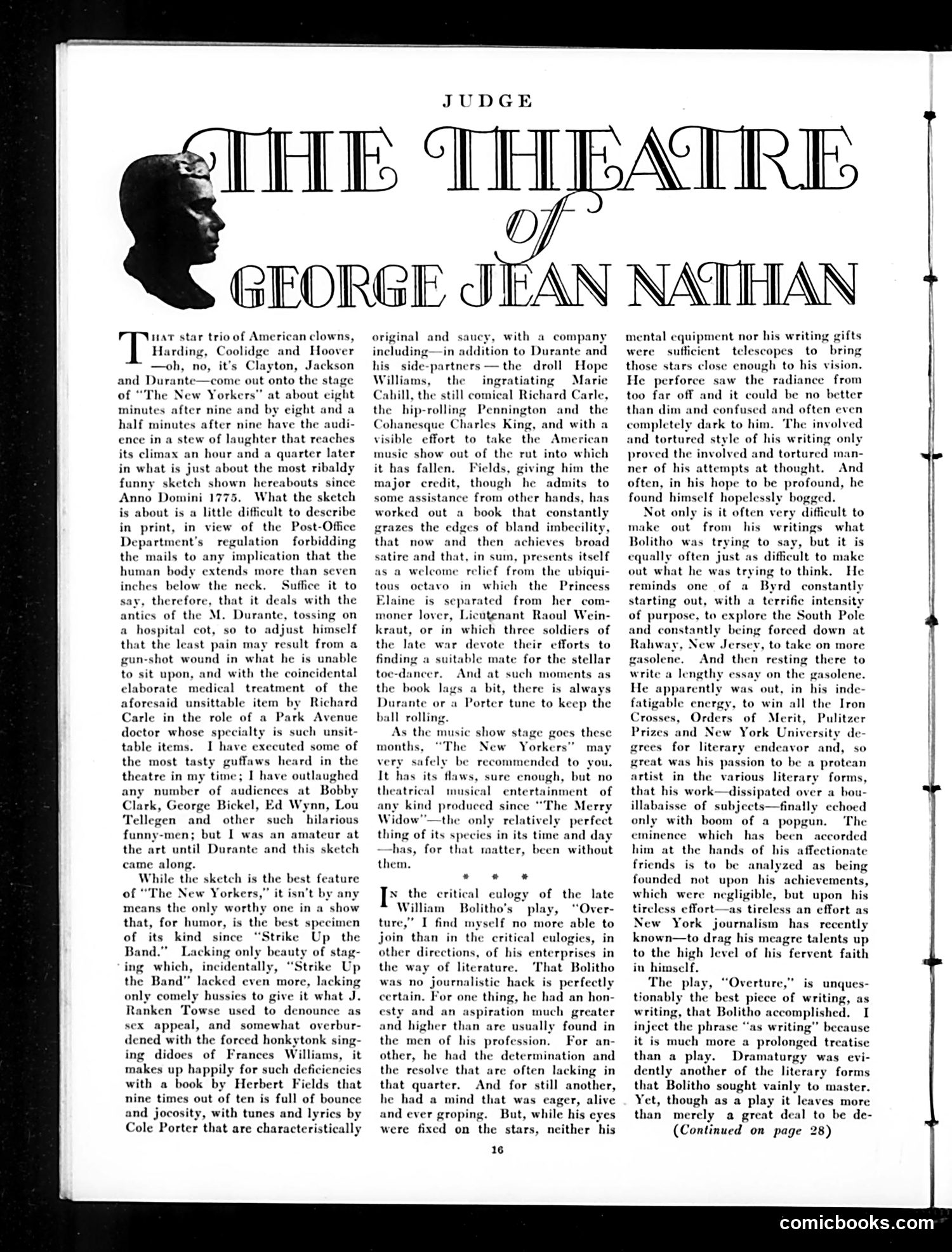
A restored page from Judge, 1931-01-03. Page through the whole issue in the reader above.
📄 Transcribed text from this page (OCR, searchable)
Machine-transcribed from the original scan — historical spelling and the odd misread are preserved.
nat star trioof American clowns, Harding, Coolidge and Hoover —oh, no, it’s Clayton, Jackson and Durante—come out onto the stat of “The New Yorkers” at about eight minutes after nine and by eight and a half minutes after nine have the audi- ence ina stew of laughter that reaches its climax an hour and a quarter later in what is just about the most ribaldy funny sketch shown hereabouts since Anno Domini 5. What the sketch is about is a little difficult to describe in print, in view of the Post-Office Department's regulation forbidding the mails to any implication that the human body extends more than seven inches below the neck. Suffice it to therefore, that it deals with the antics of the M. Durante, tossing on a hospital cot, so to adjust himself that the least p: y result from a gun-shot wound in what he is unable to sit upon, and with the coincidental elaborate medical treatment of the aforesaid unsittable item by Richard Carle in the role of a Park Avenue doctor whose specialty is such unsit- table items. I have executed some of the most tasty guffaws heard in the theatre in my time; I have outlaughed any number of audiences at Bobby Clark, George Bickel, Ed Wynn, Lou Tellegen and other such hilari funny-men; but I was an amateur at the art until Durante and this sketch came along. While the sketch is the best feature of “The New Yorkers,” it isn’t b iy means the only worthy one in a show that, for humor, is the best specimen of its kind since “Strike Up the Band.” Lacking only beauty of s ing which, incidentally, “Strike Up the Band” lacked even more, lacking only comely hussies to give it what J. Ranken Towse used to denounce as sex appeal, and somewhat overbur- dened with the forced honkytonk sing- ing didoes of Frances Williams, it makes up happily for such deficiencies with a book by Herbert Fields that nine times out of ten is full of bounce and jocosity, with tunes and lyrics by Cole Porter that are chars isti JUDGE ks GEORGE J OD original and saucy, with a company including—in addition to Durante and ide-partners — the droll Hope the ingratiating Marie Cahill, the still comical Richard Carle, the hip-rolling Pennington and the Cohanesque Charles King, and with a visible effort to take the American music show out of the rut into which it has fallen. Fields, giving him the major credit, though he admits to some assistance from other hands, has worked out a book that constantly azes the edges of bland imbecility, that now and then achieves broad satire and that, in sum, presents itself as a welcome relief from the ubiqui- tous octavo in which the Prine Elaine is separated from her com- moner lover, Licutenant Raoul Wein- kraut, or in which three soldiers of the ¢ war devote their efforts to finding a suitable mate for the stella toe-dancer. And at such moments the book lags a bit, there is always Durante or a Porter tune to keep the ball rolling. SS As the music show stage gocs these months, “The New Yorkers” may very safely be recommended to you. It has its flaws, sure enough, but no theatrical musical entertainment of any kind produced since “The Merry Widow'—the only relatively perfect thing of its species in its time and day has, for that matter, been without them. * 8 © Is the critical eulogy of the late William Bolitho’s play, “Over- ture,” I find myself no more able to join than in the critical eulogies, in other directions, of his enterprises in the way of literature. ‘T Bolitho > journalistic hack is perfectly certain. For one thing, he had an hon- esty and an aspiration much greater and higher than are usually found in the men of his profession. For other, he had the determination and the resolve that are often lacking in that quarter. And for still another, he had a mind that was eager, alive and ever groping. But, while his ey were fixed on the stars, neither his 16 AIRE: NATHAN mental equipment nor his writing gifts were sutlicient telescopes to bring those stars close enough to his vision. He perforce saw the radiance from too far off and it could be no better than dim and confused and often even completely dark to him. The involved and tortured style of his writing only proved the involved and tortured man- ner of his attempts at thought. And often, in his hope to be profound, he found himsclf hopelessly bogged. Not only is it often very difficult to make out from his writings what Bolitho was trying to say, but i equally often just as difficult to make out what he was trying to think. He reminds one of a Byrd constantly starting out, with a terrific intensity of purpose, to explore the South Pole and constantly being forced down at Rahway, New Jersey, to take on more And then resting there to lengthy essay on the gasolene. He apparently was out, in his inde- fatigable energy, to win all the Iron Crosses, Orders of Merit, Pulitzer Prizes and New York University de- grees for literary endeavor and, so great was his passion to be a protean artist in the various literary forms, that his work—dissipated over a bou- ilabaisse of subjects—finally echoed only with boom of a popgun. The eminence which has been him at the hands of his affectionate friends is to be analyzed as being founded not upon his achievements, which were negligible, but upon his tireless effort—as tireless an effort as has_ recently known—to drag his meagre talents up to the high level of his fervent faith in himself. The play, “Overture,” is unques- tionably the best piece of writing, as writing, that Bolitho accomplished. I inject the phrase “as writing” because it is much more a prolonged treatise than a play. Dramaturgy was evi- dently another of the lite that Bolitho sought vainly to master. Yet, though as a play it leaves more than mercly a great deal to be de- (Continued on page 28) accorded forms comicbooks.com