
Judge, 1930-11-29 · page 10 of 36
Judge — November 29, 1930 — page 10: what you’re looking at
What you’re looking at
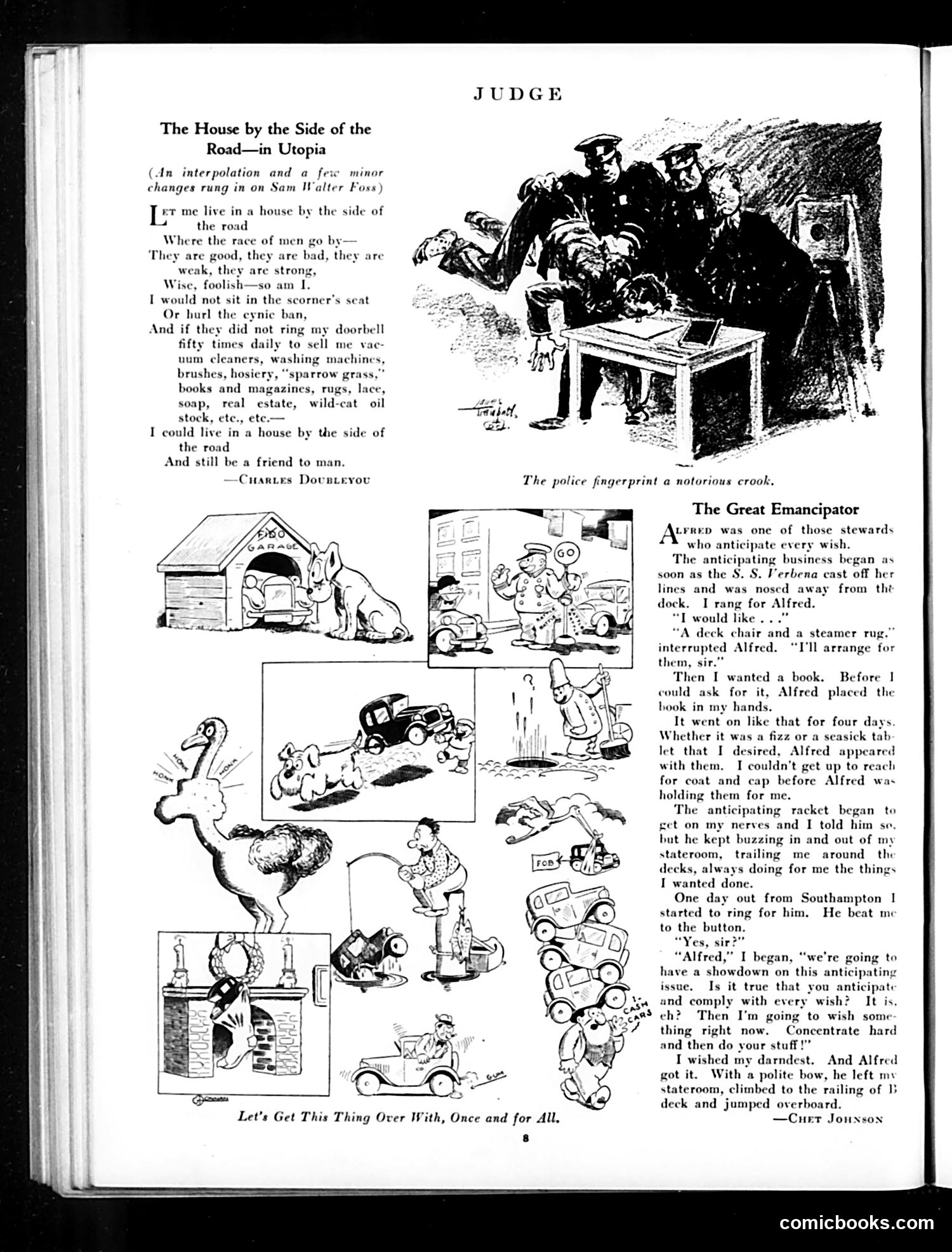
# Analysis: Judge Magazine Page This page contains two satirical pieces reflecting early 20th-century consumer anxieties. **"The House by the Side of the Road"** parodies Sam Walter Foss's sentimental poem about rural hospitality. The satire inverts the original: instead of welcoming travelers, the poet fantasizes about escaping modern **door-to-door salesmen** hawking vacuum cleaners, washing machines, and dubious investments ("wild-cat oil stock"). It mocks the aggressive commercialism and consumer culture invading American life. **"The Great Emancipator"** satirizes the opposite problem: obsessive personal service. A ship's steward named Alfred anticipates every wish so relentlessly that he becomes maddening—the passenger can't even reach for his own coat. The joke's dark punchline: the only way to escape this "anticipating racket" is suicide. The title ironically names the steward as "emancipator" only through death. Both pieces express modern anxieties about loss of autonomy—either from pushy commercialism or smothering service—reflecting concerns about industrial society's grip on personal freedom.
📄 Transcribed text from this page (OCR, searchable)
Machine-transcribed from the original scan — historical spelling and the odd misread are preserved.
JUDGE The House by the Side of the Road—in Utopia (An interpolation and a few minor changes rung in on Sam Walter Foss) et me live in a house by the side of 4 the road Wise, foolish I would not sit in the scorner’s seat Or hurl the eynic ban, And if they did not ring my doorbell fifty times daily to sell me vac- uum cleaners, washing machines, brushes, hosiery, “sparrow grass,” books and magazines, rugs, lace, soap, real estate, wild-cat oil stock, ete., ete— I could live in a house by the side of the road And still be a friend to man. Cuantes Dovntevou The police fingerprint a notorious crook. The Great Emancipator Avrreo was one of those stewards who anticipate every wish. The ant ting business began as soon as the Verbena cast off her lines and was nosed away from tht dock. I rang for Alfred. “T would like...” “A deck ch nd a steamer rug.” interrupted Alfred. “I'll arrange for them, sir.’ hen I wanted a book. Before 1 could ask for it, Alfred placed the book in my hands. It went on like that for four days. Whether it was a fizz or a seasick tab let that I desired, Alfred appeared with them, I couldn't get up to reach for coat and cap before Alfred was holding them for me. The anticipating racket began to get on my nerves and I told him se, but he kept buzzing in and out of my stateroom, trailing me around the decks, always doing for me the things I wanted done. One day out from Southampton | started to ring for him. He beat m« to the button. “Yes, sir?” “Alfred,” I began, “we're going to have a showdown on this antici ff issue. Is it true that you anticipate and comply with every wish? It is. ch? Then I’m going to wish some thing right now. Concentrate hard and then do your stuff!” I wished my darndest. And Alfred got it. With a polite bow, he left mv eroom, climbed to the railing of 1 and jumped overboard. —Cuer Jouxson comicbooks.com