
Judge, 1930-11-08 · page 18 of 36
Judge — November 8, 1930 — page 18: what you’re looking at
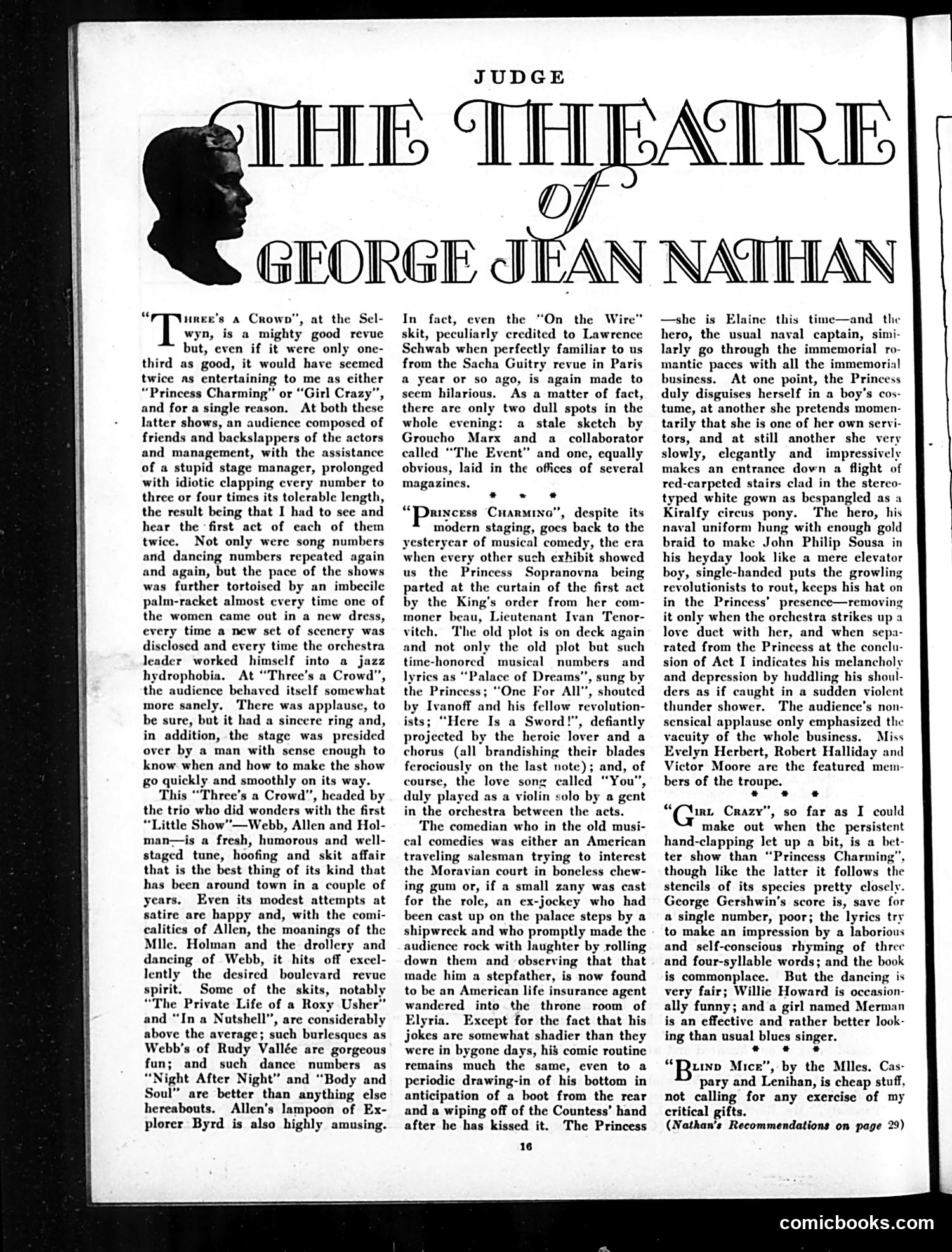
A restored page from Judge, 1930-11-08. Page through the whole issue in the reader above.
📄 Transcribed text from this page (OCR, searchable)
Machine-transcribed from the original scan — historical spelling and the odd misread are preserved.
JUDGE li “TEL ARE GEORGE JEAN NAGIHAN uree’s a Crown", at the Sel- wyn, is a mighty good revue but, even if it were only one- third as good, it would have seemed twice as entertaining to me as either “Princess Charming” or “Girl Crazy”, and for a single reason. At both these latter shows, an audience composed of friends and backslappers of the actors and management, with the assistance of a stupid stage manager, prolonged with idiotic clapping every number to three or four times its tolerable length, the result being that I had to see and hear the ‘first act of each of them twice. Not only were song numbers and dancing numbers repeated again and again, but the pace of the shows was further tortoised by an imbecile palm-racket almost every time one of the women came out in a new dress, every time a new set of scencry was disclosed and every time the orchestra leader worked himself into a jazz hydrophobia. At “Three’s a Crowd”, the audience behaved itself somewhat more sanely, There was applause, to be sure, but it had a sincere ring and, in addition, the stage was presided over by a man with sense enough to know when and how to make the show go quickly and smoothly on its way. This ‘‘Three’s a Crowd”, headed by the trio who did wonders with the first “Little Show”—Webb, Allen and Hol- man—is a fresh, humorous and well- staged tune, hoofing and skit affair that is the best thing of its kind that has been around town in a couple of years. Even its modest attempts at satire are happy and, with the comi- calitics of Allen, the moanings of the Mlle. Holman and the drollery and dancing of Webb, it hits off excel- lently the desired boulevard revue spirit. Some of the skits, notably “The Private Life of a Roxy Usher” and “In a Nutshell”, are considerably above the average; such burlesques as Webb’s of Rudy Vallée are gorgeous fun; and such dance numbers as “Night After Night” and “Body and Soul” are better than anything else hereabouts. Allen’s lampoon of Ex- plorer Byrd is also highly amusing. In fact, even the “On the Wire” skit, peculiarly credited to Lawrence Schwab when perfectly familiar to us from the Sacha Guitry revue in Paris a year or so ago, is again made to seem hilarious. As a matter of fact, there are only two dull spots in the whole evening: a stale sketch by Groucho Marx and a_ collaborator called “The Event” and one, equally obvious, laid in the offices of several magazines, - « “Draixcess Cuarmine”, despite its modern staging, gocs back to the yesteryear of musical comedy, the era when every other such exhibit showed us the Princess Sopranovna being parted at the curtain of the first act by the King’s order from her com- moner beau, Lieutenant Ivan Tenor- vitch, The old plot is on deck again and not only the old plot but such time-honored musical numbers and lyrics as “Palace of Dreams”, sung by the Princess; “One For All”, shouted by Ivanoff and his fellow revolution- ists; “Here Is a Sword!”, defiantly projected by the heroic lover and a chorus (all brandishing their blades ferociously on the last note); and, of course, the love song called “You”, duly played as a violin solo by a gent in the orchestra between the acts. The comedian who in the old musi- cal comedies was either an American traveling salesman trying to interest the Moravian court in boneless chew- ing gum or, if a small zany was cast for the role, an ex-jockey who had been cast up on the palace steps by a shipwreck and who promptly made the audience rock with laughter by rolling down them and observing that that made him a stepfather, is now found to be an American life insurance agent wandered into the throne room of Elyria. Except for the fact that his jokes are somewhat shadier than they were in bygone days, hi§ comic routine remains much the same, even to a periodic drawing-in of his bottom in anticipation of a boot from the rear and a wiping off of the Countess’ hand after he has kissed it. The Princess 16 —she is Elaine this time—and the hero, the usual naval captain, simi- larly go through the immemorial ro- mantic paces with all the immemorial business. At one point, the Princess duly disguises herself in a boy's cos- tume, at another she pretends momen- tarily that she is one of her own servi- tors, and at still another she very slowly, elegantly and_ impressively makes an entrance down a flight of red-carpeted stairs clad in the stereo- typed white gown as bespangled as a Kiralfy circus pony. The hero, his naval uniform hung with enough gold braid to make John Philip Sousa in his heyday look like a mere elevator boy, single-handed puts the growling revolutionists to rout, keeps his hat on in the Princess’ presence—removing it only when the orchestra strikes up a love duct with her, and when sepa- rated from the Princess at the conclu- sion of Act I indicates his melancholy and depression by huddling his shoul- ders as if caught in a sudden violent thunder shower. The audience's non- sensical applause only emphasized the vacuity of the whole business. Miss Evelyn Herbert, Robert Halliday and Victor Moore are the featured mem- bers of the troupe. * * * “Cnt Crazy”, so far as I could make out when the persistent hand-clapping let up a bit, is a bet- ter show than “Princess Charming”, though like the latter it follows the stencils of its species pretty closely. George Gershwin’s score is, save for a single number, poor; the lyrics try to make an impression by a laborious and self-conscious rhyming of three and four-syllable words; and the book is commonplace. But the dancing is very fair; Willie Howard is occasion- ally funny; and a girl named Merman is an effective and rather better look- ing than usual blues singer. * * “Bunn Mice”, by the Miles. Cas- pary and Lenihan, is cheap stuff, not calling for any exercise of my critical gifts. (Nathan's Recommendations on page 29) comicbooks.com