
Judge, 1930-11-08 · page 15 of 36
Judge — November 8, 1930 — page 15: what you’re looking at
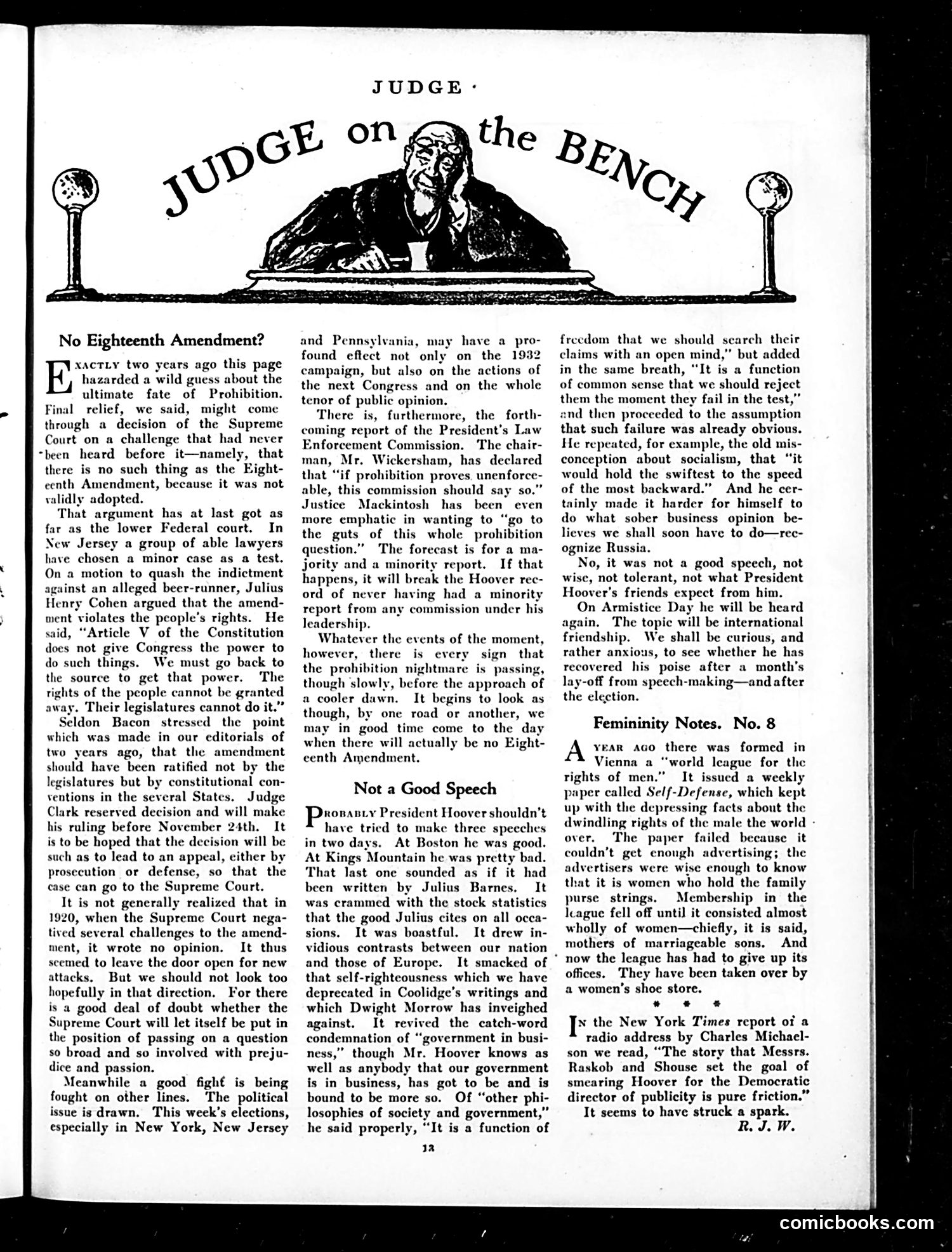
A restored page from Judge, 1930-11-08. Page through the whole issue in the reader above.
📄 Transcribed text from this page (OCR, searchable)
Machine-transcribed from the original scan — historical spelling and the odd misread are preserved.
No Eighteenth Amendment? | ree two years ago this page hazarded a wild guess about the ultimate fate of Prohibition. Final relief, we said, might come through a decision of the Supreme Court on a challenge that had never been heard before it—namely, that there is no such thing as the Eight- eenth Amendment, because it was not validly adopted. That argument has at last got as far as the lower Federal court. In New Jersey a group of able lawyers have chosen a minor case as a test. On a motion to quash the indictment against an alleged beer-runner, Julius Henry Cohen argued that the amend- ment violates the people's rights. He said, “Article V of the Constitution does not give Congress the power to do such things. We must go back to the source to get that power. The tights of the people cannot be granted away. Their legislatures cannot do it.” Seldon Bacon stressed the point which was made in our editorials of two years ago, that the amendment should have been ratified not by the legislatures but by constitutional con- ventions in the several States. Judge Clark reserved decision and will make his ruling before November 24th. It is to be hoped that the decision will be such as to lead to an appeal, either by prosecution or defense, so that the case can go to the Supreme Court. It is not generally realized that in 1920, when the Supreme Court nega- tived several challenges to the amend- ment, it wrote no opinion. It thus ‘med to leave the door open for new ks. But we should not look too hopefully in that direction. For there is a good deal of doubt whether the Supreme Court will let itself be put in the position of passing on a question so broad and so involved with preju- dice and passion. Meanwhile a good fight is being fought on other lines. The political issue is drawn. This week's elections, especially in New York, New Jersey and Pennsylvania, may have a pro- found eftect not only on the 1932 campaign, but also on the actions of the next Congress and on the whole tenor of public opinion. There is, furthermore, the forth- coming report of the President’s Law Enforcement Commission. The chair- man, Mr. Wickersham, has declared that “if prohibition proves. unenforce able, this commission should say so.” Justice Mackintosh has been even more emphatic in wanting to “go to the guts of this whole prohibition question.” The forecast is for a ma- jority and a minority report. If that happens, it will break the Hoover rec- ord of never having had a minority report from any commission under his leadership. Whatever the events of the moment, however, there is every sign that the prohibition nightmare is passing, though slowly, before the approach of a cooler da It begins to look as though, by one road or another, we may in good time come to the day when there will actually be no Eight- eenth Amendment. Not a Good Speech Pronaney President Hoover shouldn’t have tricd to make three speeches in two day At Boston he was good. At Kings Mountain he was pretty bad. That last one sounded as if it had been written by Julius Barnes. It was crammed with the stock statistics that the good Julius cites on all occa- sions. It was boastful. It drew in- vidious contrasts between our nation and those of Europe. It smacked of that self-righteousness which we have deprecated in Coolidge’s writings and which Dwight Morrow has inveighed against. It revived the catch-word condemnation of “government in busi- ness,” though Mr. Hoover knows as well as anybody that our government is in business, has got to be and is bound to be more so. Of “other phi- losophies of society and government,” he said properly, “It is a function of 312 freedom that we should search their an open mind,” but added in the same breath, “It is a function of common sense that we should reject them the moment they fail in the test,” and then proceeded to the assumption that such failure was already obvious. He repeated, for example, the old mis- conception about socialism, that “it would hold the swiftest to the speed of the most backward.” And he cer- tainly made it harder for himself to do what sober business opinion be- lieves we shall soon have to do—rec- ognize Russia. No, it was not a good speech, not wise, not tolerant, not what President Hoover's friends expect from him. On Armistice Day he will be heard again. The topic will be international friendship. We shall be curious, and rather anxious, to see whether he has recovered his poise after a month’s lay-off from speech-making—and after the election. Femininity Notes. No. 8 A YEAR AGo there was formed in Vienna a “world league for the rights of men.” It issued a weekly paper called Self-Defense, which kept up with the depressing facts about the dwindling rights of the male the world over. The paper failed because it couldn't get enough advertising; the advertisers were wise enough to know that it is women who hold the family purse strings. Membership in the Icague fell off until it consisted almost wholly of women—chiefly, it is said, mothers of marriageable sons, And now the league has had to give up its offices. They have been taken over by a women’s shoe store. * *# s the New York Times report of a radio address by Charles Michael- son we read, “The story that Messrs. Raskob and Shouse set the goal of smearing Hoover for the Democratic director of publicity is pure friction.” It seems to have struck a spark. R.J.W. comicbooks.com