
Judge, 1930-11-01 · page 18 of 36
Judge — November 1, 1930 — page 18: what you’re looking at
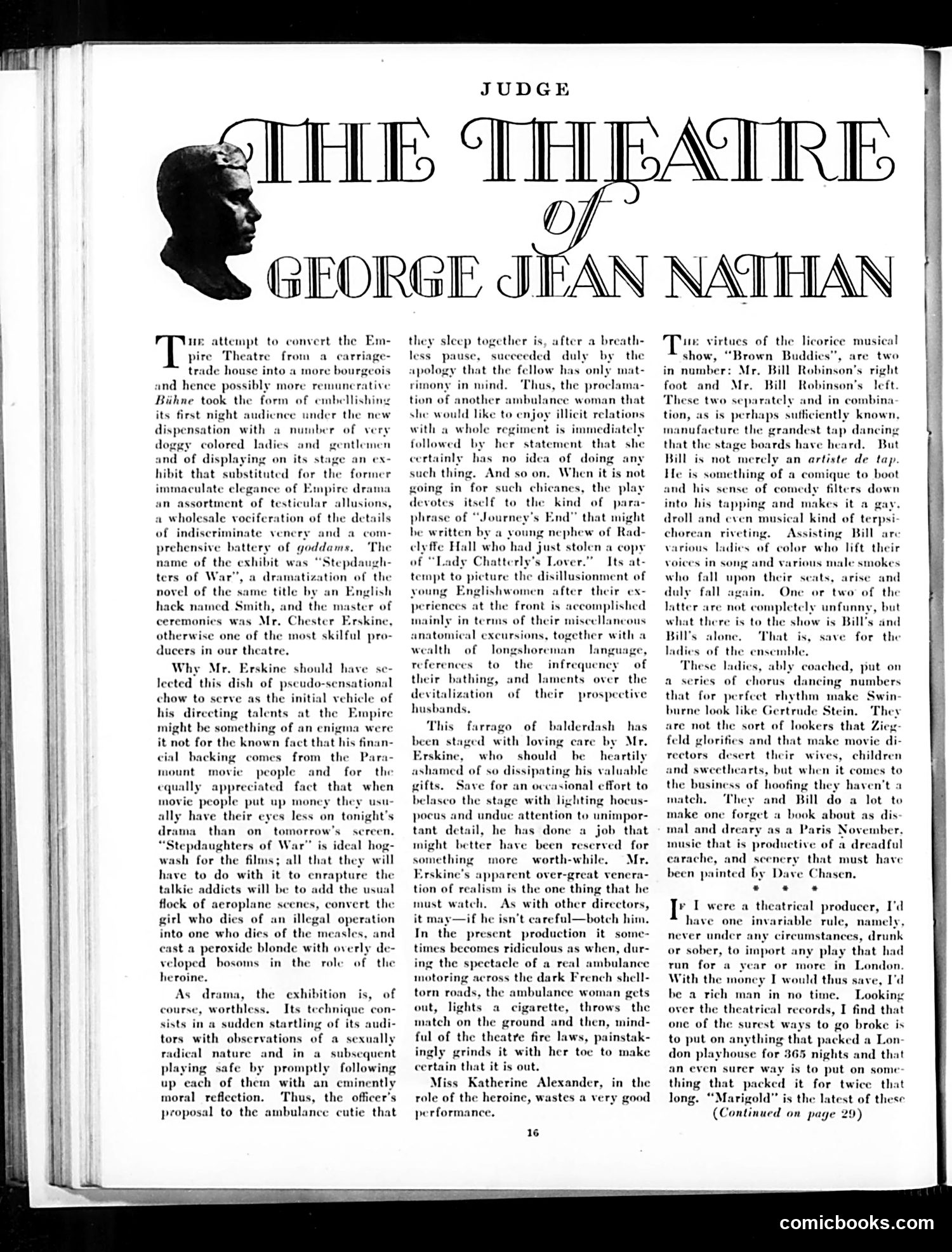
A restored page from Judge, 1930-11-01. Page through the whole issue in the reader above.
📄 Transcribed text from this page (OCR, searchable)
Machine-transcribed from the original scan — historical spelling and the odd misread are preserved.
HF attempt to convert the Em- pire Theatre from a carria trade house into a more bou and hence possibly more remunc Biihne took the form of embellishing its first night audience under the new dispensation with a number of very doggy colored ladies and gentlemen and of displaying on its stage an ex- hibit that substituted for the former immaculate elegance of Empire drama an assortment of testicular allusions, a wholesale vociferation of the details of indiscriminate venery and a com- prehensive battery of goddams, The name of the exhibit was “Stepdaugh- ters of War’, a dramatization of the novel of the same title by an E hack named Smith, and the 1 ceremonies was Mr. Chester Erskine, otherwise one of the most skilful pro- ducers in our theatre, Why Mr. Erskine should have se- lected this dish of pseudo-sensational chow to serve as the jal vehicle of his directing ts Empire might be somethin it not for the known fact that his finan- cial backing comes from the Ps mount = movie People and for the appreciated fact that when people put up money they usu- y have their eyes less on tonight's 1 than on tomorrow's sere “Stepdaughters of War” is ideal h wash for the films; all that they will have to do with it to ecnrapture the talkie addicts will be to add the usual flock of aeroplane scenes, convert the gitl who dies of an illegal ope into one who dies of the measle cast a peroxide blonde with overly de- veloped bosoms in the role of the heroine. As drama, the exhibition is, of rse, worthless. Its technique ¢ sists in a sudden startling of its audi- tors with observations of a sexually radical nature and in a subsequent playing safe by promptly following up each of them with an cminently moral reflection. Thus, the officer's proposal to the ambulance cutie that ¢ JUDGE We GEORGE J 0 they sleep together is, after a breath- duly by the less pause, succeeded apology that the fellow h: rimony in mind. ‘Thus, th tion of anothe: nbu she would like to enjoy with a whole regiment is immediately followed by her statement that she certainly has no idca of doing any such thi And so on, When it is not ng in for such chicanes, the play otes itself to the kind of p > of “Journey's End” that might he written by a young nephew of Rad- clyffe Hall who had just stolen a copy f “Lady Chatterly’s Lover.” Its at- ure the disillusionment of ishwomen after their ex- periences at the front is accomplished mainly in terms of their miscellancous anatomical excursions, together with a wealth of longshoreman language, references to. the infrequency of their bathing, and laments over the i of their prospective Hicit rel This been st Erskine, alderdash has dd with loving care by Mr. who should be heartily ashamed of so dissipating his valuable gifts. Save for an occasional effort to belasco the stage with lighting hocus- pocus and undue attention to unimpor- tant detail, he has done a job that might better have been reserved for something worth-wh Mr. Erskine’s apparent over-great venera- tion of realism is the one thing that he must ws As with other directors, it may—if he isn’t careful—botch him. In the present production it some- times becomes ridiculou: when, dur- the spectacle of a real ambulance motoring across the dark French shell- torn roads, the ambulance woman gets out, lights a cigarette, throws the match on the ground and then, mind- ful of the theatre fire laws, painstak- ingly grinds it with her toe to make certain that it is out. Miss Katherine Alexander, in the role of the heroine, wastes a very good performance, farrago of more 16 ACRE NACIHIAN | ite virtues of the show, “Brown Buddies”, are two in number: Mr. Bill Robinson's right foot and Mr. Bill Robinson's left. tely and in combir tion, as is perhaps sufficiently know manufacture the grandest tap dani that the stage boards have hi licorice musical These two sep But Kill is not merely an artiste de tap. He is something of a comique to boot and his sense of comedy filters down into his tapping and makes it a droll and cven musical kind of terpsi- can riveting. Assisting Bill ar mus ladies of color who lift their voices in song and various male smokes who fall upon their seats, arise and duly fal in. One or two of the latter are not completely unfunny, but what there is to the show is Bill's and Bill's alone, ‘That is, save for the ladies of the ensemble, These lad a series of cl \ ably coached, put on prus dancing numbers that for perfect rhythm make Swin burne look lik . Th are not the sort of lookers that Ziex- feld glorifies and that make movie di- rectors desert their wives, children and sweethearts, but when it comes to the business of hoofing they haven't a match, ‘Th nd Bill do a lot to make one forget a book about as dis mal and dre: Paris November. music that i ve of a dreadful earache, and scenery that must have been painted by Dave Chasen. « Seo e I’ I were a theatrical producer, I'd have one invariable rule, namely, never under any circumstances, drunk or sober, to import any play that had run for ar or more London. With th y I would thu: e, Vd be a rich man in no time. Looking over th records, I find that to go broke is packed a Lon © for 365 nights and that an even surer way is to put on some thing that packed it for twice that long. “Marigold” is the latest of these (Continued on page 29) one of th e surest anything t comicbooks.com