
Judge, 1930-10-25 · page 15 of 36
Judge — October 25, 1930 — page 15: what you’re looking at
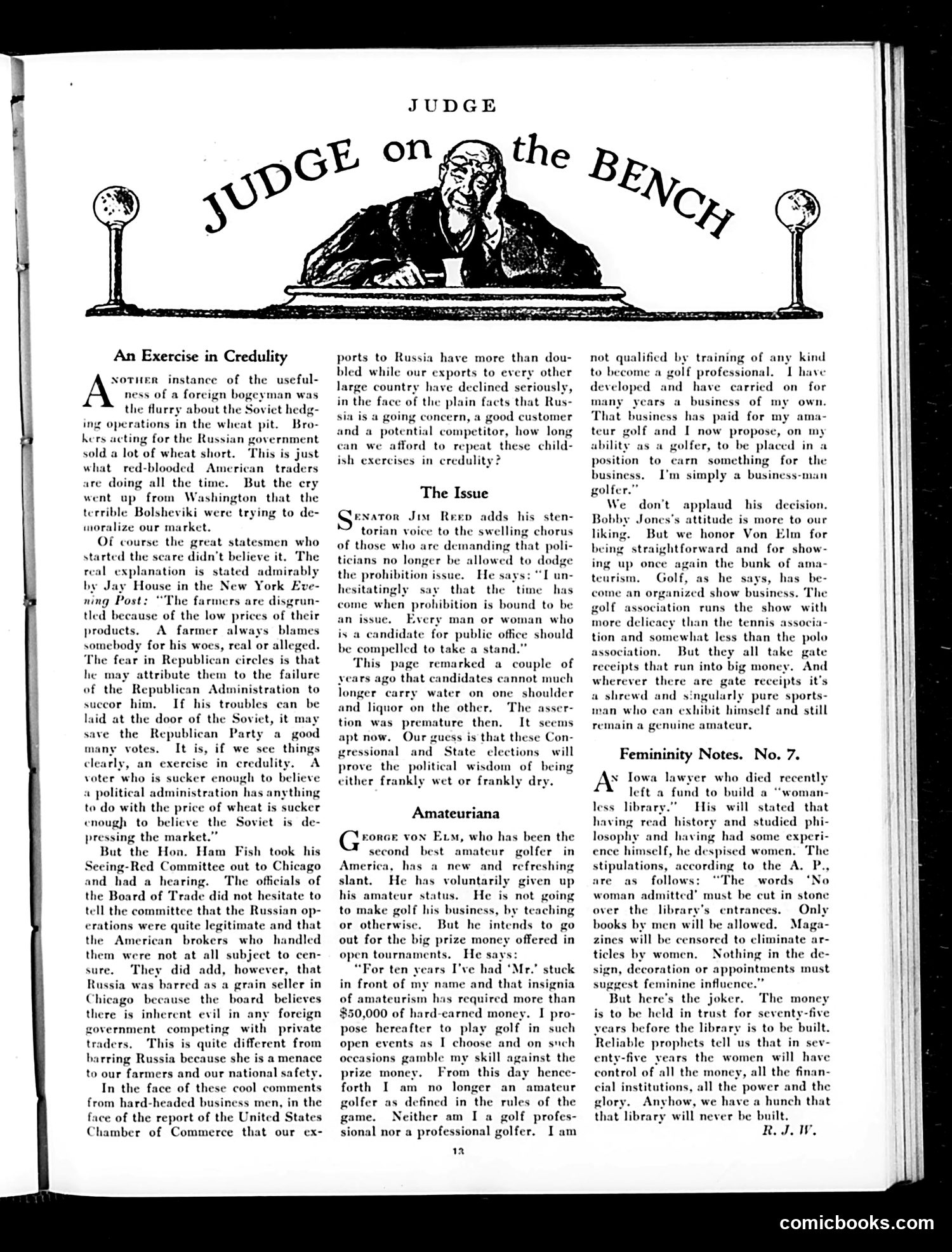
A restored page from Judge, 1930-10-25. Page through the whole issue in the reader above.
📄 Transcribed text from this page (OCR, searchable)
Machine-transcribed from the original scan — historical spelling and the odd misread are preserved.
An Exercise in Credulity NoTHER instance of the useful- A ness of a foreign bogeyman was the flurry about the Soviet hedg- ing operations in the wheat pit. Bro- hers acting for the Russian government sold a lot of wheat short. This is just what red-blooded American traders are doing all the time. But the cry went up from Washington that the terrible Bolsheviki were trying to de- lize our market. Of course the great statesmen who started the scare didn’t believe it. The real explanation is stated admi by Jay House in the New York Ev ning Post: “The farmers are disgrun- tled because of the low prices of their products. A farmer always blames somebody for his woes, real or alleged. The fear in Republican circles is that he m ttribute them to the failure of the Republican Administration to succor him, If his troubles can be laid at the door of the Soviet, it may save the Republican Party a good y votes. It is, if we see things xercise in credulity. A voter who is sucker enough to believe a political administration has anything to do with the price of wheat is sucker cnough to believe the Soviet is de- pressing the market.” But the Hon. Ham Fish took his Seeing-Red Committee out to Chicago and had a hearing. The officials of the Board of Trade did not hesitate to tell the committee that the Russian op- erations were quite legitimate and that the Ameri brokers who handled them were not at all subject to cen- sure. They did add, however, that as barred as a grain seller in icago because the board beli there is inherent evil in any overnment competing with p traders, This is quite different from barring Russia because she is a menace to our farmers and our In the face of these cool comments from hard-headed business men, in the face of the report of the United States Chamber of Commerce that our ex- JUDGE ports to Russia have more than dou- bled while our exports to every other large country have declined seriously, in the face of the plain facts that Rus- sia is a going concern, a good customer and a potential competitor, how long can we afford to repeat these child- ish exercises in credulity? The Issue Gexaton Jin Reso adds his. sten- torian voice to the swelling chorus of those who are demanding that poli- ticians no longer be allowed to do the prohibition issue. He says: “I un- hesitatingly say that the time has come when prohibition is bound to be an issue. Every man or woman who is a candidate for public office should be compelled to take a stand.” This page remarked a couple of years ago that candidates cannot much longer carry water on one shoulder and liquor on the other. ‘The asser- tion was premature then. It seems apt now. Our guess is that these Con- gressional and State elections will prove the political wisdom of be cither frankly wet or frankly dry. Amateuriana rorGe von EM, who has been the second best amateur golfer in America, has a new and refreshing slant. He has voluntarily given up his amateur status. He is not ga to make golf his business, by teaching or otherwise. But he intends to go out for the big prize money offered in open tournaments. He says: “For ten years I've had ‘Mr.’ stuck in front of my name and that insignia of amateurism has required more than $50,000 of hard-earned money. I pro- pose hereafter to play golf in such open events as I choose and on such nble my sk prize money, From this day hence- forth I am no longer an amateur golfer as defined in the rules of the game. Neither am I a golf profes- sional nor a professional golfer. I am 1% not qualified by training of any kind to become a golf professional. I have developed and have carried on for many years a business of my own. That business has paid for my teur golf and I now propose, on my ubility as a golfer, to be placed in a position to carn something for the business. I'm simply a business-man golfer.” We don’t applaud his decision. Bobby Jones's attitude is more to our liking. But we honor Von Elm for straightforward and for show- ing up once again the bunk of teurism. Golf, as he says, has be- come an organized show business. The golf association runs the show with more delicacy than the tennis associa- ion and somewhat less than the polo association, But they all take gate receipts that run into big money. And wherever there are gate receipts it's ad singularly pure sports- can exhibit himself and still genuine amateur, n- a- Femininity Notes. No. 7. A Iowa lawyer who die left a fund to build less library.” His will sts having read history and studied ph losophy and having had some experi- ence himself, he despised women. The stipulations, according to the A. P., are as follows: “The words ‘No woman admitted’ must be cut in stone over the library’s entrances. Only books by men will be allowed. Maga- zines will be censored to climinate ar- ticles by women, Nothing in the de- sign, decoration or appointments must suggest feminine influence.” But here’s the joker. The mone is to be held in trust for seventy-five years before the library is to be built. Reliable prophets tell us that in sev- enty-five years the women will have control of all the money, all the finan- cial institutions, all the power and the glory. we have a hunch that -y will never be built. RJILW, recently woman- ed tha | Hitt | it} Vi} 111 | 1 1} 1 | iT i] IF | Hh: | | comicbooks.com