
Judge, 1930-10-18 · page 9 of 36
Judge — October 18, 1930 — page 9: what you’re looking at
What you’re looking at
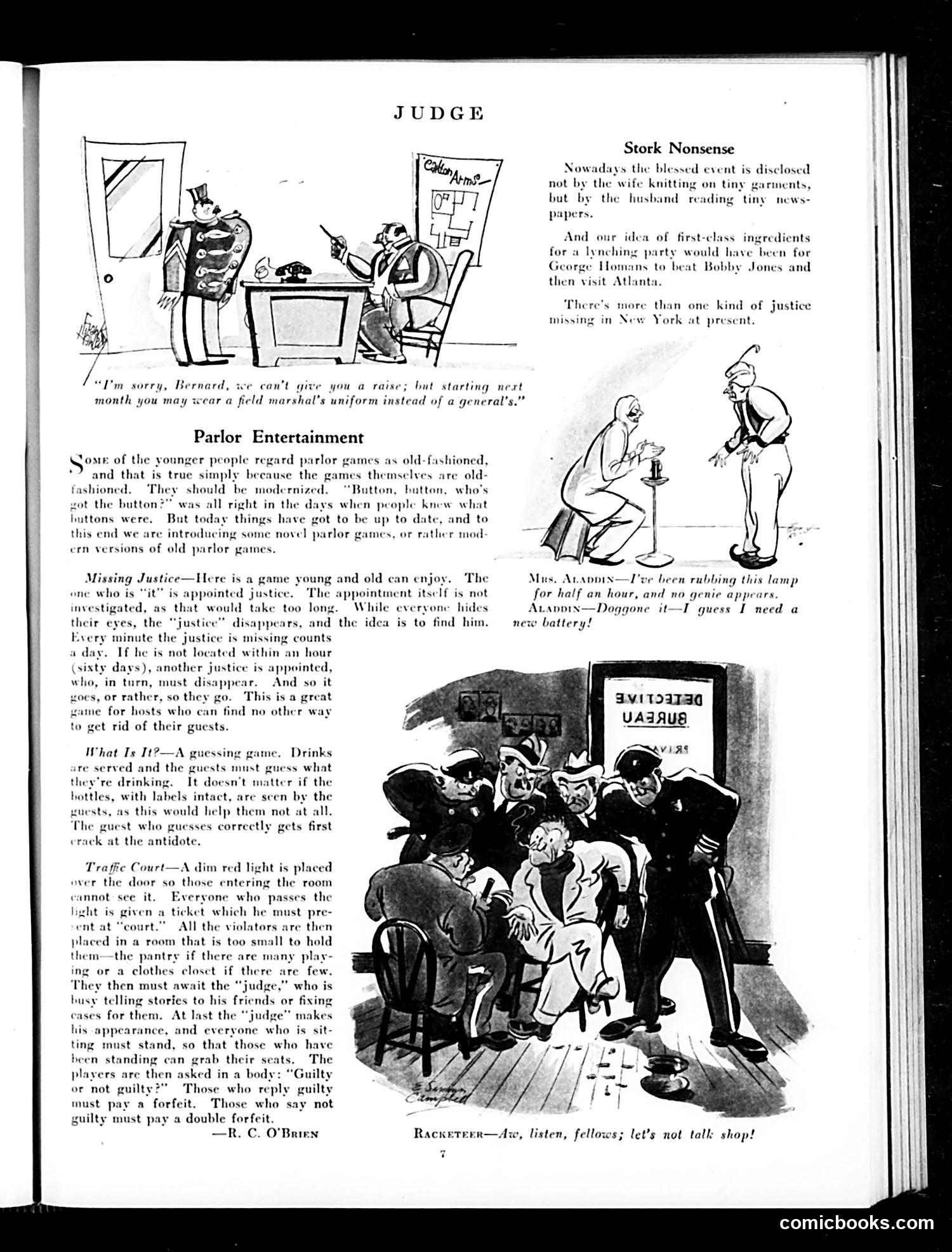
# Explanation for Modern Readers This Judge magazine page combines social commentary with parlor game instructions. The "Stork Nonsense" column satirizes how modern husbands learn of pregnancies from newspaper gossip rather than their wives' domestic preparations—mocking the media's role in spreading personal news. The references to "Bobby Jones" and "Atlanta" appear to reference a contemporary scandal or incident involving a lynching, with the author sarcastically commenting on American "justice." The "Parlor Entertainment" section presents absurdist game variations on old parlor games, mocking both the games themselves and social conventions. "Missing Justice" is a hide-and-seek variant. "Traffic Court" satirizes the legal system by creating a farcical courtroom where people are forced to stand in cramped spaces and fined either way they answer—a dark joke about how the justice system seems rigged regardless of one's response. The cartoons illustrate these games with period-appropriate drawings showing guests participating in foolish entertainment.
📄 Transcribed text from this page (OCR, searchable)
Machine-transcribed from the original scan — historical spelling and the odd misread are preserved.
Stork Nonsense Nowadays the blessed event is disclosed not by the wife knitting on tiny garments, } but by the husband reading tiny news- | And our idea of first-class ingredients for a lynching party would have been for t Bobby Jones and George Homans to then visit Atlanta. ‘There's more than one kind of justice missing in New York at present. ) you a raise; but starting nest month you may wear a field marshal’s uniform instead of a general's. ‘I'm sorry, Bernard, we can't give Parlor Entertainment Yoste of the younger people regard parlo and that is true simply because the gi fashioned. ‘They should be moderni got the button? I right in the d. huttons wer ¢ things have games as old-fashioned, s themselves are old- “Button, button, who's vs when people knew what nt to be up to date, and to this end we are introducing some novel parlor games, or rather mod ern versions of old parlor games. Missing Justice—Here is a game young and old can enjoy. ‘The Mus. Anappix—I’ve been rubbing this lamp one who is “it” is appointed justice. The appointment itscif is not for half an hour, and no genie appears. investigated, as that would take too long. While everyone hides Atappiy—Doggone it—I guess I need a their eyes, the “justice” disappears, and the idea is to find him, Every minute the justice is missing counts aday. If he is not located within an hour (sixty days), another justice is appointed, who, in turn, must disappear. And so it xoes, or rather, so they go. This is a great game for hosts who can find no other way to get rid of their guests. attery! What Is It?—A guessing game. Drinks are served and the guests must guess what they're drinking. It doesn’t matter if the bottles, with labels intact, are seen by the as this would help them not at all. uest who guesses correctly gets first crack at the antidote. Traffic Court—A dim red light is placed over the door so those entering the room cannot see it. light is na ticket which he must pre- ent at “court.” All the violators are then placed in a room that is too small to hold them—the pantry if there are many play- ing or a clothes closct if there are few. They then must await the “judge,” who is busy telling stories to his friends or fixing s for them. At last the “judge” w appearance, and everyone who is sit- ting must stand, so that those who have been standing can grab their seats. The players are then asked in a body: “Guilty or not guilty?” Those who reply guilty inust pay a forfeit. Those who say not guilty must pay a double forfeit. —R. C. O'Brten Racketreer— ryone who passes the « his listen, fell 3 let’s not talk shop! comicbooks.com