
Judge, 1930-10-18 · page 15 of 36
Judge — October 18, 1930 — page 15: what you’re looking at
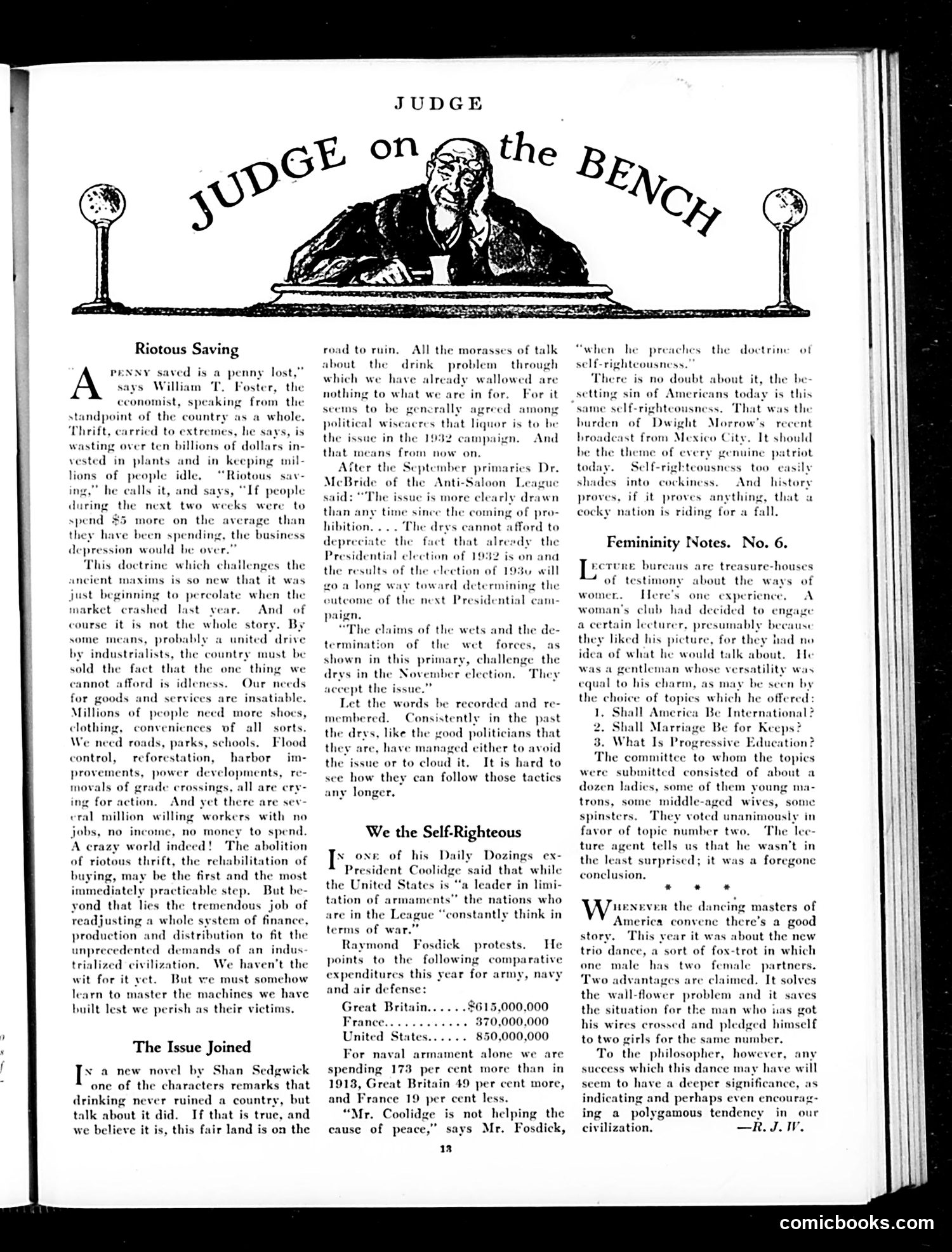
A restored page from Judge, 1930-10-18. Page through the whole issue in the reader above.
📄 Transcribed text from this page (OCR, searchable)
Machine-transcribed from the original scan — historical spelling and the odd misread are preserved.
Riotous Saving PENNY saved is a penny lost,” says William T. Foster, the ceonomist, speaking from the ndpoint of the country as a whole. ‘Thrift, carried to extremes, he says, is wer ten billions of dollars in- plants and in keeping mil- lions of people idle. ing,” he calls it, and says, “If people during the next two weeks were to spend re on the they have been spending “Riotous sav- average than the business depression would be over. This doctrine which challenges the incient maxims is so new that it was just beginning to percolate when the market crashed last year. And of course it is not the whole story. By some means, probably a united’ drive by industrialists, the country must be sold the fact that the one thing we cannot afford is idleness. Our needs for goods and services are insatiable. Millions of people need more shoes, clothing, conveniences vf all rts, need roads, parks, schools. Flood control, reforestation, harbor —im- provements, power developments, re- movals of grade crossings, all And yet there ¢ eral million willing workers with no jobs, no income, no money to spend. A crazy world indeed! The abolition of riotous thrift, the rehabilitation of buying, may be the first and the most immediately practicable step. But be- yond that lies the tremendous job of Ijusting a whole system of finance, production and distribution to fit the unprecedented demands of an indus trialized civilization. We haven't the wit for it yet. But we must somchow learn to master the machines we have built lest we perish as their victims, re cry- ing for action. re sev- The Issue Joined [§ 2 new novel by Shan Sedgwick one of the ch cters remarks that drinking never ruined a country, but talk about it did. If that is true, and we believe it is, this fair land is on the road to ruin, All the morasses of talk rout the drink problem through which we have already wallowed are nothing to what we are in for. For it seems to be generally agreed among political wiscacres that liquor is to b the issue in the 1932 campaign, And that means from now on. After the September primaries Dr. McBride of the Anti-S said: “The issue is more clearly drawn than any time since the coming of pro- hibit -- The drys cannot afford to depreciate the fact that alresdy the Presidential election of 1932 is on ana the results of the election of 193u will goa long way toward determining the eutcome of the next Presidential cam- The claims of the wets and the de- termination of the wet forces, as shown in this primary, challeng drys in the November election. accept the issue.” Let the words be recorded and re- membered. Consistently in the past the drys, like the good politicians that the, have managed cither to avoid the issue or to cloud it, It is hard to see how they can follow those tactics any longer. We the Self-Righteous of his Dail President Coolidg the United States is * tation of are in the L terms of war. Raymond Fosdick protests. He points to the following comparative expenditures this year for army, and air defense: Dozings ex- said that while 1 leader in limi- rmaments” the nations who © “constantly think in 5,000,000 70,000,000 000,000 Great Britain..... nee. United For naval armament spending 173 per cent more than in 1913, Great Britain 49 per cent more, and France 19 per cent less. “Mr. Coolidge is not helping the cause of peace,” says Mr. Fosdick, one we are 18 “when he preaches the doctrine of self-righteousness.” There is no doubt about it, the be- setting sin of Americans today is this same self-rightcousness. at was the burden of Dwight Morrow's recent broadcast from Mexico City. It should be the theme of every genuine patriot today. S ly shades into cockiness. And_ history proves, if it proves anything, that a fall. f-righteousness too ea cocky nation is riding for a Femininity Notes. No. 6. [ec re bureaus are treasure-houses of testimony about the ways of ne experience, A woman's club had decided to engage womer. — Here's a certain lecturer, presumably b Huse they liked his picture, for they had no idea of what he would talk about. He was a gentler ility was equal to his charm, as may be seen by he offered the choice of topies whic! 1, Shall America Be International? 2. Shall Marri: Be for Keeps? 3. What Is Progressive Education The committee to whom the topics were submitted consisted of about a dozen ladies, some of them young ma- trons, some middle-aged wives, some spinsters. They voted unanimously in favor of topic number two. The lec- ture agent tells us that he wasn’t in the least surprised; it we foregone conclusion, an whose vers: * 8 * HeNever the dancing masters of America convene there's a good story. This year it was about the new trio dance, a sort of fox-trot in which one male has two female partners. wo advantages are claimed, It sol the wall-flower problem and it saves the situation for the man who iis got his wires crossed and pledged himself to two girls for the same number. To the philosopher, howev success which this dance may have will seem to have a deeper significance, as indicating and perhaps even encoura- ing a polygamous tendency in our civilization. —R.JILW, ny comicbooks.com