
Judge, 1930-10-11 · page 13 of 36
Judge — October 11, 1930 — page 13: what you’re looking at
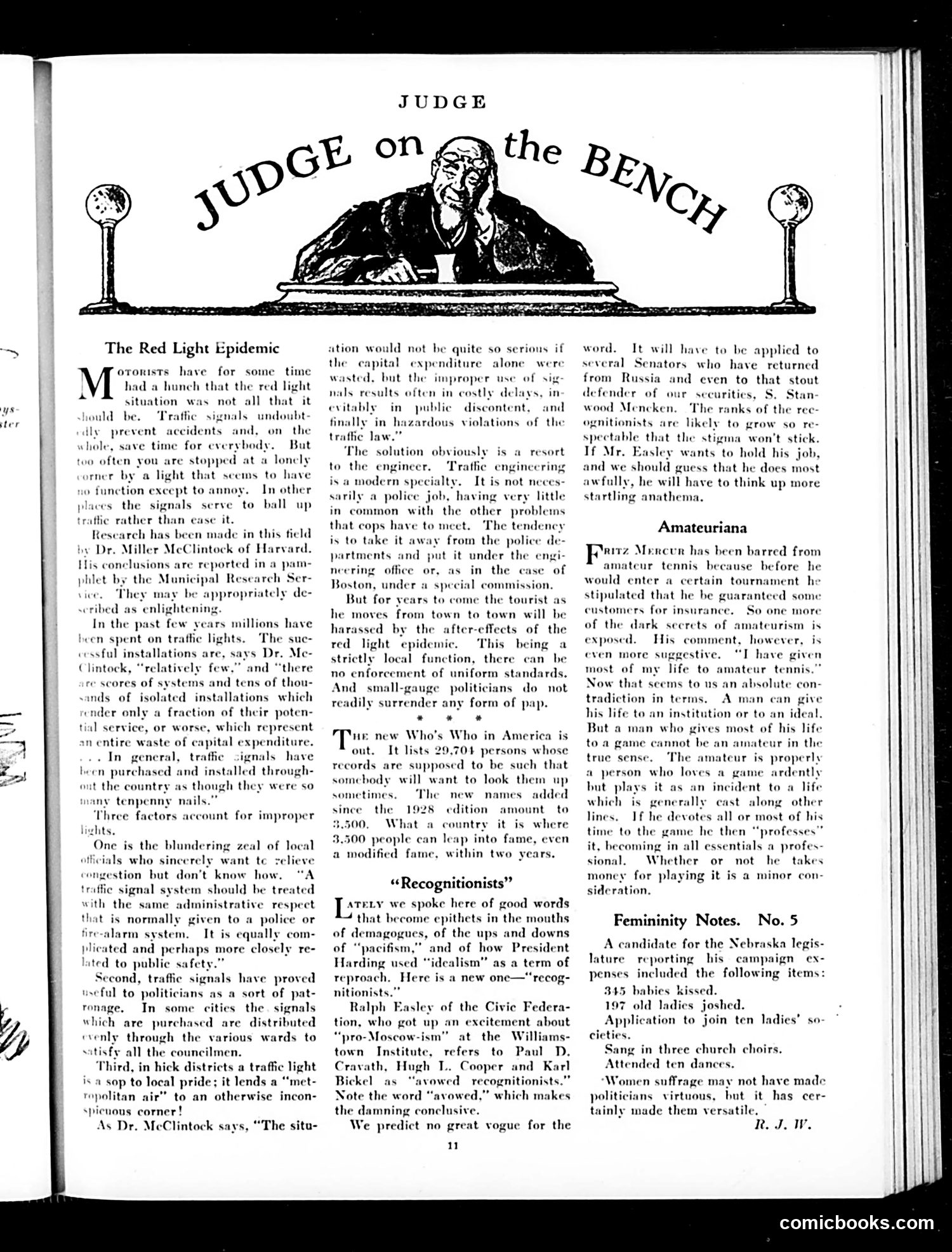
A restored page from Judge, 1930-10-11. Page through the whole issue in the reader above.
📄 Transcribed text from this page (OCR, searchable)
Machine-transcribed from the original scan — historical spelling and the odd misread are preserved.
The Red Light Epidemic otronists have for some time M had a hunch that the red light + situation was not all that it ould be. Traffic undoubt ily prevent accidents and, on the for everybody. But too often you are stopped at a lonely rner by a light that seems to have rept to annoy. In other nals serve to ball up traffic rather than case it. Research has been made in this field by Dr. Miller McClintock of Harvard. His conclusions are reported in a pam- phlet by the Municipal Research They may be scribed as enlighteni In the past few heen spent on traff cessful install Clintock, “re re scores of systems whole, save time no function e places the »propriately de- rs millions ha lights. The sue- says Dr. Me- nd “there d tens of thou- sands of isolated installations which ender only a fraction of their poten- tial service, or worse, which represent an entire waste of capital expenditure. .. In general, traffie signals have ions a heen purchased and installed through- out the country as though they were so many tenpenny nail Three factors account for improper lights, One is the blundering zeal of 1 ials who sincerely want te : stion but don’t know how, "A signal system should be treated with the same administrative respect that is normally given to a police or fire-alarm system. It is equally com- plicated and perhaps more closely re- lated to public s Second, traffic s have proved useful to poli sort of pat- ronage. In some cities the. signals which are purchased distributed cvenly through the various wards to satisfy all the councilmen. Third, in hick districts a traffic light isa sop to local pride; it lends a “met- ropolitan air” to an otherwise incon- spicuous corner! As Dr. McClintock says, “The situ- ation would not be quite so serious if rapital expenditure alone were wasted, but the improper use of sig nals results often in costly delays, in evitably in finally in 1 t law. public discontent, and dous violations of the thi The solution obviously is a resort to the engineer, rate engineering y. It is not neces- . having very little in common with the other problems that cops have to meet. ‘The tendency is to take it away from the police de- partments and put it under the engi- neering office or, as in the case of Boston, under a special commission. But for years to is a modern spec sarily a police | ne the tourist as he moves from town to town will be harassed by the after-effects of the red light epidemic. ‘This being a strictly local function, there can be no enforcement of uniform standards. And small-gauge politicians do not readily surrender any form of pap. *_ * «@ ur new Who's Who in America is out. It lists 29,704 persons whose records are supposed to be such that somebody will want to look them up sometimes. The new names added since the 1928 edition amount to 10, What a country it is where 10 people can leap into fame, even a modified fame, within two ye rs. “Recognitionists” [a we spoke here of good words that become epithets in the mouths of demagogues, of the ups and downs of “pacifism,” and of how President Harding used “idealism” as a term of reproach. Here is a new one—"recog- nitionist Ralph Easley of the Civie Federa- tion, who got up an excitement about “pro-Moscow-ism” at the Williams- town Institute, refers to Paul D. Cravath, Hugh L.. Cooper and Karl Bickel recognitionists.”” Note the word “avowed,” which makes the damning conclusive. We predict no great vogue for the “avowed 1 word. It will have to be applied to several Senators who ave returned from Russia and even to that stout defender of our securities, Stan wood Mencken. The ranks of the ree- tionists are likely to grow so re- table that the stigma won't stick. Jasley wants to hold his job, and we should guess that he does most » he will have to think up more nathema, Amateuriana rnivz Mrrcvun has been barred from mateur tennis because before he would enter a certain tournament he stipulated that he be guaranteed some rs for insurance. So one more of the dark secrets of amateurism is exposed. i custor His comment, howe even more suggestive. is “I have given most of my life to amateur tennis.” Now that seems to us an absolute con- tradiction in terms. A man can g his life to an institution or to an i¢ But a man who gives most of his to a game cannot be an amateur in the true sense. The amateur is properly a person who loves a game ardently but plays it as an incident to a life which is generally lines. cast along other If he devotes all or most of his time to the game he then “professes” it, becoming in all essentials a profes- Whether or not he takes money for playing it is a minor con- sideration. sional. No. 5 A candidate for the Nebraska legis- lature reporting his campaign ex- penses included the following items: 345 babies kissed. 197 old ladies joshed. Application to join ten ladies’ so- cieties. Sang in three church choirs. Attended ten dances. Women suffrage may not have made politicians virtuous, but it has cer- tainly made them versatile Femininity Notes. R.JLW. comicbooks.com