
Judge, 1930-10-04 · page 18 of 36
Judge — October 4, 1930 — page 18: what you’re looking at
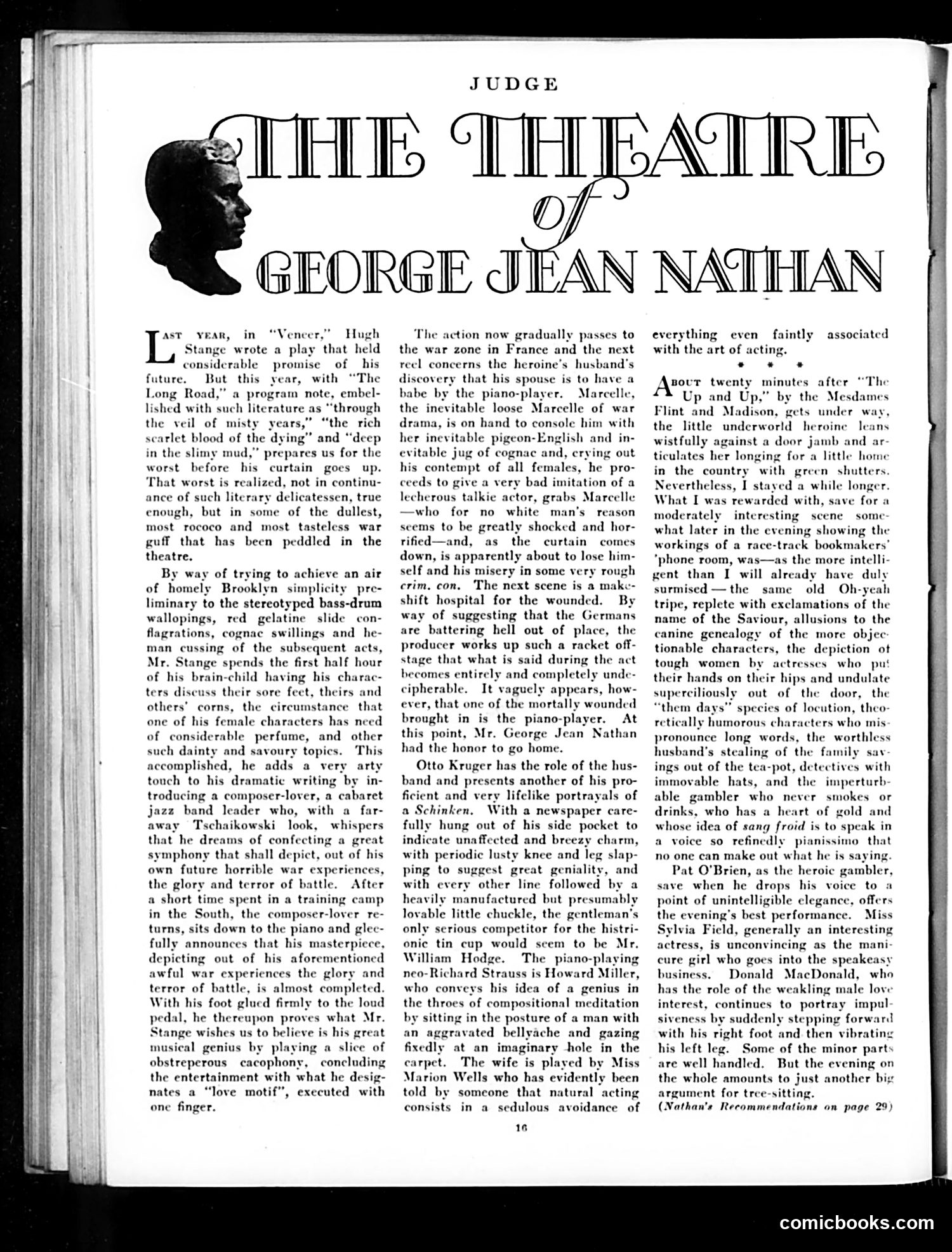
A restored page from Judge, 1930-10-04. Page through the whole issue in the reader above.
📄 Transcribed text from this page (OCR, searchable)
Machine-transcribed from the original scan — historical spelling and the odd misread are preserved.
JUDGE kb GEORGE J ast year, in “Veneer,” Hugh I Stange wrote a play that held considerable promise of _ his future. But this year, with “The Long Road,” a program note, embel- lished with such literature as “through the veil of misty years,” “the rich scarlet blood of the dying” and “deep in the slimy mud,” prepares us for the worst before his curtain goes up. That worst is realized, not in continu- ance of such literary delicatessen, true enough, but in some of the dullest, most rococo and most tasteless war guff that has been peddled in the theatre, By way of trying to achieve an air of homely Brooklyn simplicity pre- liminary to the stereotyped bass-drum wallopings, red gelatine slide con- flagrations, cognac swillings and he- man cussing of the subsequent acts, Mr. Stange spends the first half hour of his brain-child having his charac- ters discuss their sore feet, theirs and others’ corns, the circumstance that one of his female characters has need of considerable perfume, and other such dainty and savoury topics. This accomplished, he adds a very arty touch to his dramatic writing by in- troducing a composer-lover, a cabaret jazz band leader who, with a far- away Tschaikowski look, whispers that he dreams of confecting a great symphony that shall depict, out of his own future horrible war experiences, the glory and terror of battle. After a short time spent in a training camp in the South, the composer-lover re- turns, sits down to the piano and glec- fully announces that his masterpiece, depicting out of his aforementioned awful war experiences the glory and terror of battle, is almost completed. With his foot glued firmly to the loud pedal, he thereupon proves what Mr. Stange wishes us to believe is his gr musical genius by playing a slic obstreperous cacophony, concluding the entertainment with what he desig- nates a “love motif”, executed with one finger. O The action now gradually passes to the zone in France and the next reel concerns the heroine's husband's discovery that his spouse is to have a babe by the piano-player. Marcelle, the inevitable loose Marcelle of war drama, is on hand to console him with her inevitable pigeon-English and in- evitable jug of cognac and, crying out his contempt of all females, he pro- ceeds to give a very bad imitation of a lecherous talkie actor, grabs Marcelle —who for no white man’s reason seems to be greatly shocked and hor- rified—and, as the curtain comes down, is apparently about to lose him- self and his misery in some very rough crim, con, The next scene is a makc- shift hospital for the wounded. By way of suggesting that the Germans are battering hell out of place, the producer works up such a racket off- stage that what is during the act nd completely unde- aguely appears, how- ever, that one of the mortally wounded brought in is the piano-player. At this point, Mr. George Jean Nathan had the honor to go home. Otto Kruger has the role of the hus- band and presents another of his pro- ficient and very lifelike portrayals of a Schinken. With a newspaper care- fully hung out of his side pocket to indicate unaffected and breezy charm, with periodic lusty knee and leg slap- ping to suggest great geniality, and with every other line followed by a only serious competitor for the histri- onic tin cup would seem to be Mr. William Hodge. The neo-Richard Strauss is He who conveys his ide the throes of compositional medit by sitting in the posture of a man with an aggravated bellyache and gazing fixedly at an imaginary hole in the carpet. The wife is played by Miss Marion Wells who has evidently been told by someone that natural acting consists in a sedulous avoidance of 16 ACR Es NACHIAIAN everything even faintly associated with the art of acting. o 8 @ Bout twenty minutes after “The Up and Up,” by the Mesdames Flint and Madison, gets under we the little underworld heroine leans wistfully against a door jamb and ar- ticulates her longing for a little home in the country with green shutters. Nevertheless, I stayed a while longer. What I was rewarded with, save for a moderately interesting scene some what later in the evening showing the workings of a race-track bookmakers’ ‘phone room, was—as the more intelli- gent than I will already have duly surmised —the same old Oh-yeah tripe, replete with exclamations of the name of the Saviour, allusions to the of the more objec ers, the depiction ot women by actresses who put their hands on their hips and undulate superciliously out of the door, the “them da, pecies of locution, theo- retically humorous characters who mis pronounce long words, the worthless husband's stealing of the family sav ings out of the tea-pot, detectives with immovable hats, and the imperturb- able gambler who never smokes or drinks, who has a heart of gold and whose idea of sang froid is to speak in a voice so refinedly pianissimo that no one can make out what he is saying. Pat O'Brien, as the heroic gambler, save when he drops his voice to a point of unintelligible elegance, offers the evening's best performance. Miss yIvia Field, generally an interesting actress, is unconvincing as the mani- cure girl who goes into the speakeasy business. Donald MacDonald, who has the role of the weakling u interest, continues to portray impul siveness by suddenly stepping forward with his right foot and then vibrating his left leg. Some of the minor parts are well handled. But the evening on the whole amounts to just another biz argument for trce-sitting. (Nathan's Recommendations on page 29) comicbooks.com