
Judge, 1930-09-20 · page 23 of 36
Judge — September 20, 1930 — page 23: what you’re looking at
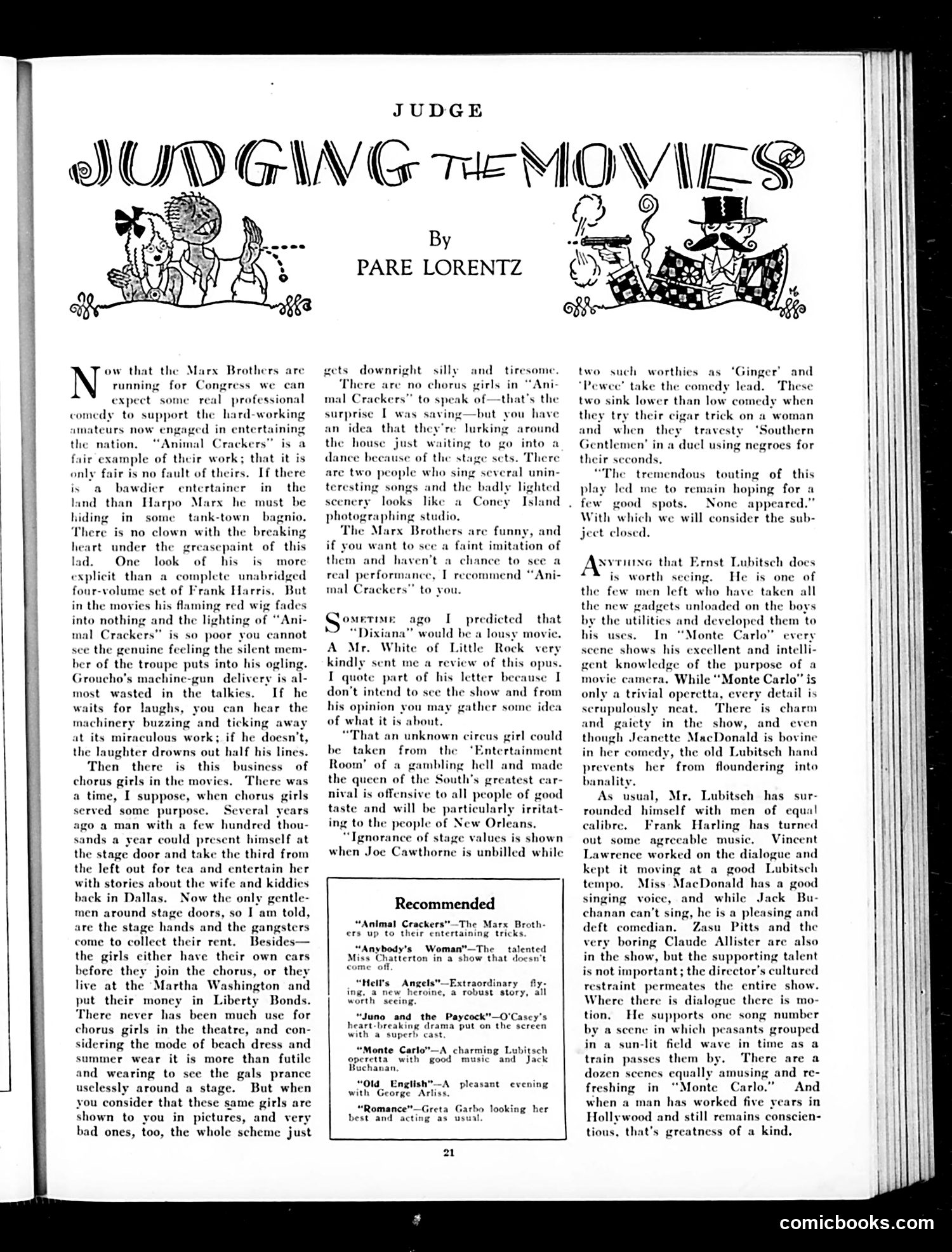
A restored page from Judge, 1930-09-20. Page through the whole issue in the reader above.
📄 Transcribed text from this page (OCR, searchable)
Machine-transcribed from the original scan — historical spelling and the odd misread are preserved.
JUDGING THM ow that the Marx Brothers are running for Congress we can expect some real professiona comedy to support the hard-working umateurs now engaged in entertaining the nation, “Animal Crackers” is a fair example of their work; that it is only is no fault of theirs. If there is a bawdier entertainer in the land than Harpo Marx he must be hiding in) some tank-town — bagni There is no clown with the breaking heart under the greasepaint of this lad One look of his is more explicit than a complete unabridged four-volume set of Frank Harris, But in the movies his flaming red wig fades into nothing and the lighting of “Ani- mal Crackers” is so poor you cannot see the genuine feeling the silent mem- ber of the troupe puts into his ogling. Groucho’s machine-gun delivery is al- most wasted in the talkies. If he for laughs, you can hear the machinery buzzing and ticking away at its miraculous work; if he doesn't, the laughter drowns out half his lines. Then there is this busin of chorus girls in the movies. ‘There was a time, I suppose, when chorus girls served some purpose. Several years ago a man with a few hundred thou- ands a year could present himself at the stage door and take the third from the left out for tea and entertain her with stories about the wife and kiddies back in Dallas. Now the only gentle- men around stage doors, so I am told, are the stage hands and the gangsters come to collect their rent. Besides— the girls either have their own cars before they join the chorus, or they live at the Martha Washington and put their money in Liberty Bonds. There never been much use for chorus girls in the theatre, and con- sidering the mode of beach dress and summer wear it is more than futile and wearing to sce the gals prance uselessly around a stage. But when you consider that these same girls are shown to you in pictures, and very bad ones, too, the whole scheme just JUDGE By PARE LORENTZ gets downright silly and_ tiresome. There are no chorus girls in “Ani- mal Crackers” to speak of—that’s the surprise [was saving—but you ha an idea that they're lurking around the house just waiting to go into a dance because of the st sets. There re two people who sing several unin- sting songs and the badly lighted scenery looks lik Coney Island photographing studio. The Marx Brothers are funny, and if you want to see a faint on of them and haven't a chance to see a real performance, I recommend “Ani- mal Crackers” to you. Gomerine ago I predicted that 7 “Dixiana” would be a lousy movie. A Mr. White of Little Rock very kindly sent me a review of this opus. I quote part of his letter beeause I don’t intend to see the show his opinion you m of what it is about. “Th n unknown circus girl could be take from the ‘Entertainment Room’ of a gambling hell and made the queen of the South’s greatest car- nival is offensive to all people of good and from gather some idea taste and will be particularly irritat- ing to the people of New Orleans. “Ignorance of stage values is shown when Joe Cawthorne is unbilled while Recommended “Animal Crackers"—The Marx Broth- ers up to their entertaining tricks. “Anybody's Woman"—The talented Miss Chatterton in a show that doesn’t nme off. “Hell's Angets"—Extraordinary fly- ing, a new heroine, a robust story, all worth seeing. “Juno and the Paycock”—O'Cascy’s heart-breaking drama put on the screen with a superb cast “Monte Carlo"—A charming Lubitsch operetta with good music and Jack Buchanan. “Old English"—A pleasant evening with George Arliss, “Romance’ ta Garbo looking her best and acti i} as usual » few OVIEe if 2? two such worthies as ‘Ginger’ and ‘Pewee’ take the comedy lead. These two sink lower than low comedy when they try their cigar trick on a woman nd when they travesty ‘Southern Gentlemen’ in a duel using negroes for their seconds, “The tremendous touting of this play led me to remain hoping for ood spots. None appeared. With which we will consider the sub- ject closed. A yruine that Ernst Lubitsch does is worth seeing. He is one of the few men left who have taken all the new gadgets unloaded on the boys by the utilities and developed them to his uses. In ‘Monte Carlo” every scene shows his excellent and intelli- gent knowledge of the purpose of movie camera. While ‘Monte Carl only a trivial operetta scrupulously neat. and ge There is charm icty in the show, and even though Jeanette MacDonald is bovine in her comedy, the old Lubitsch hand prevents her from floundering into banality. As usual, Mr. Lubitsch has sur- rounded himself with men of equal calibre. Frank Harling has turned out some agrecable music. Vincent Lawrence worked on the dialogue and kept it moving at a good Lubitsch tempo. Miss MacDonald has a good singing voice, and while Jack Bu- chanan can't sing, he is a pleasing and deft com . Zasu Pitts and the very boring Claude Allister are also in the show, but the supporting talent is not important ; the director's cultured restraint permeates the entire show. Where there is dialogue there is mo- tion, He supports one song number by a scene in which peasants grouped in a sun-lit field w in time a train passes them by. There are a dozen scenes equally amusing and re- freshing in “Monte Carlo.” And when a man has worked five 3 Hollywood tious, t 's greatness of a kind. comicbooks.com