
Judge, 1930-09-20 · page 18 of 36
Judge — September 20, 1930 — page 18: what you’re looking at
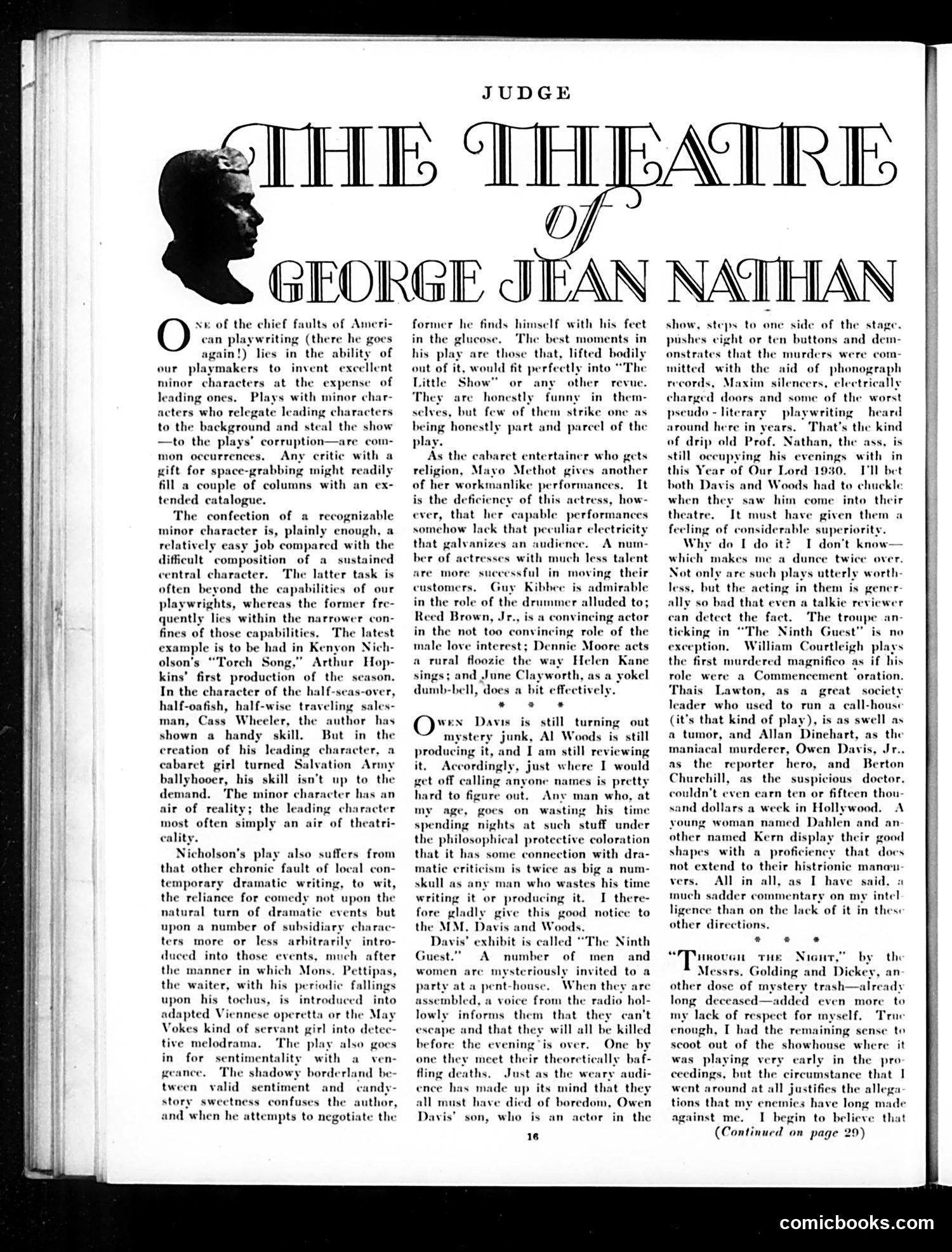
A restored page from Judge, 1930-09-20. Page through the whole issue in the reader above.
📄 Transcribed text from this page (OCR, searchable)
Machine-transcribed from the original scan — historical spelling and the odd misread are preserved.
O GEORGE J xe of the chief faults of Ame can playwriting (there he ge again!) lies in the ability of our playmakers to invent exce minor characters at the expens leading ones. Plays with minor ch: acters who relegate leading characters to the background and steal the show —to the plays’ corruption—are com- mon occurren: Any critic with a gift for space-grabbing might readily fill a couple of columns with an ex- tended catalogue. The confection of a recognizable minor character is, plainly enough, a relatively easy job compared with the difficult“ compos of a. sustained central character. The latter task is often beyond the playwrights, whereas the former fre- quently lies within the narrower con- fines of those cay example is to be olson’s “Torch Song,” Arthur Hop- kins’ first production of the season. In the character of the half-seas-over, half-oafish, half-wise traveling sales- man, Cass Wheeler, the author has shown a handy skill. But in the creation of his leadi aracter, a cabaret girl turned ation Army ballyhooer, his skill isn’t up to the |. The minor character has an air of reality; the leading character most often simply an air of theatri- li holson’s play also suffers from that other chronic fault of local con- temporary dramatic writing, to the reliance for comedy upon the natural turn of dramatic events but upon a number of subsidiary charac- ters more or less arbitrar intro- duced into those events, much after the manner in which Mons. Pettipas, the waiter, with his periodic fallings upon his tochus, is introduced into adapted Viennese operetta or the May Vokes kind of servant girl into detec- tive melodrama. in for geance. twei The play also goes sentimentality with a ve The shadowy borderland b valid sentiment and candy- sweetness confuses th author, and when he attempts to negotiate the story If with his feet st moments in his play are those that, lifted bodily out of it, would fit perfectly into “The Little Show” any other revue. They honestly funny in’ them- selves, but few of them strike one as being honestly part and parcel of the play. As the cabaret entertainer who gets religion, Mayo Methot gives another of her workmanlike performances. It is the deficiency of this actress, how- ever, that her capable performances somehow lack that peculiar electricity that galvanizes an audience. A num- ber of actresses with much less talent are more successful in moving their customers. Guy Kibbee is admirable in the role of the drummer alluded to; Reed Brown, Jr., is a convincing actor in the not too convincing role of the le love interest; Dennie Moore acts a rural floozie the way Helen Kane sings; and June Clayworth, as a yokel dumb-bell, does a hit effe tively. *“ @ Ores Davis is still turning out mystery junk, Al Woods is still producing it, and I am still re ing it. Accordingly, just where I would get off calling anyone names is pretty hard to figure out. Any man who, at my age, goes on wasting his time spending nights at such stuff under the philosophical protective color: that it h: me connection with dra matic criticism is twice as big a num- skull as any man who wastes his time writing it or producing it. I there- fore zl udly give this good notice to a a d Woods. exhibit is called Guest.” A’ number of and women are mysteriously invited to a party ata pent-house. When they are assembled, a voice from the radio hol- lowly informs them that they can't escape and th 1 be killed before the eve One by one they meet th af. fling deaths. Just as the ence has made up its mind that they all must have died of boredom, Owen Davis’ son, who is an actor in the finds him: The t former he in the glucose. are The men Ninth ACI E NACTHIAN show, steps to one side of the stage. pushes cight or ten buttons and dem- onstrates that the murders were com- mitted with the aid of phonograph records, Maxim silencers, electri charged doors and some pseudo - literary around here in 4 “That's th of drip old Prof. Nathan, the still occupying his evenings with in this Year of Our Lord 1930. I'll bet both Davis and Woods had to chuckle when they saw him come into their theatre. “It must have given them a feeling of considerable superiority. Why do I do it? I don’t know— ii © twice over. utterly worth less, but the acting in them is gener- ally so bad that even a talkie reviews n detect the fact. The troupe an- ticking in “The Ninth Guest” is r exception. William Courtleigh play the first murdered magnifico as if his role were a Commencement ‘oration. Thais Lawton, as a great so leader who used to run a call-house (it’s that kind of play), is as swell as a tumor, and Allan Dinehart, as the maniacal murderer, Owen Davis, Jr.. as the reporter hero, and Berton Churchill, as the suspicious doctor. couldn't even earn ten or fifteen thou- sand dollars a week in Hollywood. A young wot amed Dahlen and an other named Kern display their good shapes with a proficiency that docs not extend to their histrionie manau vers, All in all, as I have said, : much sadder commentary on my intel ligence than on the lack of it in thes: other direct “Timovan THE Messrs. Gol: other dose of mystery y trash—alres 3 long deceased—added even more to my lack of respect for myself. Truc enough, T had the remaining sense to scoot out of the showhonse where it was playing very early in the pro ceedings, but the circumstance that I went around at all justifies the allega tions that my enemies have long made against me. I begin to believe that (Continued on page 29) heard kind ss, is Niowr,” by comicbooks.com