
Judge, 1930-09-20 · page 15 of 36
Judge — September 20, 1930 — page 15: what you’re looking at
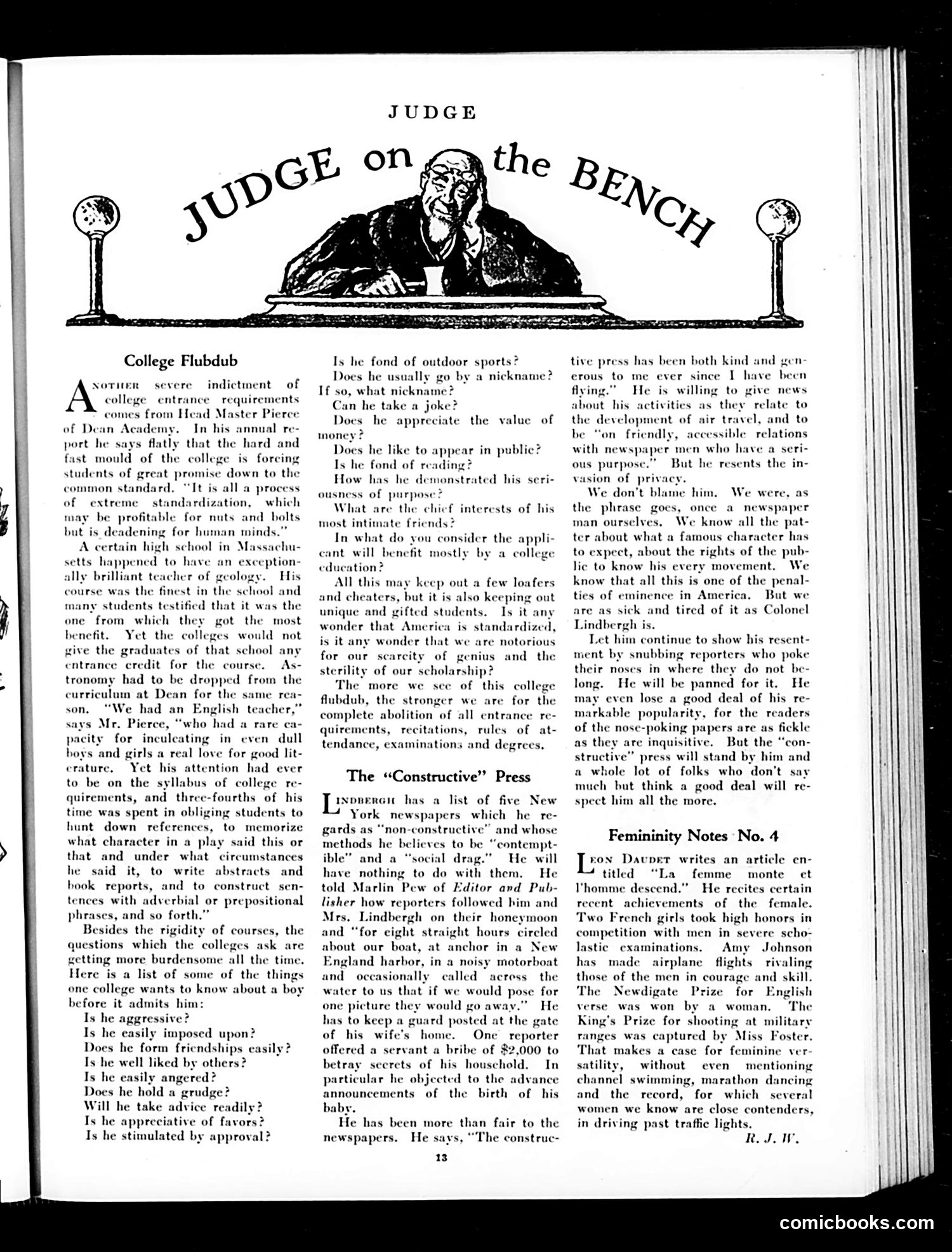
A restored page from Judge, 1930-09-20. Page through the whole issue in the reader above.
📄 Transcribed text from this page (OCR, searchable)
Machine-transcribed from the original scan — historical spelling and the odd misread are preserved.
College Flubdub indictment of NoTHER » entrance requirements comes from Head Master Pierce n Academy. In his annual re- port he says flatly that the hard and fast mould of the college is foreing students of great promise down to the common standa of extreme st may be profital severe d. “It is all a process ndardization, which > for nuts and bolts but is deadening for human minds.” A certain high school in Massachu- setts happened to have an exception- ally brilliant teacher of geolc His course was the finest in the school and many students testified that it was the one from which they got the most benefit. Yet the colleges would not give the graduates of that school any entrance credit for the course. As- tronomy had to be dropped from the curriculum at Dean for the same ri son, “We had an English teacher,” says Mr. Pierce, “who had a rare ca- for inculeating in even dull hoys and girls a real love for good lit- erature, Yet his attention had ever to be on the sy labus of college re- quirements, and three-fourths of his time was spent in obliging students to hunt down references, to memorize what character in a play said this or that and under what circumstances he said it, to write abstracts and hook reports, and to construct’ sen- tences with adverbial or prepositional phrases, and so forth.” Besides the rigidity of courses, the questions which the colleges ask are getting more burdensome all the time. Here is a list of some of the things college wants to know about a boy before it admits him: Is he aggressive? Is he easily imposed upon Does he form friendships eas Is he well liked by others? Is he easily angered? Does he hold a grudge? Will he take advice readily? Is he appreciative of favor Is he stimulated by approval? Is he fond of outdoor sport Does he usually go by a nickname? If so, what nickname? Can he take a joke? Does he appreciate the value of money? Does he like to appes Is he fond of readin How has he demonstrated his seri- ousness of purpose? What are the chief interests of his most intimate friends? In what do you consider the appli- cant will benefit mostly by a college education? All this may rin publi keep out a few loafers and cheaters, but it is also keeping out unique and gifted students. Is it any wonder that America is standardized, is it any wonder that we are notorious for our scarcity of genius and the sterility of our scholarship? The more we sce of this college flubdub, the stronger we © are for the mplete abolition of all entrance re- quirements, recitations, rules of at- tendance, examinations and degrees, The “Constructive” Press Lisenenon has a list of five New York newspapers which he re- gards as “non-constructive’ methods he believes to be “contempt- ible” and a “social drag.” He will have nothing to do with them. He told Marlin Pew of Editor and Pub- lisher how reporters followed him and Mrs. Lindbergh on their honeymoon and “for cight straight hours circled about our boat, at anchor in a New England harbor, in a noisy motorboat and occasionally called acress the water to us that if we would pose for one picture they would go away.” He has to keep a guard posted at the gate of his wife's home. One reporter offered a servant a bribe of $2,000 to betray secrets of his houschold. In particular he objected to the advance announcements of the birth of his baby, He has been more than fair to the newspapers. He says, “The construc- 13 nd whose erous to me ever since I flying.” He is willing to give news about his activiti y relate to the development of air travel, and to be “on. friendly, accessible with newspa ous purpos vasion of privacy We don’t blame him. We were the phrase goes, once a man ourselves, We know ter about what a famous character has bout the rights of the pub- y movement. We know that all this is one of the penal- ties of eminence in America, But we are as sick and tired of it as Colonel Lindbergh is. Let him continue to show his resent- ment by snubbing reporters who poke their noses in where they do not be- long. He will be panned for it. He may even lose a good deal of his re- markable popularity, for the readers of the nose-poking papers are as fickle as they are inquisitive. But the “con- structive” press will stand by him and a whole lot of folks who don't say much but think a good deal will re- spect him all the more. sr men who have a seri- But he resents the in- cy. newsp: All the pat- Femininity Notes No. 4 oN Davupet writes an article en- a femme monte et end.” He recites certain recent hievements of the female. Two French girls took high honors in competition with men in severe sc lastic examinations. Amy Johnson has made airplane flights rivaling those of the men in cours and skill. The Newdigate Pri for English verse won by a woman, The King’s Prize for shooting at military ntured by Miss Foster. case for feminine ver tility, without even mentioning nnel swimming, marathon dancing and the record, for which several women we know are close contenders, in driving past traffic lights. RILW, comicbooks.com