
Judge, 1930-09-06 · page 6 of 36
Judge — September 6, 1930 — page 6: what you’re looking at
What you’re looking at
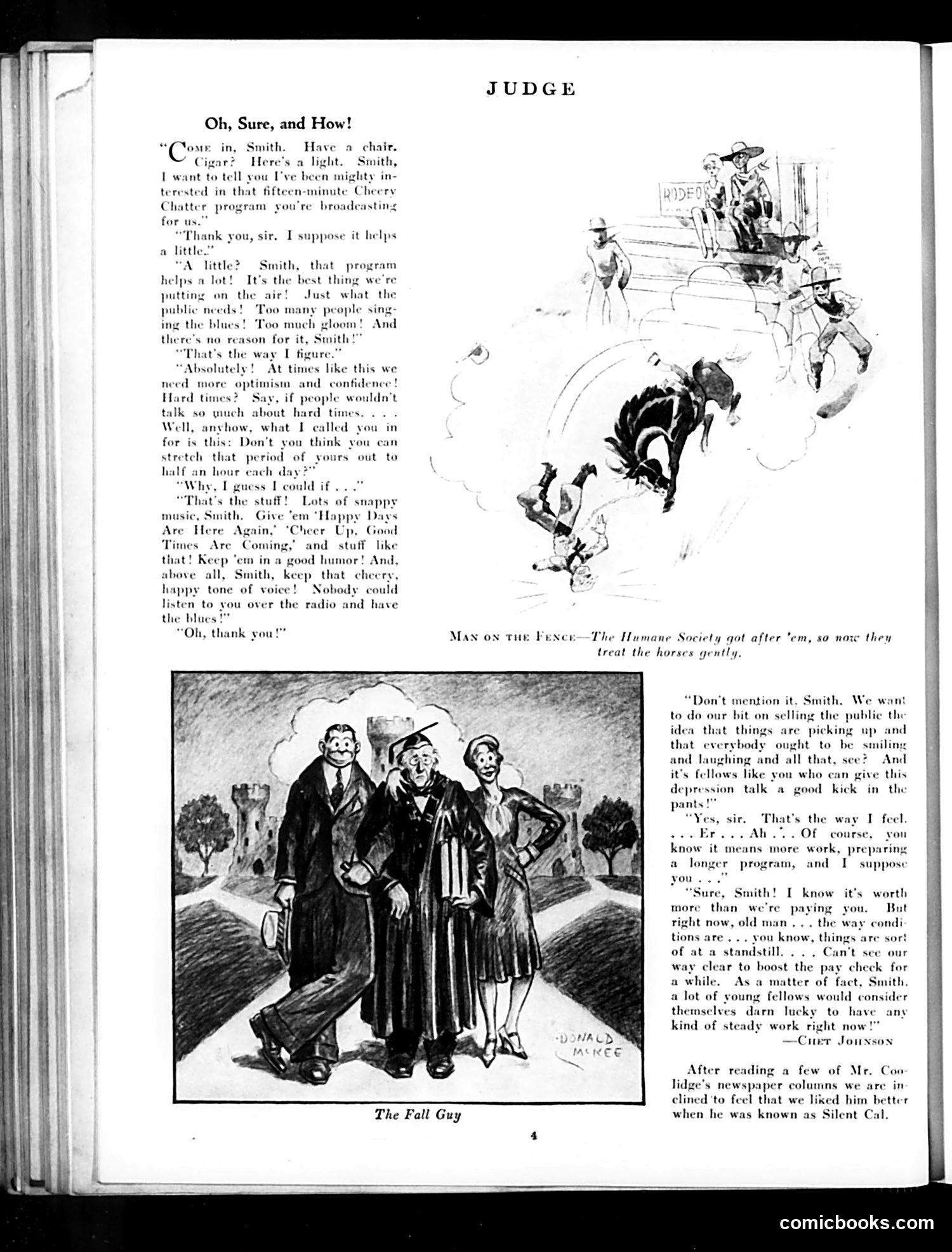
# Analysis of Judge Magazine Page This page contains a dialogue between two radio broadcasters discussing programming during hard economic times. One character advocates for upbeat content—"Happy Days Are Here Again," cheerful music, and humor—to counter public depression and "the blues." His colleague argues this is insufficient without addressing underlying economic conditions. The accompanying cartoon "The Fall Guy" depicts three figures in formal dress, likely representing political or business leaders responsible for the economic crisis, shown in a vulnerable or fallen position. The satire critiques the tension between entertainment as palliative during the Great Depression versus genuine economic reform. Radio broadcasts offered escapism, but the cartoon suggests those in power bear responsibility for actual hardship rather than merely lifting spirits through cheerful programming.
📄 Transcribed text from this page (OCR, searchable)
Machine-transcribed from the original scan — historical spelling and the odd misread are preserved.
Oh, Sure, and How! “Cou in, Smith. Have a chair. Cigar? Here's a lis Smith, I want to tell you I've been mighty in- terested in that fifteen-minute Cheery Chatter program you're broadcasting for us.” “Thank you, sir. I suppose it helps a little.” “A little? Smith, that program helps a lot! It’s the best thing we're putting on the air! Just what the public needs! ‘Too many people sing ing the blues! Too much gloom! And there’s no reason for it, Smith!” “That's the way I figure.” Absolutely! At times like this we need more optimism and confidence! Hard times? Say, if people wouldn't talk so wuch about hard times... . Well, anyhow, what I called you in for is this: Don’t you think you can stretch that period of yours out to half an hour each day?” “Why, I guess I could if...” “That's the stu Lots of snappy music, Smith. Give ‘em ‘Happy Days Are Here Again,’ ‘Cheer Up, Good Times Are Comi and stuff like that! Keep ‘em in a good humor! And, above all, Smith, keep that cheery, happy tone of voice! Nobody could Man on tue Fexer—The Humane Society got after ’em, so now they treat the horses gently. “Don't mention it. Smi We want to do our bit on selling the public the idea that things picking up and that everybody it to be smiling and laughing and all that, see? And it’s fellows like you who can give this depression talk” a good kick in. the «+ Er... Ah... Of cour: know it means more work, pre a longer program, and [suppose Smith! [ know it's worth more than we're paying you. But right now, old man... the condi tions are you know, things are sort ndstill. . . ‘t see our to boost the 5 As a matter of fact, a lot of young fellows would consider themselves darn lucky to have any kind of steady work right now! —Cuer Jouxson After reading a few of Mr. Coo lidge’s newspaper columns we are in clined 'to feel that we liked him better when he was known as Silent Cal. comicbooks.com