
Judge, 1930-08-23 · page 15 of 36
Judge — August 23, 1930 — page 15: what you’re looking at
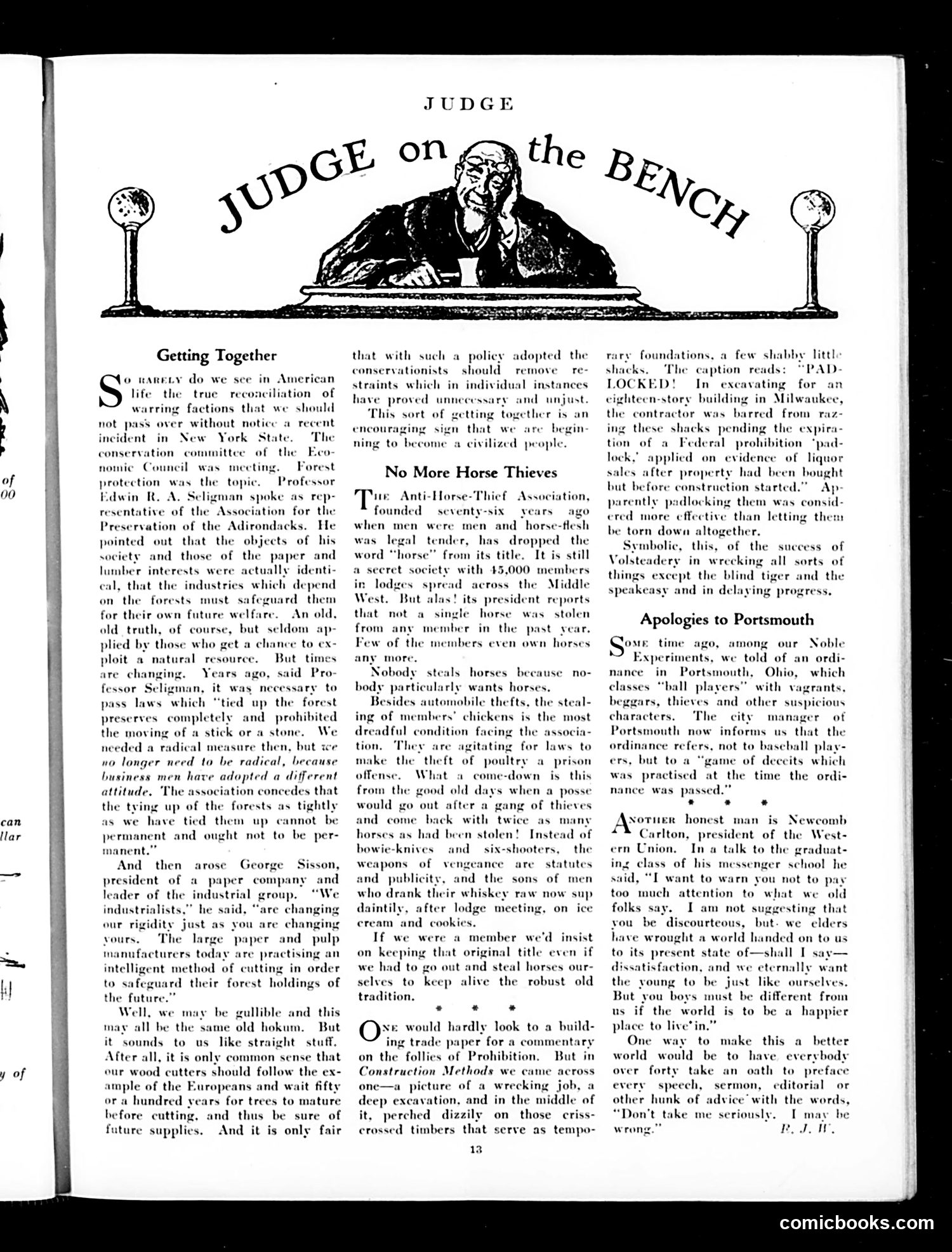
A restored page from Judge, 1930-08-23. Page through the whole issue in the reader above.
📄 Transcribed text from this page (OCR, searchable)
Machine-transcribed from the original scan — historical spelling and the odd misread are preserved.
ee -_—- of 00 can Nar y of Getting Together o nanety do we see in Ameri S life the true reconciliation of warring factions that we should ‘Ss over without notice a recent incident in New York State. The conservation committee of the E Council was meeting. Fo: protection was the topic. Professe Edwin R.A. Seligman spoke as rep- resentative of the Association for the Preservation of the Adirondacks. He pointed out that the objects of his ind those of the paper and lumber interests were actually identi- cal, that the industries which depend on the not p: nomic society forests must safeguard them for their own future welfare. An old, old truth, of course dom ap- plied by those who get a chance to ex- But times rs ago, said Pro but si ploit a natural resource, are chs ‘ fessor pass laws which “tied up the forest preserves completely and prohibited the moving of a stick or a stone. We needed a $ necessary to dical measure then, but we no longer need to be radical, be ause nt business men have adopted a diffe attitude, ‘The association concedes that the t¢, up of the forests as tightly AS We ve tied them up cannot be permanent and ought not to be per- manen And then arose George Sisson, president of a paper company and leader of the industrial group. “We industrialists,” he said, “are changing our rigidity just as you are changing yours. The large ‘paper and pulp manufacturers today are practising an intelligent method of cutting in order to safeguard their forest holdings of the future.” Well, we may be gullible and this may all be the Same old hokum. But it sounds to us like straight stuff. After all, it is only common sense that our wood cutters should follow the ¢ ample of the E t fifty or a hundred years for trees to mature before cutting. and thus be sure of future supplies, And it is only fair ropeans and w JUDGE that with such a policy conservationists should straints which in individual instances have proved dopted the remove — re- necessary and unjust. This sort of getting together is an ug sign that we 4 ning to. become encour: © begin dle. 1 civilized px No More Horse Thieves ne Anti-Horse-Thicf founded Association, seventy six years ag when men were men and horse-flesh we al tender, has dropped the word “horse” from its title. It is still a secret society with 45,000 members in lodges spread across the Middle West. But alas! its president reports that not a sir stolen from any member in the past year. Few of the members even own horses any more. Nobody horses body particularly wants horses. Besides automobile thefts, the steal- ing of members’ chickens is the most dreadful condition facing the associa- tion, They are tating for laws to m the theft of poultry a prison offen What «a come-down is this from the good old days when a posse would go out after a ¢ and come back with twi horses as had been stolen! bowie-knives and weapons of veng and publicity, and the sons of men who drank their whiskey raw now sup daintily, after lodge meeting, on ice cream and cookies. horse was steals. because no- x of thieves as many Instead of six-shooters, the are statutes If we were a member we'd insist on keeping that original title even if we had to go out and steal horses our- selves to keep alive the robust old tradition. O on the follies of Prohibition. Construction Methods we c: * * * : would hardly look to a build- ing trade paper for a commentary But in one—a_ picture of a wrecking j . deep excavation, and in the middle of it, perched dizzily on those criss- crossed timbers that serve as tempo- 12 rary foundations, a few shabby littl ks. The caption. red LOCKED! In exe cighteen-story building in Milwaukee, the contractor was barred from raz- ing these shacks pending the expira- tion of a Federal prohibition ‘pad- lock,’ applied on evidence of liquor sales after property had been bought but before construction started.” Ap parently padlocking them was consid- ered more effective than letting then: be torn down altogether. , . this, of the Volsteadery in wrecking things except the blind speakeasy and in de mbe success of all sorts of er and the ying prog Apologies to Portsmouth rE time among our Noble or ts, we told of an ordi- nance in’ Portsmouth, Ohio, which classes “ball players” with vagrants, beggars, thieves and other suspicious characters. ‘The city manager of Portsmouth now informs us that the ordinance refers, not to baseball play- ers, but to a “game of de cits: which was practised at the time the ordi- nance was passed.” 8 A’ THER honest man is Newcomb i Iton, president of the West- ern Union. Ina talk to the graduat- ing class of his messenger school he “I want to warn you not to pay too much attention to what we old folks say. I am not suggesting that you be discourteous, but- we elders have wrought a world handed on to us to its present state of—shall Is dissatisfaction, and we ¢ said, srnally want the young to be just like ourselves. But you boys must be different fre us if the world is to be a happier place to live’in.” One w to make this a world would be to 1 over forty take an to every speech, sermon, editorial or other hunk of advice’ with the words, “Don't take me seriously. [may be wrong.” del. better comicbooks.com