
Judge, 1930-08-02 · page 15 of 36
Judge — August 2, 1930 — page 15: what you’re looking at
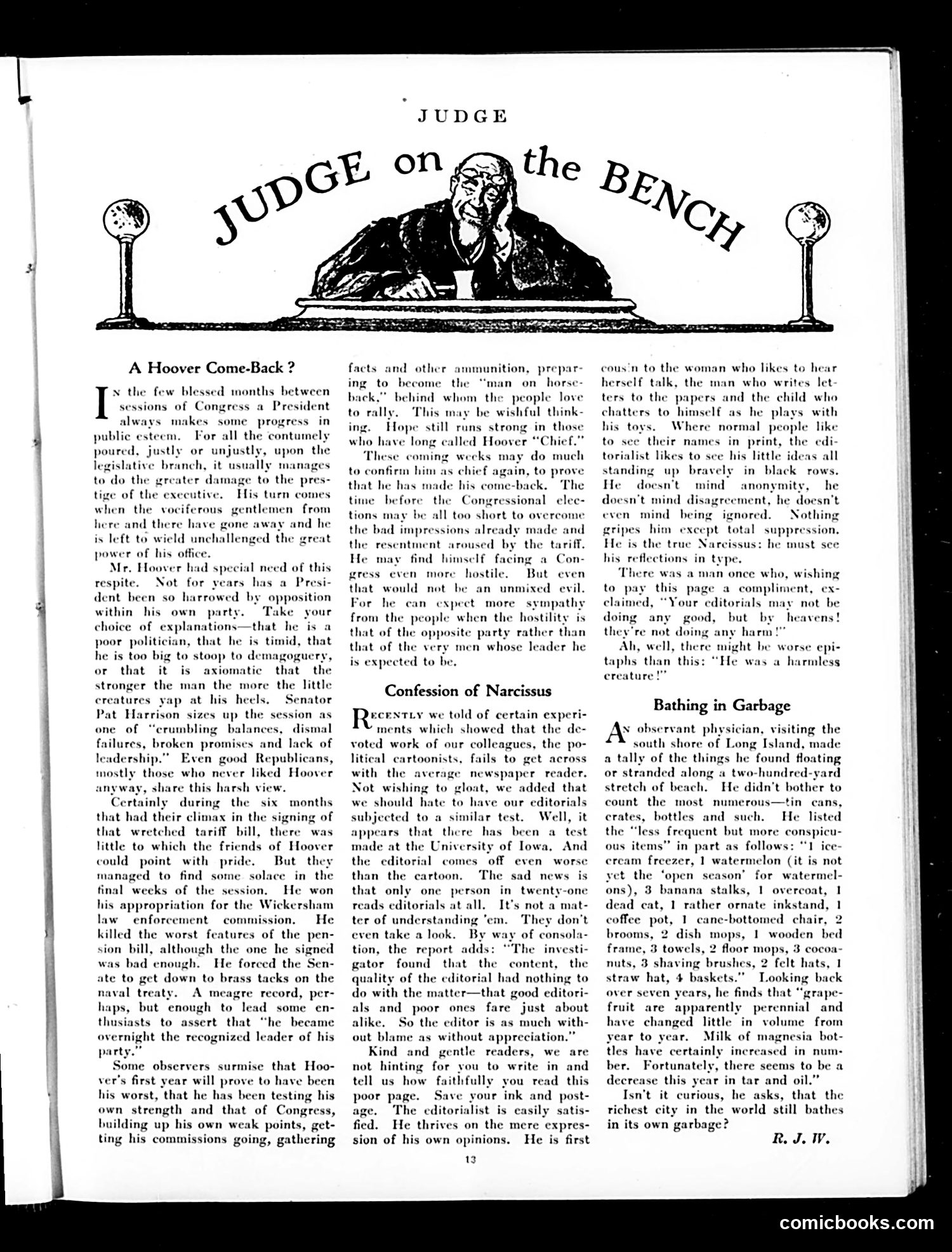
A restored page from Judge, 1930-08-02. Page through the whole issue in the reader above.
📄 Transcribed text from this page (OCR, searchable)
Machine-transcribed from the original scan — historical spelling and the odd misread are preserved.
| JUDGE A Hoover Come-Back ? LT the few blessed months between sessions of Congress a President alwe progress in public esteem, For all the contumely poured, justly or unjustly, upon the legislative branch, it usually man: to do the greater damage to the pres- tige of the executive. His turn comes when the vociferous gentlemen from here and there have gone away and he is left to wield unchallenged the great power of his office. Mr. Hoover had special need of this respite. t for years has a Presi- dent been so harrowed by opposition within his own party. Take your choice of explanations—that he is a poor politician, that he is timid, that he is too big to stoop to demagoguery, or that it is axiomatic that the stronger the man the more the little p at his heels. tor Pat Harrison sizes up the session as one of “crumbling balances, dismal failures, broken promises and lack of leadership.” Even good Republicans, mostly those who never liked Hoover s makes some anyway, share this harsh vi Certainly during the six months that had their climax in the signing of that wretched tariff bill, there was little to which the friends of Hoover could point with pride. But they managed to find some solace in the tinal weeks of the session, his appropriation for the V law enforcement killed the worst features of the pen- sion bill, although the one he signed was bad enough. He forced the Sen- n to brass tacks on the A meagre record, per- haps, but enough to lead some en- thusiasts to assert that “he became ight the recognized leader of his party.” Some observers surmise that Hoo- ver's first year will prove to have been his worst, that he has been testing his own strength and that of Congress, building up his own weak points, get- ting his commissions going, gathering commission, facts and other ammunition, prepar- ing to become the “man on horse- back.” behind whem the people love to rally. This may be wishful think- ing. Hope still runs strong in those who have long called Hoover “Chief.” These coming weeks may do much to confirm him as chief again, to prove that he has made his come-back, The time before the tions m th the resentment He may gress even more Congressional! Il too short to overcome ad impressions already made and aroused by the tariff. find himself facing a Con- hostile. But even that would not be an unmixed evil. For he can expect more sympathy from the people when the hostility. ix that of the opposite party rather than that of the very men whose leader he is expected to be, yb Confession of Narcissus Ricestey we told of certain experi- ments which showed that the de- voted work of our colleagues, the po- litical cartoonists, fails to get across with the average newspaper reader. Not wishing to gloat, we added that we should hate to have our editorials subjected to a similar test. Well, it appears that there has been a test made at the University of Iowa, And the editorial comes off even’ worse than the cartoon, The sad news i that only one person in twenty-on reads editorials at all. It’s not a mat- ter of understanding ’em. They don’t even take a look. By of consola- tion, the report adds: “The investi- gator found that the content, the quality of the editorial had nothing to do with the matter—t! good editori- ay als and poor ones fare just about with- alike. So the editor is as much out blame as without appreciatior Kind and gentle readers, we are not ting for you to write in and tell us how faithfully you read this poor page. : your ink and post- age. The editorialist is ily satis- fied. He thrives on the mere expres- sion of his own opinions. He is first 13 cous'n to the woman who likes to hear herself talk, the man who writes let ters to the papers and the child who chatters to himself as he plays with his toys. Where normal people like to see their names in print, the edi torialist likes to see his little ideas all standing up bravely in black rows. He doesn't mind nonymity, he doesn’t mind disagreement, he doesn’t even mind being ignored. Nothing gripes him except total suppression, He is the true Narcissus his reflections in type. The to } claimed, : he must see © Was a man once who, wishing this page a compliment, ex- “Your editorials may not be doing any good, but by they're not doing any hart Ah, well, there might be worse epi- taphs than this: “He was a harmless creature heavens! Bathing in Garbage yN observant physician, visiting the south shore of Long Island, made a tally of the things he found floating or stranded along « two-hundred-yard stretch of beach. He didn’t bother to count the most numerous—tin cans, crates, bottles and such. He listed the “less frequent but more conspicu- ous items” in part as follows: * ercam freezer, 1 watermelon (it is not yet the ‘open season’ for watermel- ons), 3 banana stalks, 1 overcoat, 1 dead cat, 1 rather ornate inkstand, 1 coffee pot, 1 cane-bottomed chair, brooms, 2 dish mops, 1 wooden bed frame, 3 towels, 2 floor mops, 3 cocos nuts, 3 shaving brushes, 2 felt hats, 1 y hat, 4 baskets.” Looking back over seven years, he finds that “g. fruit are apparently perennial and have changed little in volume from year to year. Milk of magnesia bot- tles have certainly increased in num- ber. Fortunat there seems to be a decrease this year in tar and oil.” Isn't it curious, he asks, that the richest city in the world still bathes in its own garbage? 1 ice- st RJ. WW. comicbooks.com