
Judge, 1930-07-19 · page 9 of 36
Judge — July 19, 1930 — page 9: what you’re looking at
What you’re looking at
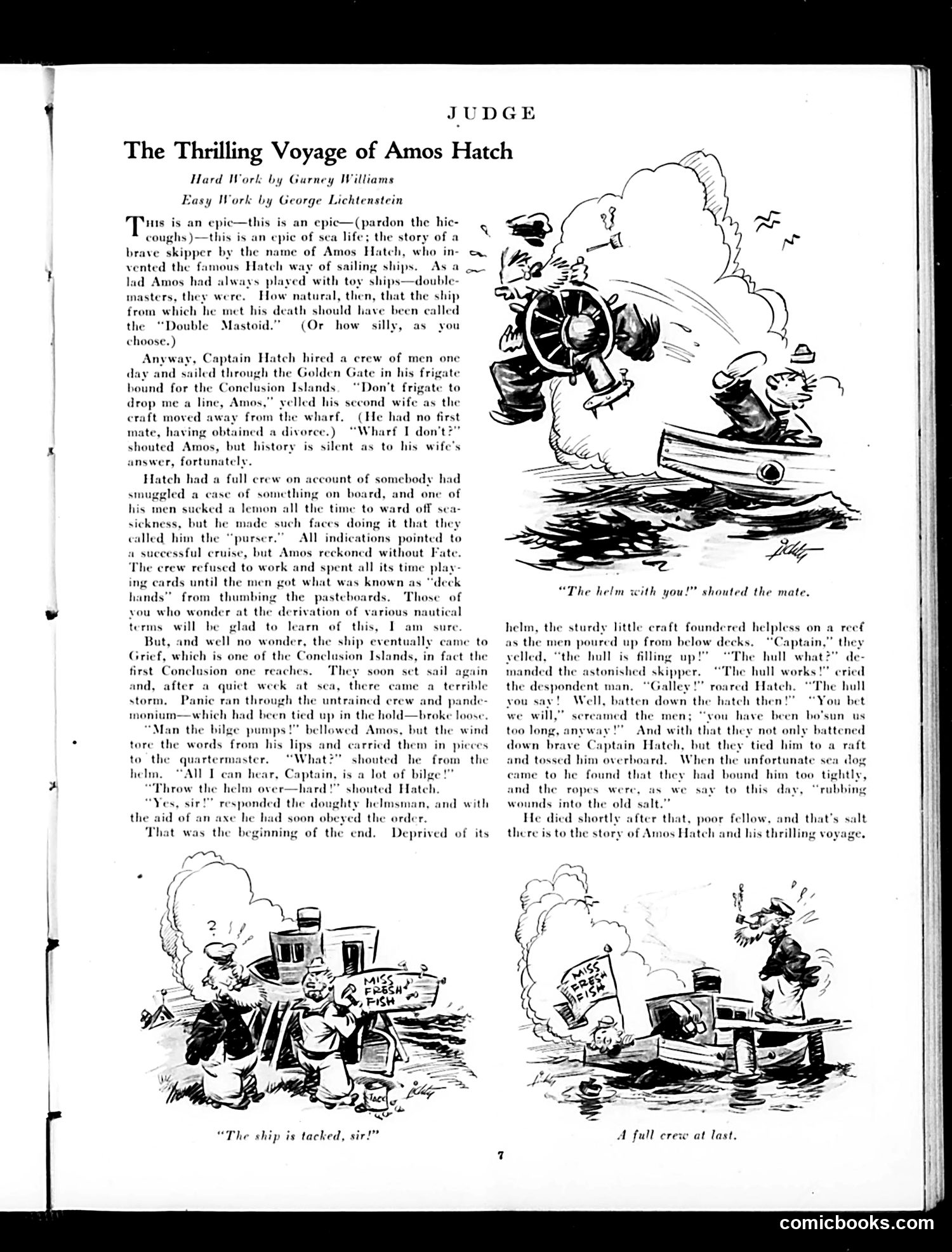
# "The Thrilling Voyage of Amos Hatch" Explained This is a humorous tall tale, not political satire. The story follows Captain Amos Hatch on a doomed sea voyage, illustrated by cartoonist Gurney Williams. The satire works through **puns and absurdist logic**: Hatch invented a peculiar "Hatch way of sailing ships"; his ship is called the "Double Mastoid" (a medical condition); crew members develop "deck hands" from playing cards; someone is called the "purser" for making faces while sucking lemons. The narrative culminates in farce: during a storm, the crew mutinies, ties the captain to a raft and tosses him overboard. When he survives, they bind him "too tightly," creating the idiom "rubbing wounds into the old salt"—a playful etymology of nautical slang. The joke is gentle wordplay and maritime humor rather than commentary on contemporary politics or social issues. It's simply entertainment through linguistic absurdity and slapstick situations.
📄 Transcribed text from this page (OCR, searchable)
Machine-transcribed from the original scan — historical spelling and the odd misread are preserved.
JUDGE The Thrilling Voyage of Amos Hatch Hard Work by Gurney Williams Easy Work by George Lichtenstein nis is an epic—this is an epic—(pardon the hic- coughs)—this is an epic of sea life; the story of a brave skipper by the name of Amos Hatch, who in- vented the famous Hatch way of sailing ships. As a lad Amos had always played with toy: ships—double- masters, they were. How natural, then, that the ship from which he met his death should ¢ been called the “Double Mastoid.” (Or how silly, ay you choose.) way, Captain Hatch hired a crew of men one day and sailed through the Golden Gate in his frigate bound for the Conclusion Islands. “Don’t frigate to drop me a line, Amos,” yelled his second wife as the craft moved away from the wharf. (He had no first having obtained a divorce.) “Wharf I don’t?” shouted Amos, but history is silent as to his wife's answer, fortunately. Hateh h smuggled 4 on board, and one of his men sucked a lemon all the time to ward off sea- sickness, but he made such faces doing it that they called him the “purser.” All indications pointed to a successful cruise, but Amos reckoned without Fate. The erew refused to work and spent all its time play- ing cards until the men got what was known as “deck hands” from thumbing the pasteboards. Those of you who wonder at the derivation of various nautical terms will be glad to learn of this, I am_ sure. helm, the sturdy little craft founde But, and well no wonder, the ship eventually came to as the men poured up from below di Grief, which is one of the Conclusion Islands, in fact the — yelled, “the hull is filling up!" first Conclusion one reaches. They soon set sail again manded the astonished skipper. “The hull works and, after a quict week at sea, there came a terrible the despondent man. “Galley!” roared Hatch. “The hull full crew on account of somebody had ase of somethii “The helm with you!” shouted the mate. 1 helpless on a reef storm. Panic ran through the untrained crew and pande- you say! Well, batten down the hatch then “You bet monium—which had been tied up in the hold—broke loose. we will,” screamed the men; u have been bo'sun us “Man the bilge pumps!" bellowed Amos, but the wind — too long, anywa tore the words from his liz to the quartermaster. And with that they not only battened in Hatch, but they tied him to a raft shouted he from the and tossed him overboard. When the unfortunate sea dog 1 carried them in pieces down brave Capt helm. “All I can hear, Captain, is a lot of bilge!” came to he found that they had bound him too tightly, “Throw the helm over—hard!” shouted Hateh, and the ropes were, we say to this day, “rubbing “Yes, sir!” responded the doughty helmsman, and with wounds into the old salt.” the aid of ans © he had soon obeyed the order. He died shortly after that, poor fellow, and that’s salt That was the beginning of the end. Deprived of its — there is to the story of Amos Hatch and his thrilling voy: aan “The ship is tacked, sir!” A full crew at last. comicbooks.com