
Judge, 1930-07-19 · page 25 of 36
Judge — July 19, 1930 — page 25: what you’re looking at
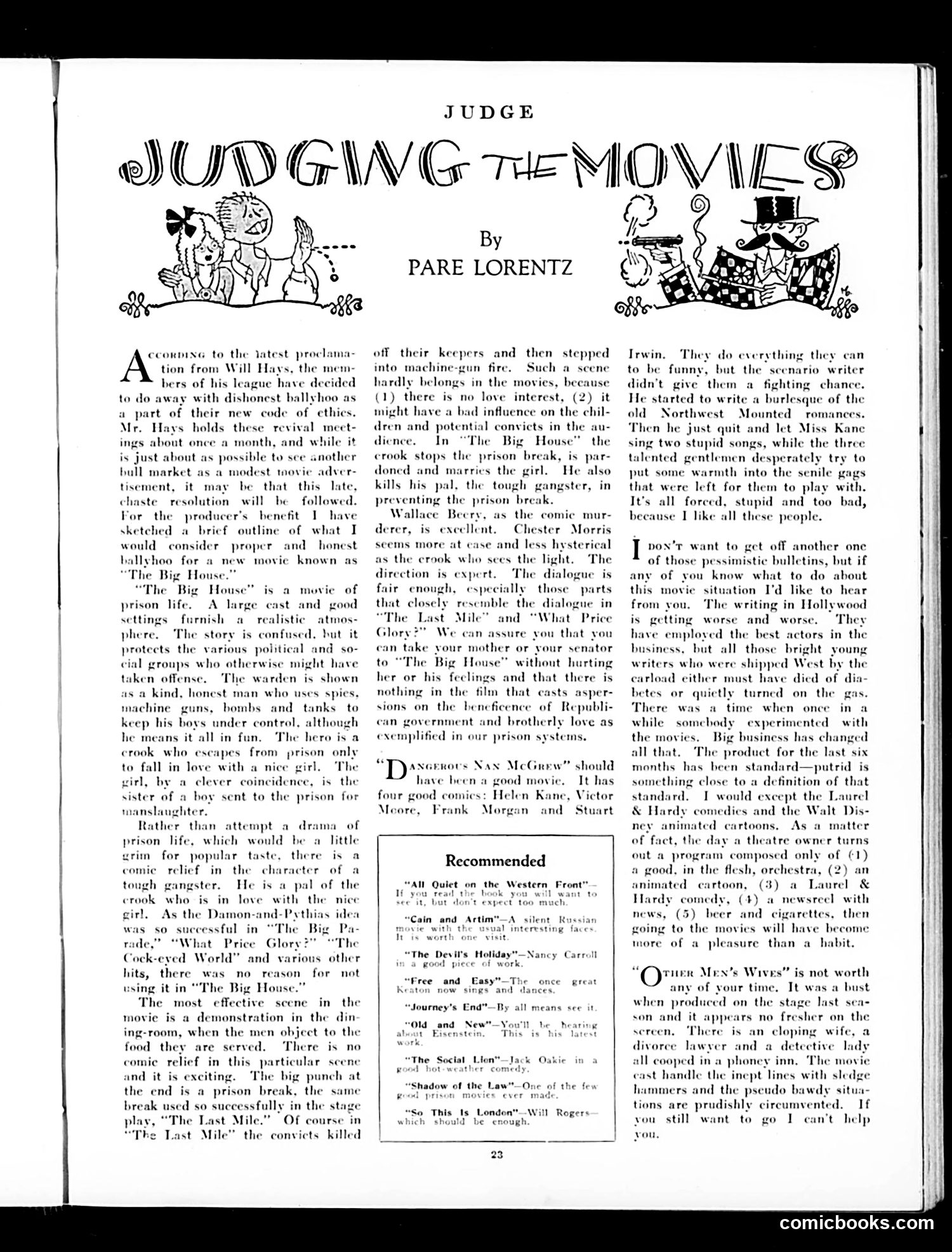
A restored page from Judge, 1930-07-19. Page through the whole issue in the reader above.
📄 Transcribed text from this page (OCR, searchable)
Machine-transcribed from the original scan — historical spelling and the odd misread are preserved.
JUDGE JIUDGWG T=MOVIES cconmixg to the latest: proclama- A tion from Will Hays, the mem- bers of his league have decided to do away with dishonest ballyhoo as a part of their new code of ethics. Mr. Hays holds these revival meet- about once a month, and while it possible to sce another modest tnovie adver- be that this late, chaste resolution will be followed. For the producer's benefit I have sketched a brief outline of what I would consider proper and honest hallyhoo for a new movie known as “The Big House.” “The Big House” is a movie of prison life. A large cast settings furnish a realistic atmos- phere. The story is confused, hut it protects the various politica cial groups wh taken offense. 1 good and so- therwise might have ye warden is shown as a kind, honest man who uses spies, machine guns, bombs and to keep his boys under contr: he means it all in fan. The hero is a crook who escapes from prison only to fall in love with a nice girl. The uirl, by a clever coincidence, is the sister of 1 boy sent to the prison for iter. Rather than attempt a drama of prison life. which would be a little grim for popular taste, there is a comic relief in the character of a tough gangster. He is a pal of the crook who is in love with the nice girl, As the Damon-and-Pythias idea was so successful in “The Big Pa- rade,” “What Price Glory he Cock-eyed World” and various other hits, there was no reason for not using it in “The Big House.” The most effective scene in the movie is a demonstration in the din ing-room, when the men object to the food they are served. There is no comic relief in this particular scene and it is exciting. The big punch at the end is a prison break, the same break used so successfully in the stage play, “The Last Mile.” Of course in oT Last Mile” the convicts killed tmanslang By PARE LORENTZ off their keepers and then stepped into machine-gun fire. Such a scene hardly belongs in the movies, because (1) there is no love interest, (2) it might have a bad influence on the chil- dren and potential convicts in the au- In “The Big House” the crook stops the prison break, is par- doned and marries the girl. He kills his pal, the tough g preventing the prison break. Wallace Beer derer, is exce Iso ster, in as the mie mur- nt. Chester Morris seems more at case and less hysterical as the crook who sees the light. The direction is expert. The dialogue is fair enough, especially those parts that closely resemble the dialogue in “The Last Mile” and “What Price Glory We can assure you that you can take your mother or your senator to “The Big House” without hurting her or his feelings and that there is nothing in the film that casts asper- is on the beneficence of Republi- can government and brotherly love as exemplified in our prison systems. “Dp sxernors Naw MeGirsw” should have been a good movie. It has four good comics: Helen Kane, Victor Moore, Frank Morgan and. Stuart Recommended ve 1 Quiet on the Western Front” | “The Devil's Moliday"—Nancy Carroll once great ' “Old and New"—Y, | about Eisenstein This is ep Irwin. They do everythir to be fu > but the scenario writ didn’t give them a fighting chance He started to write a burlesque of the old Northwest Mounted romances. Then he just quit and let Miss Kane sing two stupid songs, while the three talented gentlemen desperately try to put some warmth into the senile gags that were left for them to play with. It's all forced, stupid and too bad, because I like all these people. they can pox’r want to get off another one of those pessimistic bulletins, but if any of you know what to do about I'd like to hear The writing in Hollywood is getting wors d worse. They have employed the best actors in the business, but all those bright young writers who were shipped West by the carload either must have died of d betes or quictly turned on the gas. There was a time when once in a while somebody experimented with the movies. Big business has changed all that. The product for the last six months has been standard—putrid is something close to a definition of that standard. I would except the Laurel & Hardy comedies and the Walt Dis- ney animated cartoons, As a matter of fact, the day a theatre owner turns out a program composed only of (1) a good, in the flesh, orchestra, (2) an animated cartoon, (3) a Laurel & Hardy comedy, (4) a newsreel with news, (5) beer and cigarettes, then going to the movies will have become more of a pleasure than a habit. this movie situation from you. “Ome Mey’s Wives” is not worth any of your time, It was a bust when produced on the stage last sea- son and i screen, ppears no fresher on the There is an cloping wife, a divorce lawyer and a detective lady all cooped ina phoney inn, The movie cast handle the inept lines with sledg hammers and the pseudo bawdy situa- tions are prudishly circumvented. If you still want to go IT can't help you, comicbooks.com