
Judge, 1930-07-19 · page 15 of 36
Judge — July 19, 1930 — page 15: what you’re looking at
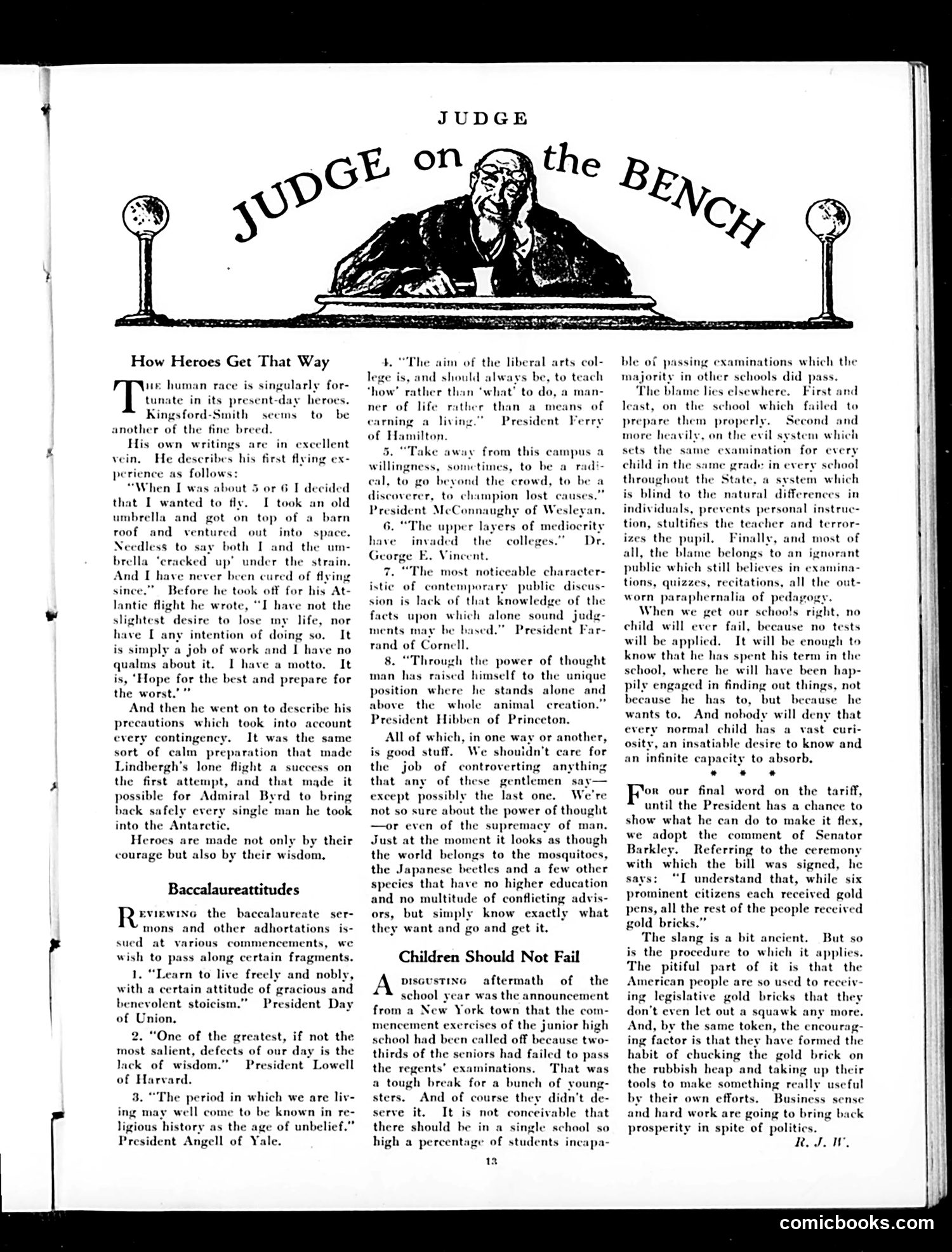
A restored page from Judge, 1930-07-19. Page through the whole issue in the reader above.
📄 Transcribed text from this page (OCR, searchable)
Machine-transcribed from the original scan — historical spelling and the odd misread are preserved.
JUDGE How Heroes Get That Way ue human race is singularly for- tunate in its present-day heroes. Kingsford-Smith seems to be another of the fine breed. His own writings are in excellent vein. He describes his first flying ex- perience as follows: “When I was about 5 or 6 I decided that I wanted to fly. I took an old umbrella and got on top of barn roof and ventured out into spa Needless to say both I and the um- brella ‘cracked up’ under the strain. And I have never been cured of flying Before he took off for his At- lantic flight he wrote, “I have not the slightest desire to lose my life, nor have [ any intention of doing so. It is simply a job of work and I have no qualms about it. I have a motto. It is, ‘Hope for the best and prepare for the worst.’ ”” And then he went on to describe his precautions which took into account every contingency. It was the same sort of calm preparation that made Lindbergh's lone flight a success on the first attempt, and that made it possible for Admiral Byrd to bring hack safely every single man he took into the Antarctic, Herocs are made not only by their courage but also by their wisdom, since, Baccalaureattitudes R: ewING the baccalaureate ser- mons and other adhortations is- sued at various commencements, we wish to pass along certain fragments. 1. “Learn to live freely and nobly, with a certain attitude of gracious and benevolent stoicism.” President Day of Union. “One of the greatest, if not the most salient, defects of our day is the lack of wisdom.” President Lowell of Harvard. “The period in which we are liv- ing may well come to be known in re- ligious history as the age of unbelief.” President Angell of Yale. 4. The aim of the liberal arts col- lege is, and should always be, to teach ‘how’ rather than ‘what’ to do, a man- ner of life rather t ans of earning a living.” nt Ferry of Hamilton. willingness, sometimes, to be a radi- cal, to go beyond the crowd, to discoverer, to champion lost cause: President McConr of Wesleyan. rhe upper layers of mediocrity invaded the colleges.” Dr. Vincent. » away from this campus a “The most noticeable character- istie of contemporary public discus- sion is lack of that knowledge of the facts upon which alone sound judg- ments nm be based.” President Fs rand of Cornell. 8. “Through the power of thought man has raised himself to the unique position where h ind above the whole anim creation.” President Hibben of Princeton. lone All of which, in one way or another, is good stuff. We shou the job of controverting an that any of these gentlemen except possibly the last one. We're not so sure about the power of thought —or even of the supremacy of man, Just at the moment it looks as though the world belongs to the mosquitoes, the Japanese beetles and a few other species that have no higher education and no multitude of conflicting advis- ors, but simply know exactly what they want and go and get it. Children Should Not Fail A piscustinG aftermath of — the school year was the announcement from a New York town that the com- mencement exercises of the junior high school had been called off because two- thirds of the seniors had failed to pass the regents’ examinations. That was a tough break for a bunch of young- sters. And of course they didn’t de- serve it. It is not conceivable that there should be in a single school so high a percentage of students incapa- 12 ajority in other schools did pass. The blame lies elsewhere. First and least, on the school which failed to prepare them properly. Second and more heavily, on the evil system whieh sets the same examination for every child in the same grade in every school throughout the State, a system which is blind to the natural differences in individuals, prevents personal instruc- tion, stultifies the teacher and terror- izes the pupil. ly, and most of all, the blame belongs to an ignorant public which still believes in examina- tions, quizzes, recitations, all the out- worn parapherna When we get our schoo!s right, no child will ever fail, because no tests will be applied. It will be enough to know that he has spent his term in the school, where he will have been hap- pily engaged in finding out things, not because he has to, but because he wants to. And nobody will deny that every normal child has a vast curi- osity, an insatiable desire to know and an infinite capacity to absorb. 8 « Fe our final word on the tariff, until the President has a chance to show what he can do to make it flex, we adopt the comment of Senator Barkley. Referring to the ceremony with which the bill was signed, he says: “I understand that, while six prominent citizens each received gold pens, all the rest of the people received gold bricks.” The slang is a bit ancient. But so is the procedure to which it applies. The pitiful part of it is that the American people are so used to receiv- ing legislative gold bricks that they don’t even let out a squawk any more. And, by the same token, the encourag- ing factor is that they have formed the habit of chucking the gold brick on the rubbish heap and taking up their tools to make something really useful by their own efforts. Business sense and hard work are going to bring back prosperity in spite of politics. RILW, comicbooks.com