
Judge, 1930-06-14 · page 8 of 36
Judge — June 14, 1930 — page 8: what you’re looking at
What you’re looking at
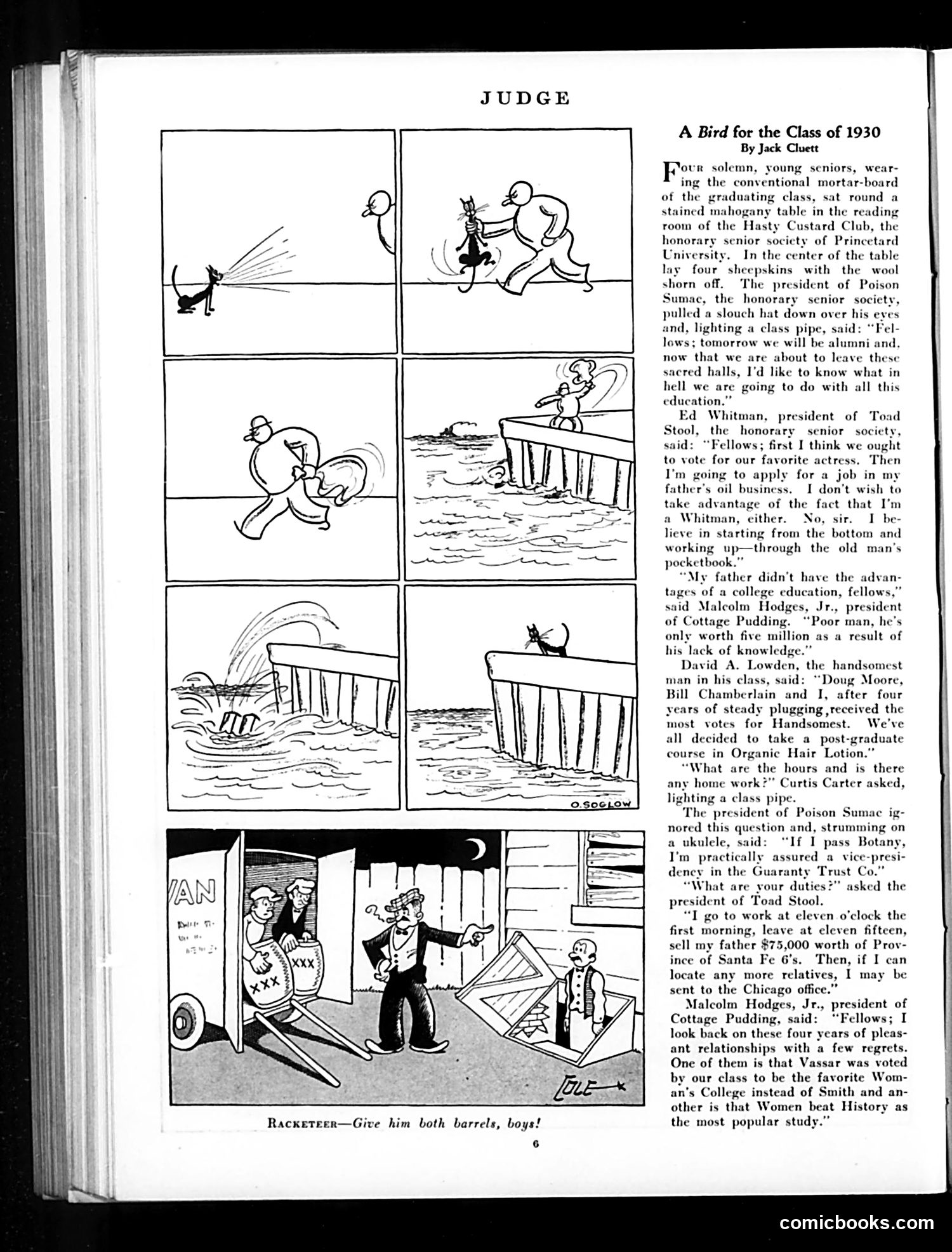
# "A Bird for the Class of 1930" This satirical piece mocks Princeton University's graduating class of 1930 through a fictional club meeting. Senior society members discuss their post-graduation prospects with self-important pomposity. The humor targets their entitled assumptions: one plans to leverage his father's oil business; another claims he'll get a vice presidency through family connections; a third admits his father's wealth comes from questionable sources. The accompanying cartoon shows young men literally "racketeering"—dumping barrels marked "XXX" (bootleg alcohol), a direct reference to Prohibition-era illegal activity. The satire suggests that despite their elite education, these graduates will rely on family money and criminal enterprises rather than actual merit or legitimate work.
📄 Transcribed text from this page (OCR, searchable)
Machine-transcribed from the original scan — historical spelling and the odd misread are preserved.
A Bird for the Class of 1930 By Jack Cluett Fe solemn, young seniors, wear- ng the conventional mortar-board of the graduating class, sat round a stained mahogany table in the reading room of the Hasty Custard Club, the honorary senior society of Princetard University. In the center of the table lay four’ sheepskins with the wool shorn off. The president of Poison Sumac, the honorary senior society, pulled a slouch hat down over his and, lighting a class. pipe lows; tomorrow we will be alumni and, now that wi about to leave these sacred halls, I'd like to know what in hell we are going to do with all this education.” Ed Whitman, president of Toad Stool, the honorary senior society, said: “Fellows; first I think we ought to vote for our favorite actress. Then I'm going to apply for a job in my father’s oil business. I don’t wish to antage of the fact that I’m an, either. No, sir. I be- lieve in starting from the bottom and working up—through the old man’s pocketbook.” y father didn't have the advan- tages of a college education, fellows,” said Malcolm Hodges, Jr., president of Cottage Pudding. “Poor man, he's only worth five million as a result of his lack of knowledge.” David A. Lowden, the handsomest man in his class, said: ‘Doug Moore, Bill Chamberlain and I, after four years of steady plugging received the most votes for Handsomest. We've all decided to take a post-graduate course Organic Hair Lotion.” “What are the hours and is there any home work?" Curtis Carter asked, lighting a class pipe. The president of Poison Sumac ig- nored this question and, strumming on a ukulele, said: “If I pass Botany, I'm practically assured a vice-presi- dency in the ¢ 'y Trust Co. sked the el- president of Toad Stool. “I go to work at eleven o'clock the first morning, leave at eleven fifteen, sell my father $75,000 worth of Prov- ince of Santa Fe 6's. Then, if I can locate any more relatives, I may be sent to the Chicago office.” Malcolm Hodges, Jr., president of Cottage Pudding, : “Fellows; I look back on these four years of pleas- ant relationships with a few regrets. One of them is that Vassar was voted by our class to be the favorite Wom- an’'s College instead of Smith and an- other is that Women beat History as Racxeteer—Give him both barrels, boys! the most popular study.” Mi | 6 comicbooks.com