
Judge, 1930-06-14 · page 18 of 36
Judge — June 14, 1930 — page 18: what you’re looking at
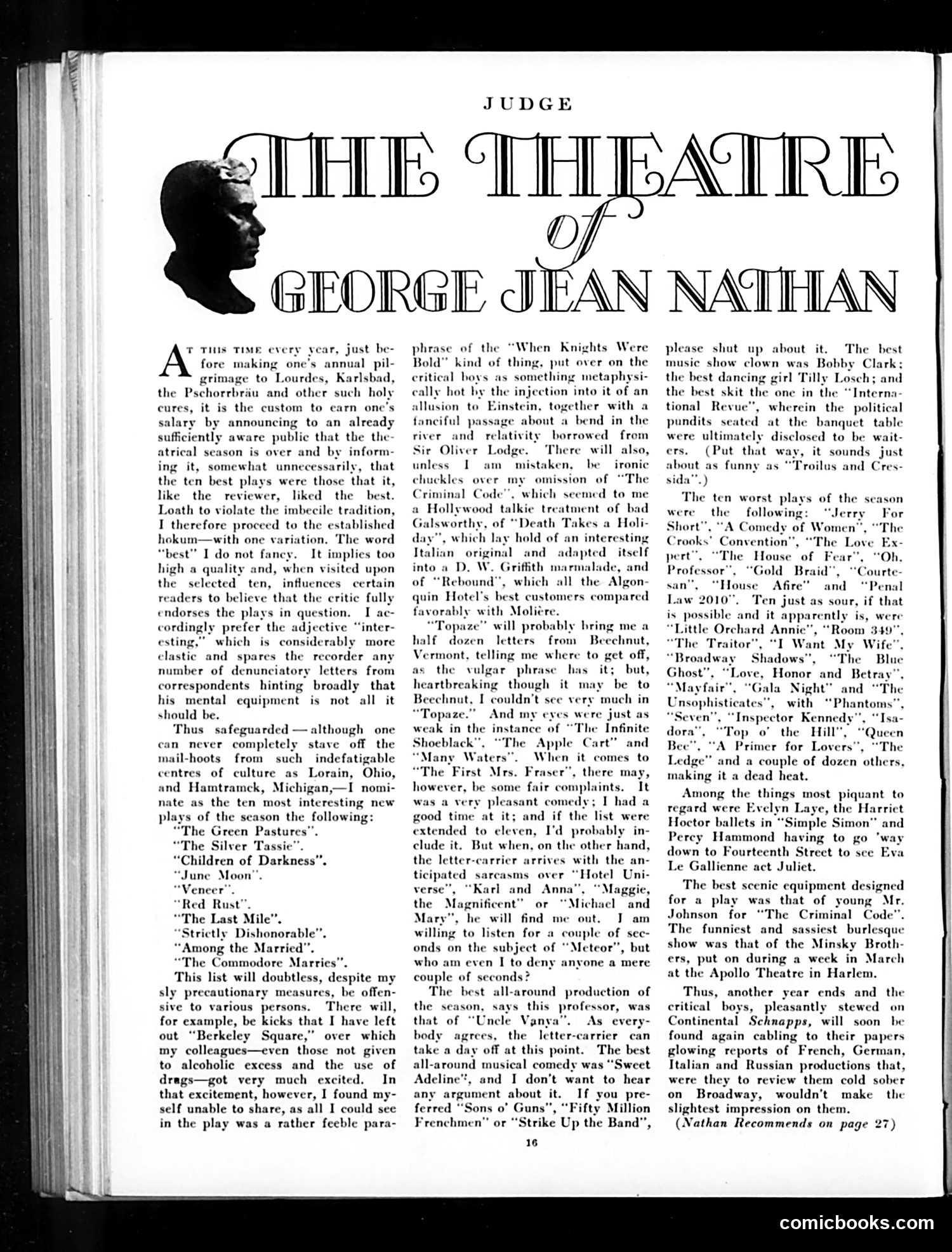
A restored page from Judge, 1930-06-14. Page through the whole issue in the reader above.
📄 Transcribed text from this page (OCR, searchable)
Machine-transcribed from the original scan — historical spelling and the odd misread are preserved.
JUDGE © GEORGE J T THs A fore annual _pil- grimage to Lourdes, Karlsbad, the Pschorrbriiu and other such holy cures, it is the custom to earn one’s salary by announcing to an already sufficiently aware public that the the atrical season is over and by inform- ing it, somewhat unnecessarily, that the ten best 1 were those that it, like the reviewer, liked the best. Loath to violate the imbecile tradition, I therefore proceed to the established hokum—with one variation. The word “best” Ido not fancy. It implies too high a quality and, when visited upon the selected ten, influences certain readers to believe that the critic fully endorses the plays in question. I ac- cordingly prefer the adjective “inter- esting,” which is considerably more clastic and spares the recorder any number of denunciatory letters from correspondents hinting broadly that his mental equipment’ is not all it should be. Thus safeguarded — although one can never completely stave off the mail-hoots from such indefatigable centres of culture as Lorain, Ohio, and Hamtramck, Michigan,—I nomi- nate as the ten most interesting new ’s of the season the following: “The Green Pasturi “The Silver Tassie”. “Children of Darkness”. June Moon”. Veneer”. “Red Rust”. “The Last Mile”. “Strictly Dishonorable”. “Among the Married”. “The Commodore Marri This list will doubtless, despite my sly precautionary measures, be offen- sive to various persons. There will, for example, be kicks that I have left out “Berkeley Square,” over which my colleagues—even those not given to alcoholic excess and the use of drags—got very much excited. In that excitement, however, I found my- self unable to share, as all I could see in the play was a rather feeble para- phrase of the “When Knights Were Bold” kind of thing, put over on the critical boys as something metaphysi- cally hot by the injection into it of an allusion to Einstein, together with a fanciful pa a bend in the and relativity borrowed from Sir Oliver Lodge.” There will also, unless I am = mistaken, be ironic chuckles over my “The Criminal Code”, which seemed to me a Hollywood talkie treatm of bad Galsworthy, of “Death Takes a Holi- day”, which lay hold of an interesting Its original and pted itself into a D, W. Griffith m Na id of “Rebound”, which all the Algon- quin Hotel's best customers compared ably with Moliére. will probably bring me a letters from Beechnut, mont, telling me where to get off, as the vulgar phrase has it; but, heartbreaking though it may be to Beechnut, I couldn't see very much in “Topaze.” And my ¢ weak in the ance of “The Infinite Shocblack”, “The Apple Cart” and any Waters”. When it comes to Phe First Mrs. Fraser”, there may, however, be some fair complaints. It was a very pleasant comedy; I had a good time at it; and if the list were extended to eleven, I'd probably in- clude it. But when, on the other hand, the letter-carrier arrives with the an- reasms over “Hotel Uni- url and Anna”, ggie, Magnificent” or “Michael and ", he will find me out. J am to listen for a couple of sec onds on the subject of “Meteor”, but who am even I to deny anyone a mere couple of seconds? The best all-around production of the season, says this professor, was that of “Uncle Vanya”. As every- body rees, the letter-carrier can off at this point. The best ound musical comedy was “Sweet Adeline", and I don't want to hear any argument about it. If you pre- ferred “Sons o’ Guns”, “Fifty Million Frenchmen” or “Strike Up the Band”, 16 river omission of s were just as ACRE NATHAN please shut up about it. The best music show clown was Bobby Clark: the best dancing girl Tilly L the best skit the one the “Inter tional Revue", wherein the politica pundits seated at the banquet table were ultimately disclosed to be ers, (Put that way, it sounds just about as funny as “Troilus and Cres- sida”’.) The ten worst plays of the season were the following: “Jerry For Short”, “A Comedy of Women”, “The Crooks’ Convention”, “The Love pert’. “The House of Fear’, “Oh, Professor’, ld Braid”, “Courte- san”, “House Afire’ and “Pe Law 2010". Ten just as sour, if the is possible and it apparently is, were “Little Orchard Annie’, “Room 349", “The Traitor”, “I Want My Wife”. “Broadway Shadows", “The Blue Love, Honor and Betray”, a and * > with “Pha n Tenet Kennedy po’ the Hill”, “Queen A Primer for Lovers ', The ind a couple of dozen others, ng it a dead heat. Among the things most piquant to regard were Evelyn Laye, the Harriet Hoctor ballets in * ple Simon” and Percy Hammond having to go * down to Fourteenth Street to sce Le Gallienne act Juliet. The best scenic equipment designed for a play was that of young Mr. Johnson for “The iminal Code” The funniest and sassiest burlesque show was that of the Minsky Broth- ers, put on during a week in March at the Apollo Theatre in Harlem. Thus, another year ends and the critical boys, pleasantly stewed on Continental Schnapps, will soon be found again cabling to their papers glowing reports of French, German, Italian and Russian productions that, were they to review them cold sober on Broadway, wouldn't make the slightest impression on them. (Nathan Recommends on page 2 comicbooks.com