
Judge, 1930-06-14 · page 15 of 36
Judge — June 14, 1930 — page 15: what you’re looking at
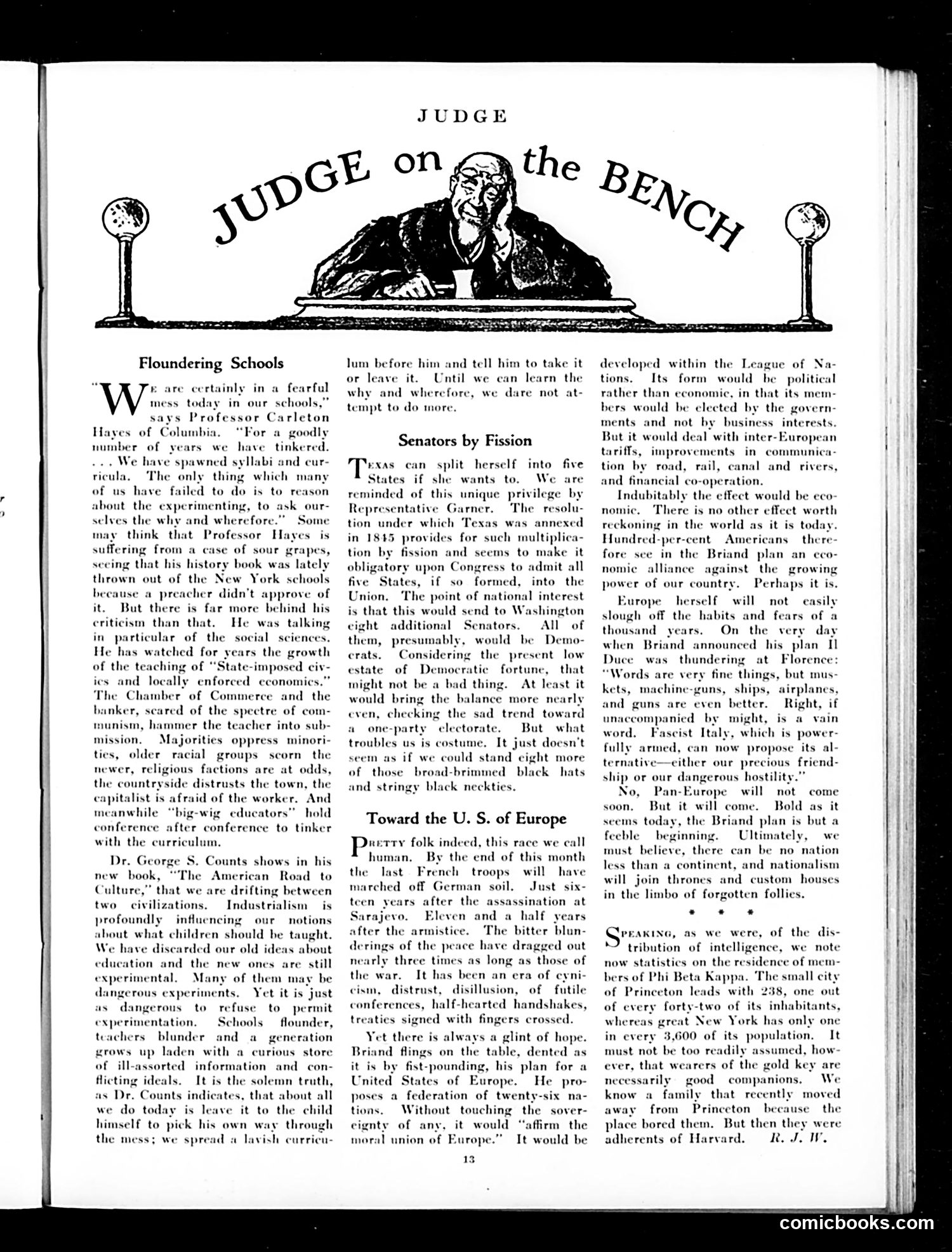
A restored page from Judge, 1930-06-14. Page through the whole issue in the reader above.
📄 Transcribed text from this page (OCR, searchable)
Machine-transcribed from the original scan — historical spelling and the odd misread are preserved.
Floundering Schools “ are certainly in a fearful Wi. ss today in our schools,” says Professor Carleton Hayes of Ce “For a goodly number of years we have tinkered. ... We have spawned syllabi and cur- ricula, ‘The only thing which many of us have failed to do is to reason about the experimenting, to ask our- selves the why and wherefore.” Some think that Professor Hayes is suffering from a case of sour grapes, sceing that his history book was lately thrown out of the New York schools because a preacher didn't approve of it. But there is far more behind his criticism than that. He was talking in ticular of the social scienc He has watched for of the teaching of “State-imposed civ- ics and locally enforced economics.” The Chamber of Commerce and the banker, scared of the spectre of com- munism, hammer the teacher into sub- mission. Majorities oppress minori- older racial groups scorn the religious factions are at odds, the countryside distrusts the town, the capitalist i sid of the worker. And meanwhile “big-wig educators” hold conference after conference to tinker with the curriculum, Dr. Georg book, Culture,” t two civili profoundly ears the growth ties, new S. Counts shows in his “The American Road to at we are drifting between Industrialism is our notions children should be taught. ve discarded our old ideas about and the new ones are still experimental. Many of them ni dangerous experiments. Yet it is just as dangerous to refuse to permit experimentation. Schools flounder, blunder and a grows up laden with a curious store of ill-assorted information and con- flicting ideals. It is the solemn truth, as Dr, Counts indicates, that about all we do today is leave it to the child himself to pick his own way through the mess; we spread a lavish curricu- new teachers: JUDGE lum before him and tell him to take it or leave it. Until we can learn the why and where tempt to do more. ", we dare not at- Senators by Fission Tes can split herself into five States if she wants to. We are reminded of this unique privilege by Representative Garner. The resolu- tion under which Texas was annexed in 1845 provides for such multiplic tion by fission and seems to make it obligatory upon Congress to admit all fiv e if so formed, into the Union. The point of national interest is that this would send to W eight additional them, presumably, crats. shington Senators. All of ould be Demo- the present low pf Democratic fortune, that might not be a bad thing. At least it would bring the balance more nearly even, checking the sad trend toward a one-party electorate. But what troubles us is costume, It just doesn't seem as if we could stand of those and strir Consideri estate ht more broad-brimmed black black neckties. hats Toward the U. S. of Europe netty folk indeed, this race we call human, By the end of this month the last) French troops will have marched off German soil. Just six- teen years after the assassination at Sarajevo. Eleven and a half years after the armistice. The bitter blun- derings of the peace have dragged out nearly three times as long as those of the war. It has been an era of eyni- cism, distrust, disillusion, of futile conferences, half-hearted handshakes, treaties signed with fingers crossed. Yet there is always a glint of hope. Briand flings on the table, dented as it is by fist-pounding, his plan for a United States of Europe. H poses a federation of twenty-six na- Without touching the sover- cignty of any, it would rm the moral union of Europe.” It would be pro- tions, 13 developed within the League of Na- tions. Its form would be political rather than economic, in that its mem- bers would be elected by the govern- ments and not by business interests. But it would deal with inter-European tariffs, improvements in) communica tion by road, rail, canal and rivers, and financial co-operation. Indubitably the effect would be eco. nom There is no other effect worth reckoning in the world as it is today. Hundred-per-cent. Americans there fore see in the Briand plan an eco- nomic alliance ainst the growing power of our country. Perhaps it is. Europe herself will not easily slough off the habits and fears of a thousand years. On the very day when Briand announced his plan Il Duce was thundering at “Words are very fine things, but mus- kets, machine-guns, ships, airplanes, and guns are even better. Right, if unaccompanied by might, is a vain word. Fascist Italy, which is power- fully its al- ternative—either our precious friend- ship or our dangerous hostility.” No, Pan-Europe will not come But it will come. Bold as it seems today, the Briand plan is but a Florence: rmed, can now propose soon, must believe, there can be no less than a continent, and nationa will join thrones and custom houses in the limbo of forgotten follies. e+ AKING, as we were, of the dis- tribution of intelligence, we note now statistics on the residence of mem- bers of Phi Beta Kappa. The small city of Princeton leads with 238, one out of every forty-two of its inhabitants, whereas great New York has only one in every 3,600 of its population, It must not be too readily assumed, how- ever, that wearers of the gold key are necessarily »od ~=companions, We know a family that recently moved from Princeton the place bored them. But then they were adherents of Harvard. RoI WS, because comicbooks.com